

Best practice medical standards, in a locum context, come down to four things done consistently: verified credentialling before a doctor sets foot on site, a proper orientation and handover, rostering that does not burn people out, and clear communication between the doctor, the agency and the facility. Get those right and a short-term placement runs like a permanent one. Get them wrong and you get cancelled shifts, clinical risk and doctors who never come back.
This guide is written for two groups: doctors who work locum across Australia, including JMOs, registrars and specialists, and the hospital, clinic and practice managers who book them. The standards below apply to both sides of the booking.
What best practice medical means for locum work
In locum work, best practice means a short-term doctor can practise safely from the first hour, with the same clinical governance a permanent staff member would have. That sounds obvious. In practice, it is where most placements succeed or fail.
A permanent doctor gets weeks of onboarding. A locum may get a phone call the night before. The gap between those two experiences is the risk, and the standards in this guide exist to close it.
Four areas carry most of the weight:
- Credentialling and registration checks completed before the shift is confirmed, not on arrival.
- Orientation and handover that covers systems, escalation paths and local protocols.
- Rostering and workload that respect fatigue and recovery.
- Communication with one named contact on each side who can solve problems quickly.
The rest of this article takes each in turn, then covers wellbeing, which is where the evidence has moved most in the last three years.
Credentialling: the check that has to happen before the shift
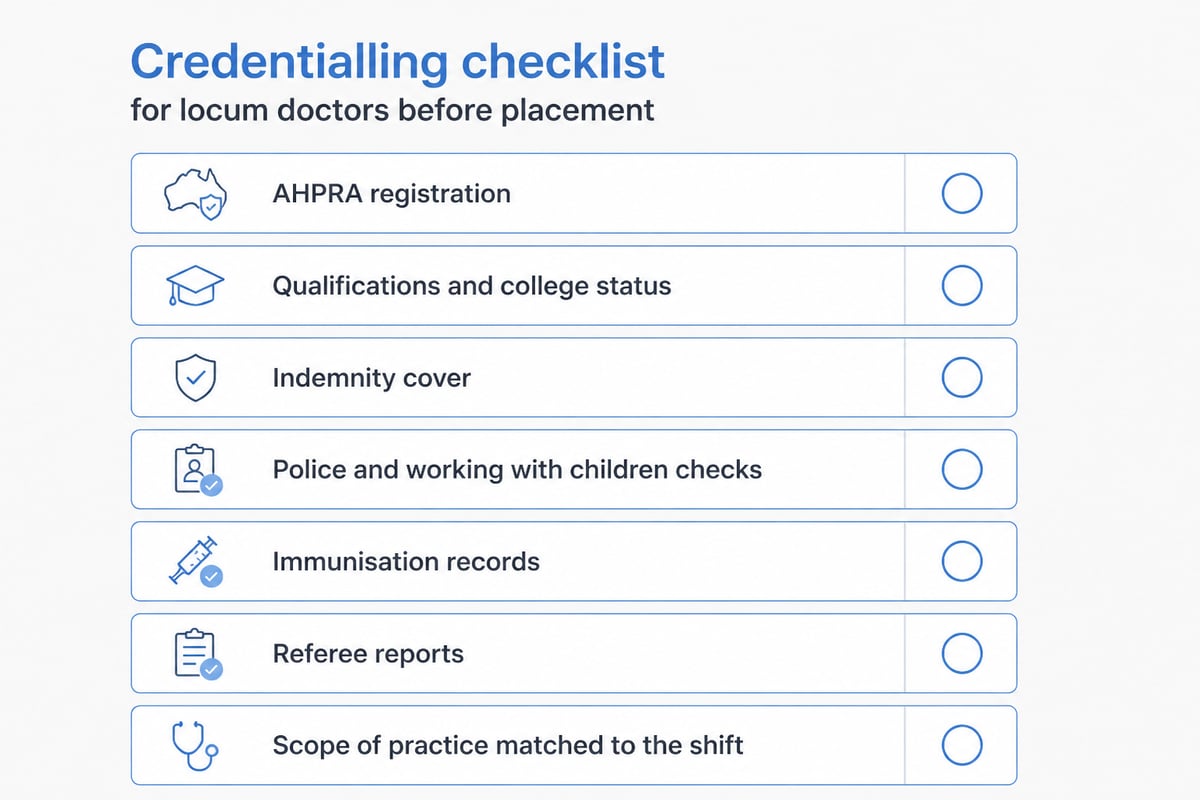
Credentialling is the verification of a doctor's identity, registration, qualifications, scope of practice and fitness to work, and it must be finished before placement, not during the first shift.
At a minimum, a facility should have evidence of:
- Current AHPRA registration, with any conditions or undertakings visible
- Qualifications and, for specialists and registrars, college status
- Professional indemnity cover appropriate to the work
- Working With Children Check and National Police Check where the setting requires them
- Immunisation status for the relevant jurisdiction
- Referee reports from recent clinical supervisors
- Scope of practice matched to the shift, such as procedural privileges for anaesthetics or O&G
For facilities, the practical problem is time. A hospital managing an unexpected gap on a Friday afternoon cannot run a full credentialling process from scratch. That is the main reason agencies exist. At Best Practice Medical, every locum is credentialled before placement, and the agency is accredited to ISO 9001:2015 Quality Management. For a facility auditor, that is a documented process rather than a promise.
For doctors, the best practice is to keep a ready-to-send credentialling pack: registration, indemnity certificate, immunisation records, police checks, two current referees and an up-to-date CV. If you are writing your first medical CV, this guide to writing a CV for the medical profession covers what facilities look for. Doctors who can send a complete pack within an hour get booked more often, particularly for short-notice shifts.
Orientation and handover for a doctor who is only there for a week
A good locum orientation takes 20 to 30 minutes and covers where things are, who to call and how this particular facility does things differently.
The facility's side of the job is to have a one-page induction ready and a named person to hand it over. It should cover:
- Login credentials and access to the clinical information system, set up before arrival
- The escalation pathway: who to call for a deteriorating patient, a senior opinion or a bed management problem
- Local protocols that differ from what a doctor would expect, such as sepsis pathways, discharge criteria or prescribing restrictions
- Where the resus trolley, pathology request forms and referral templates live
- The names and extensions of the nurse in charge, the on-call consultant and the after-hours manager
A locum who spends the first two hours hunting for a login has had a bad start, and the cost lands on patient flow.
The doctor's side is to arrive early, ask what the facility's biggest pressure point is that day, and confirm the handover process for patients already under care. Clinical handover is where errors cluster, and structured formats such as ISBAR exist because free-form handover loses information. If you are new to short-term work and want to know how to build rapport quickly with patients you will only see once, building patient relationships as a locum is worth reading before your first placement.
Rostering and workload: how to avoid burning out the people covering your gaps
The safest rosters give a locum the same limits on consecutive hours, night shifts and recovery time that a permanent doctor would have, with no exceptions made because the shift is urgent.
It is tempting for a facility to stack hours onto a locum because the alternative is an unfilled roster. This backfires. Fatigued doctors make more errors, and a doctor who has been overworked once will not accept a second booking.
For facilities, some practical rules:
- Confirm the shift pattern in writing, including start and finish times and any on-call component.
- Do not add unplanned extension hours without the doctor's explicit agreement.
- Make sure a break is rostered and actually protected.
- Allow for travel time when a locum is covering a regional site, particularly after a long drive.
For doctors, best practice is to be honest about your limits when you accept a shift. If you have just come off nights, say so. A good consultant at the agency would rather re-offer a shift than have you cancel it mid-block.
Regional and rural placements add another layer. Distance, isolation and limited back-up mean preparation matters more, which is covered in this piece on being prepared for medical staffing in regional areas. The broader workforce picture, including why gaps keep opening, is outlined in why Australia's medical workforce is under increasing pressure.
Wellbeing is part of clinical standards now
Doctor wellbeing belongs in any best practice medical framework because fatigue, stress and burnout directly affect patient safety and retention.
The most recent large dataset comes from the United States, so the numbers are not Australian, but the pattern is relevant to anyone working in hospital-based medicine. In 2025, 41.9% of physicians reported at least one symptom of burnout, down from 43.2% in 2024 and 48.2% in 2023. Job-related stress followed the same direction: 42.9% reported a great deal of stress in 2025, compared with 45.1% in 2024 and 50.7% in 2023. Those are improvements, but they still describe a workforce where roughly two in five doctors are showing symptoms.
A separate Physicians Foundation survey in 2025 of more than 1,000 U.S. physicians found 54% often experienced feelings of burnout. The same survey reported that 73% of respondents agreed there is stigma around mental health and seeking care among physicians. That second number matters for facilities. Doctors who feel they cannot say they are struggling will not say it, and the first sign you get is a resignation or a cancelled block.
Burnout also varies by career stage, which is useful to consider when deciding whether a registrar or a consultant is better placed to cover a demanding roster.
Locum work is one of the few levers a doctor controls. Choosing when and where to work, taking a month off between contracts, or rotating between metropolitan and regional sites can all reduce the load. It is not a cure, and a poorly managed locum placement can be as draining as a poorly managed permanent job. But the control over your own calendar is real.
For facilities, the wellbeing standard is simple: treat locums as part of the team. Introduce them, feed them, give them a place to sit and ask how the shift went. These are small costs, and the return is a doctor who accepts the next booking.
Short notice, urgent shifts and how to handle them well
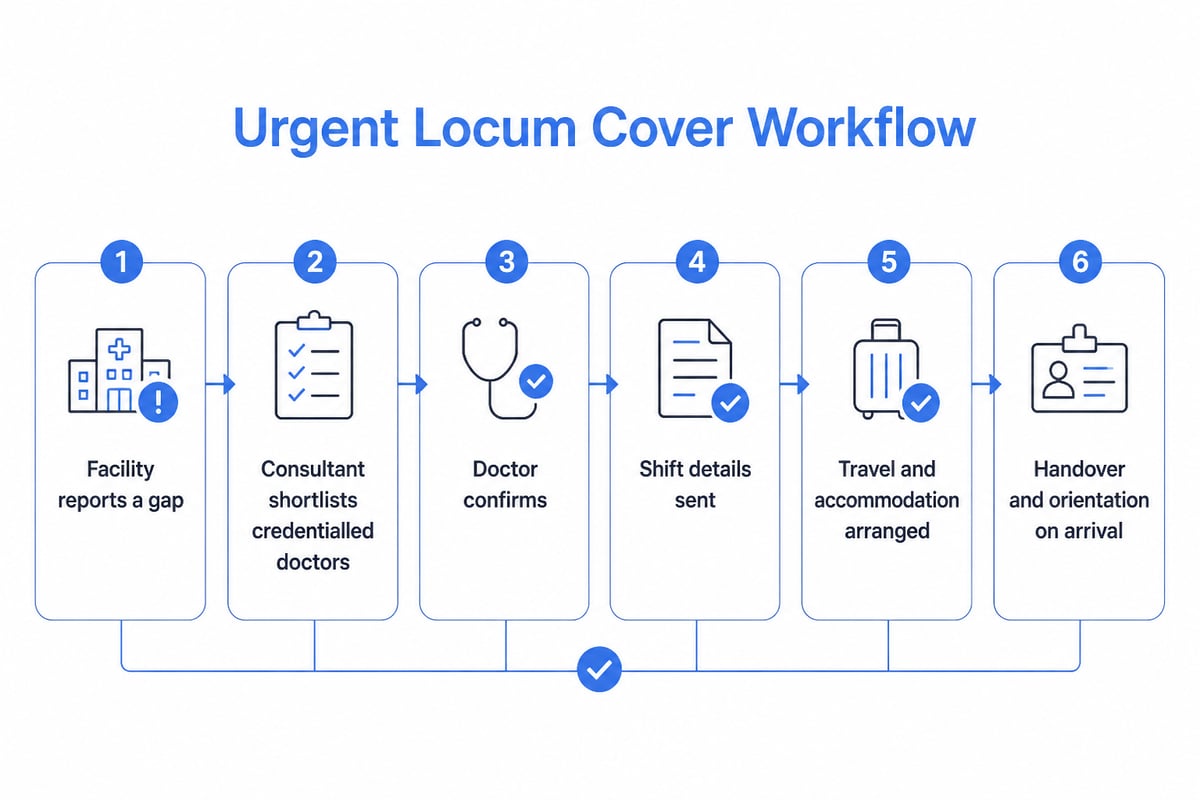
The best practice for urgent cover is to have the process ready before the gap appears, so a 6am phone call about a 2pm shift is a routine task rather than a crisis.
For facilities, that means:
- Keeping an up-to-date list of the specialties and grades you most often need to cover
- Pre-approving your agency or agencies so credentialling paperwork is already in place
- Knowing your own budget limits for urgent bookings
- Having a clear sign-off path, so a manager is not hunting for the person who can approve a booking
Agencies differ in how they handle after-hours requests. Best Practice Medical's consultants are available to handle urgent shift needs, and each doctor and facility works with a dedicated consultant. For ad hoc and short-notice shifts across Emergency Medicine, Anaesthetics, ICU, O&G, Paediatrics, Psychiatry and Surgical, the short-term medical locum placement service matches doctors on specialty, credentialling status and availability, whether the need is a single shift or a block of weeks.
For doctors who want short-notice work, being reachable matters more than being available. Keep your phone on, reply within the hour and tell your consultant which days you can reliably cover. Doctors who respond quickly get the first call.
Travel, accommodation and logistics
A placement is not complete until the doctor has arrived, slept somewhere decent and found the car park, so travel and accommodation are part of the clinical standard.
This is especially true outside the capital cities. A doctor flying into a regional hospital after an early start is not at their best if the accommodation is not confirmed, the hire car is not booked or the airport transfer does not turn up. Facilities lose more locums to logistics problems than to anything clinical.
Best Practice Medical covers placements end to end, including shift confirmation, travel and accommodation, which removes that load from both the doctor and the facility's administrative staff. If you are managing logistics in-house, confirm these items in writing at least 48 hours ahead where possible:
- Flight or drive details and reimbursement terms
- Accommodation address, check-in time and parking
- Where to collect an ID badge and keys
- Who is meeting the doctor on arrival
Doctors should also keep their own checklist. Confirm start time, dress requirements, on-call phone arrangements and how and when you will be paid.
Pay, contracts and clarity on both sides
Clear terms agreed before the shift protect everyone, and most disputes in locum work trace back to something that was assumed rather than written down.
The items worth confirming in writing include the hourly or sessional rate, overtime and on-call loadings, public holiday rates, travel allowances and how and when payment will be made. Doctors comparing offers will find the factors that move rates in this overview of locum doctor pay. Facilities should be equally clear on cancellation terms, including what happens if either side cancels at short notice.
For doctors weighing up whether locum work suits them, am I eligible to become a locum doctor sets out the baseline requirements.
Choosing an agency partner on evidence, not promises
The best way to judge a locum agency is by what it can document: accreditations, memberships, approved supplier status and the length of its working relationships.
Some questions to put to any agency you are considering:
- Is its quality management system independently accredited, and to what standard?
- Is it a member of recognised industry bodies?
- Is it an approved supplier for the state health departments you work with?
- Who owns it, and does the leadership have clinical experience?
- How long has it supplied the same facilities?
For reference, Best Practice Medical is accredited to ISO 9001:2015 and is a member of the Recruiting, Consulting and Staffing Association (RCSA) and the Association of Medical Recruiters Australia and New Zealand (AMRANZ). It is an approved supplier for NSW Health, Tasmanian Health, WA Country Health Service, NT Health, Vic Health, QLD Health and ACT Health, and it supplies major private providers including Ramsay Health Care, Healthscope and St Vincent's Health. One facility partner has been supplied continuously for over 15 years, which says something about repeatability that a website claim cannot.
Facilities that want to understand how an agency's service compares with running recruitment internally can read about tailored medical staffing. Managers looking at broader practice operations, including patient engagement and communication, may also find the resources at Medical Management useful for thinking about clinic performance beyond staffing.
Review the placement afterwards
A short debrief after each placement, even five minutes by phone, is the cheapest quality control a facility or doctor has.
Facilities should ask the consultant for feedback on how the doctor found the shift, and share their own on the doctor's performance. Doctors should flag any gaps in orientation, equipment or support, because the next locum will hit the same ones. Over a year, those small corrections change how a facility runs.
Track a few simple measures:
- Fill rate for requested shifts
- Number of cancellations from either side
- Time from request to confirmed doctor
- Repeat bookings of the same locum
- Incidents or near-misses involving a locum, and what changed afterwards
None of this needs software. A shared spreadsheet and a monthly 15-minute review will do it.

If you are a doctor, send your credentialling pack to a consultant this week so you are ready for the next short-notice shift, and if you manage a facility, write down your three most frequent coverage gaps before the next one opens. Contact Best Practice Medical to talk through either, with a consultant who can match credentialled doctors to your specialty, dates and location.