

To find registered doctors NSW employers and patients can trust, search the Ahpra public register by name or registration number and confirm the practitioner holds current, unrestricted registration with the Medical Board of Australia. Every doctor practising in New South Wales must be registered nationally, and the register is free, public and updated continuously. This guide covers how to read a register entry, what the qualifications mean, which red flags matter, and what hospital managers and locum doctors should check before a shift is confirmed.
How are doctors in NSW registered?
Doctors in NSW are registered nationally through the Australian Health Practitioner Regulation Agency (Ahpra) on behalf of the Medical Board of Australia, not by a separate state body. A registration issued in New South Wales is valid in every state and territory, which is why a locum can cover a Dubbo shift on Monday and a Darwin shift the following week without re-registering.
The scale of the system is worth knowing. Ahpra's 2024/25 annual report recorded 959,838 registered health practitioners across all professions, up 4.3% on the previous year, and 96.9% of them held some form of practising registration. Applications are also climbing: 111,294 were received in 2024/25, a record at the time, with 101,564 of them (91.3%) for practising registration.
NSW also has its own layer. The Medical Council of New South Wales handles complaints and conduct matters for doctors in the state, working alongside Ahpra and the Health Care Complaints Commission. Registration tells you a doctor is eligible to practise. The Council and Commission deal with what happens when a concern is raised.
For national workforce numbers, the Medical Board publishes quarterly medical workforce statistics, which is useful if you are planning staffing or trying to understand how many doctors hold each registration type.
Where to check that a doctor is registered
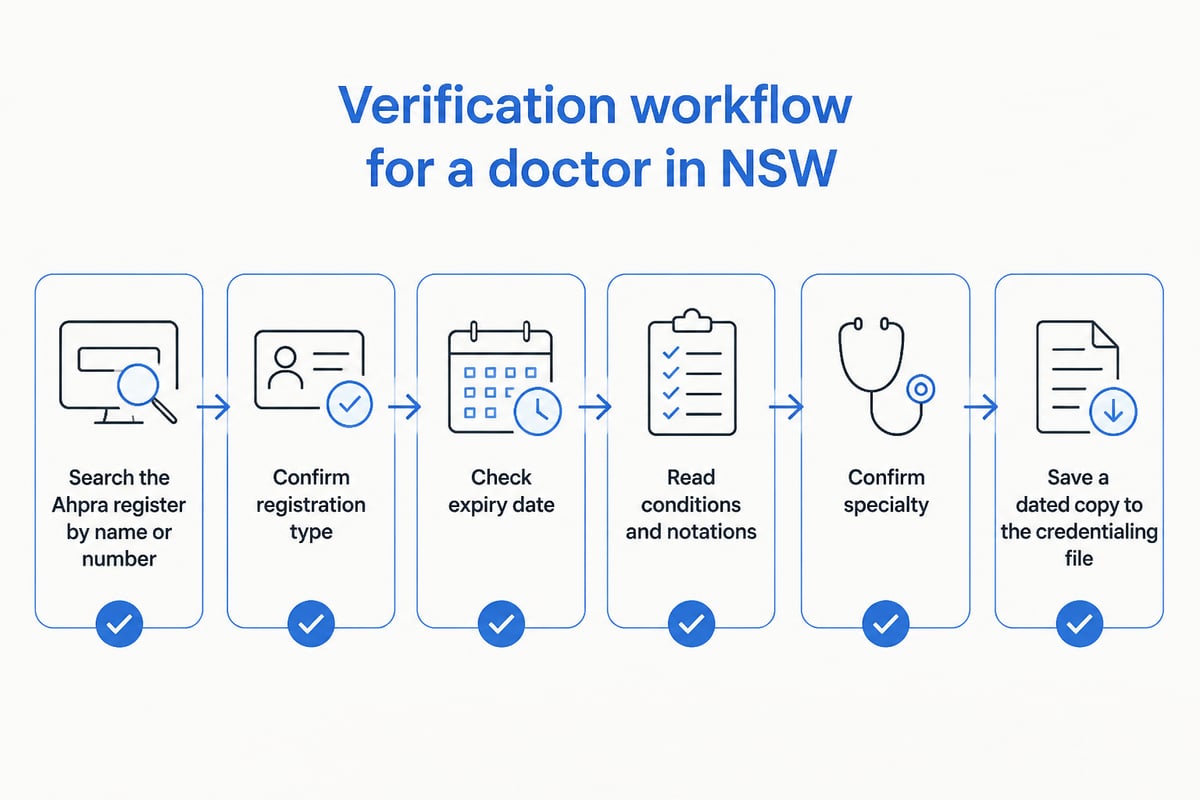
The only authoritative source is the Ahpra public register of practitioners, and it takes about a minute to search. You can look up a doctor by name, or by their registration number if you already have it from a CV or credentialing file.
Usage has grown sharply. According to the same Ahpra annual report, the public register received more than 8 million unique visits and more than 14 million searches in 2024/25, with searches up sharply on the year before. People are checking the register routinely.
When you open a record, look at these fields in order:
Registration type. General, specialist, provisional, limited or non-practising. A doctor listed as non-practising cannot treat patients.
Registration status and expiry. Registration renews annually, so a lapsed date is a real problem, not a clerical one.
Conditions, undertakings and notations. These appear on the record and can restrict scope, location, supervision level or the type of work allowed.
Specialty and endorsements. Specialist registration shows the recognised field, such as anaesthesia, psychiatry or emergency medicine.
Principal place of practice. Useful context, though it does not limit where a registered doctor can work.
Print or save a dated copy of the record for the credentialing file. A register entry is accurate on the day you view it, and facilities are expected to show they checked.
Understanding registration types and what each allows
Each registration type permits a different scope of practice, and mismatching the type to the role is one of the most common credentialing errors. The differences matter most for locum placements, where a doctor may move between facilities with different supervision arrangements.
| Registration type | Who holds it | What it permits |
|---|---|---|
| General | Doctors who completed an approved internship and meet the Board's standards | Independent practice within their training and competence |
| Specialist | Doctors recognised in a specialty, usually after fellowship | Practice as a specialist in the recognised field |
| Provisional | Interns and some overseas-trained doctors completing requirements | Supervised practice, often with a defined program |
| Limited | Doctors in postgraduate training, teaching or research, or in public interest areas | Practice restricted to the approved purpose and location |
| Non-practising | Doctors maintaining registration without clinical work | No clinical practice |
Overseas-trained doctors often start on provisional or limited registration while working towards general or specialist status, usually under supervision. A doctor on limited registration approved for one hospital cannot simply pick up a shift at another site, so approvals need to match the facility and role.
The Medical Board's registration FAQs and fact sheets set out the requirements in plain language and are worth keeping to hand.
Does Australia do MD or MBBS?
Australia uses both, depending on the university and when the doctor graduated. Historically the MBBS (Bachelor of Medicine, Bachelor of Surgery) was the standard first degree. Since the mid-2000s many universities have moved to a graduate-entry Doctor of Medicine (MD), which sits at the same professional level and leads to the same registration pathway.
For credentialing, the letters after a name matter less than three things: the medical school is accredited by the Australian Medical Council, the doctor completed the required internship, and the register shows the correct registration type. A doctor with an MD from an Australian university and a doctor with an MBBS are treated identically by the Board.
International graduates follow a different route, through Australian Medical Council assessment or a recognised specialist pathway, and the register will reflect where they sit on it.
What are the red flags when checking doctors?
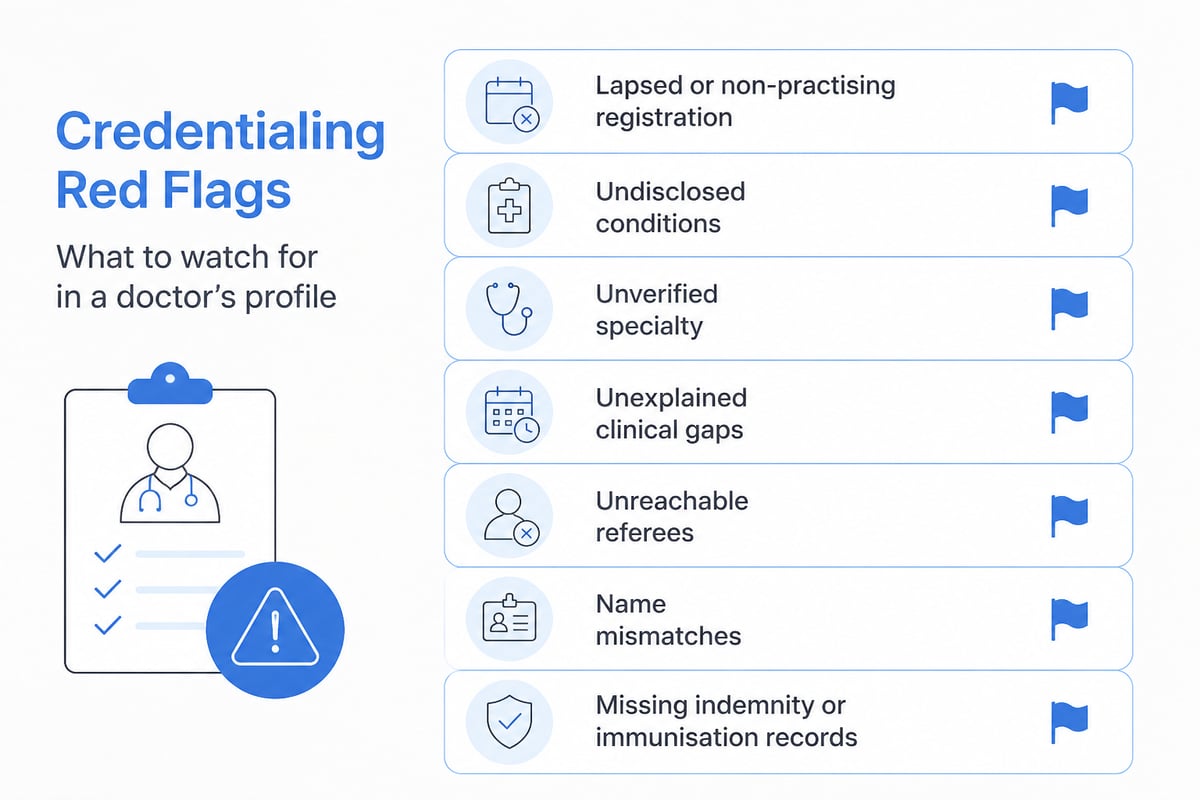
The red flags worth acting on are gaps and mismatches between a doctor's claims and their register record, not unusual-looking CVs. A working locum can have a patchwork career for perfectly good reasons, so the test is whether the documents hold together.
Treat these as prompts for a further question, a call to the referee, or a pause on the booking:
- Registration that has lapsed, is non-practising, or expires before the shift ends
- Conditions or undertakings on the register that the facility has not been told about
- A specialty claimed on a CV that does not appear on the register
- Unexplained gaps of several months with no clinical work, particularly in the most recent two years
- Referees who cannot be reached or will only give a confirmation of dates
- A name on the register that differs from identification documents, with no explanation
- Reluctance to provide current indemnity insurance details or immunisation records
- Work history that does not align with the registration timeline, such as clinical roles listed before registration was granted
A single item is rarely disqualifying. A pattern is. The Medical Council of NSW publishes information on common complaint themes, including unsafe care, behaviour and health concerns, and managers who understand those categories are better placed to ask the right questions at interview or reference check.
What does a credentialing check involve for hospitals and clinics?
A proper credentialing check goes well beyond the register search, because the register confirms registration and little else. A facility needs to be satisfied about identity, qualifications, current fitness to practise and competence for the specific role.
For a locum placement the file usually includes:
- Proof of identity and right to work in Australia
- Registration confirmation from the Ahpra register, dated
- Primary qualification evidence and, for specialists, fellowship or college documentation
- Current professional indemnity insurance
- Immunisation status and any required screening
- Working with Children and police checks where the role requires them
- Two recent clinical referees who have worked directly with the doctor
- Orientation and credentialing sign-off for the facility's scope of practice
Doing this for every short-notice shift is slow, which is why many facilities rely on a recruiter to hold a pre-credentialled pool. Best Practice Medical screens candidates thoroughly before placement, holds ISO 9001:2015 quality management accreditation (since 2009), and is an approved supplier for NSW Health as well as several other state health services. That does not replace the facility's own sign-off, but it shortens the path to it.
For managers building a roster, the practical guide to what makes a good locum doctor and how to find one covers the qualities worth screening for beyond paperwork.
Finding doctors NSW facilities can book at short notice
Facilities usually fill gaps through one of three routes: their own casual pool, a recruitment agency, or an informal network of known doctors. Each has a place, and the right mix depends on how predictable the gaps are.
A casual pool is cheapest when absences are foreseeable and the facility has time to credential people in advance. Informal networks work for a particular specialty or a doctor the team already trusts, but they thin out quickly when two or three people are unavailable at once. An agency earns its fee on urgent and unpredictable cover, particularly outside business hours and in regional sites.
For registrars and junior doctors, the environment shapes the placement as much as the credentials. A metropolitan teaching hospital and a regional base hospital differ in supervision, case mix and after-hours expectations. Best Practice Medical's Registrar and JMO placement service places hospital registrars and junior medical officers across NSW metro public and private hospitals, with secondary coverage in regional and interstate facilities, and briefs doctors on those differences before they start.
Managers weighing a new staffing approach can also read about how locum agency doctors fit into a facility's workforce before deciding how much of the roster to outsource.

How locum doctors can present themselves to NSW facilities
For a doctor looking for locum work, the register entry is part of your first impression, because facilities will check it before anything else. Make sure your details are current, your conditions (if any) are explained in your CV, and your documents are ready to send.
A tidy credentialing pack typically saves days. Keep scanned copies of your registration, qualifications, indemnity certificate, immunisation record and referee contacts in one folder. If you hold limited or provisional registration, state the approved role and supervision arrangements up front so a manager does not have to chase them.
Eligibility questions come up often, especially for recent graduates and overseas-trained doctors considering locum work. The guide on whether you are eligible to become a locum doctor walks through the typical requirements, and the overview of medical locum jobs shows how shifts and contracts tend to be structured.
Locums also need to think about their own compliance. Continuing professional development, indemnity renewal and annual registration renewal all run to deadlines, and a missed renewal stops you working immediately. Diary these dates when you start, and treat them like any other shift commitment.
Specialists, specialties and how to read the label
The specialty shown on the register is the only reliable guide to what a doctor is recognised to practise, and titles used informally can mislead. A doctor who "works in cardiology" may be a registrar, a general doctor with an interest in the field, or a fully recognised cardiologist, and the register distinguishes between them.
Check three things when a role requires a specialist: that specialist registration is held, that the listed field matches the role, and that any sub-specialty claims are supported by college documentation. Where a post is advertised for a particular scope, such as paediatric anaesthesia or emergency medicine at a rural hospital, confirm the doctor's recent experience matches it, not just their title.
For an overview of how fields are organised, the breakdown of kinds of specialist doctors is a useful reference for managers writing a position description. The Medical Board's annual report also presents practitioner counts and specialty figures, which helps when you are trying to gauge how scarce a particular skill set is nationally.
Scarcity is real in regional NSW. Some specialties have very few practitioners within a few hours' drive, and the facility's planning needs to reflect that.
When something goes wrong: concerns and complaints
If a patient, colleague or manager has a concern about a doctor, NSW has a clear route: complaints go to the Health Care Complaints Commission or to Ahpra, and the Medical Council of NSW manages conduct, performance and health matters for doctors in the state. The categories broadly cover unsafe care, unprofessional behaviour, and a practitioner's health affecting their ability to practise.
Managers have separate obligations. Registered health practitioners, including employers who are themselves practitioners, may have mandatory notification duties where there is a risk of substantial harm. If you are unsure whether a situation meets the threshold, seek advice early from the Commission or Ahpra rather than waiting for certainty.
For a locum placed through an agency, the practical steps are the same, with the added point that the agency should be informed promptly so it can support both parties. Best Practice Medical keeps doctors and facilities informed through a dedicated consultant, with support available for urgent shift needs, which keeps communication open when a placement hits difficulty.
What is a primary care physician, and who counts as a doctor in NSW?
A primary care physician is the doctor a patient sees first for ongoing, non-emergency care, and in Australia that role is filled by community-based doctors who coordinate referrals to hospitals and specialists. In NSW, "doctor" is a protected idea in practice, because only registered practitioners can hold themselves out as medical practitioners and use the protected titles associated with registration.
That distinction matters for anyone searching the register. People holding a PhD, or other doctorates, may use the title "Dr" socially without being registered medical practitioners. If a role requires clinical practice, only the register entry settles the question, not the title on a business card or email signature.
FAQ
Can I search for doctors NSW wide by specialty?
Yes. The Ahpra public register lets you filter practitioners by profession, specialty and location, so you can narrow results to specialist registrants in a region or suburb. Always open the individual record to confirm registration status and any conditions, because a search list does not show them all.
How often does a doctor's registration need renewing?
Registration renews annually, and a doctor whose registration has lapsed cannot practise until it is restored. Facilities should confirm status at the point of booking and again for any long or repeat engagement.
Do locum doctors need to be registered in every state?
No. National registration through Ahpra covers all states and territories. Some facilities, particularly public health services, do have their own credentialing and orientation requirements, so a locum may need local sign-off even though no additional registration is needed.
If you manage a service with a gap on the roster, start today by pulling the Ahpra register record for each doctor you have booked in the next fortnight and checking type, expiry and conditions. If you are a doctor planning locum work, get your credentialing pack in order so you can say yes quickly when a shift appears. Best Practice Medical is doctor-owned and operated, led by a practising doctor with over 30 years in medical recruitment, and covers placements end to end, including shift confirmation, travel and accommodation. To talk through cover or locum opportunities, contact the team at Best Practice Medical and we will help you find the right fit.