

Health recruitment specialists are agencies and consultants who place doctors and other clinicians into short-term and long-term roles, and the right one for a locum doctor is the agency that credentials you properly, holds approved supplier status with the health services you want to work for, and answers the phone when a shift changes. Choosing badly costs you pay delays, unsuitable placements and weeks of paperwork. Choosing well means one consultant who knows your registration, your preferred specialties and the regions you will actually travel to.
This article is for JMOs, registrars and specialists who want flexible work across Australia. It covers what to check before you sign anything, which questions expose a weak agency, and how to compare your options without relying on a brochure.
What a health recruitment specialist actually does for a locum doctor
A health recruitment specialist sits between you and the facility, handling credentialling, shift matching, contracts, travel and payment so you can spend your time on clinical work.
For a locum, the useful parts of that job are specific:
- Credentialling and onboarding. Collecting your registration, indemnity, immunisation records, references and identity documents, then packaging them to the standard each hospital or health service requires.
- Matching. Finding shifts that fit your grade, specialty and availability, rather than sending every vacancy to every doctor on the books.
- Logistics. Confirming the shift, arranging flights and accommodation where needed, and sorting out what happens if the roster changes.
- Payment and compliance. Making sure invoicing, tax treatment and award or contract rates are clear before you start.
Facilities rely on the same people for cover. The reasons that cover is so often needed are explored in why regional healthcare relies on locum doctors.
Check credentialling and registration practices first
The first thing to test is how an agency handles your credentials, because a careless process puts your registration and your reputation at risk as well as your pay.
Employers of registered health practitioners are obliged to make sure practitioners hold current registration appropriate for their role, and Ahpra's Register of Practitioners is a free service for checking an individual practitioner's registration details. Approved healthcare organisations can also use Ahpra's Practitioner Information Exchange to check and monitor registration details. A competent agency will be doing this routinely, not only at first placement.
Ask these questions directly:
- Who verifies my registration, and how often is it rechecked while I am on the books?
- What documents do you need from me, and do I upload them once or resubmit for every facility?
- Do you credential to the facility's standard, or to a lower internal standard?
- How do you handle conditions on registration, supervision requirements or expiring documents?
If the answers are vague, treat that as the answer. Credentialling to a high standard before placement is the benchmark to hold any agency to when you ask for specifics.
Look for approved supplier status with the health services you want to work for
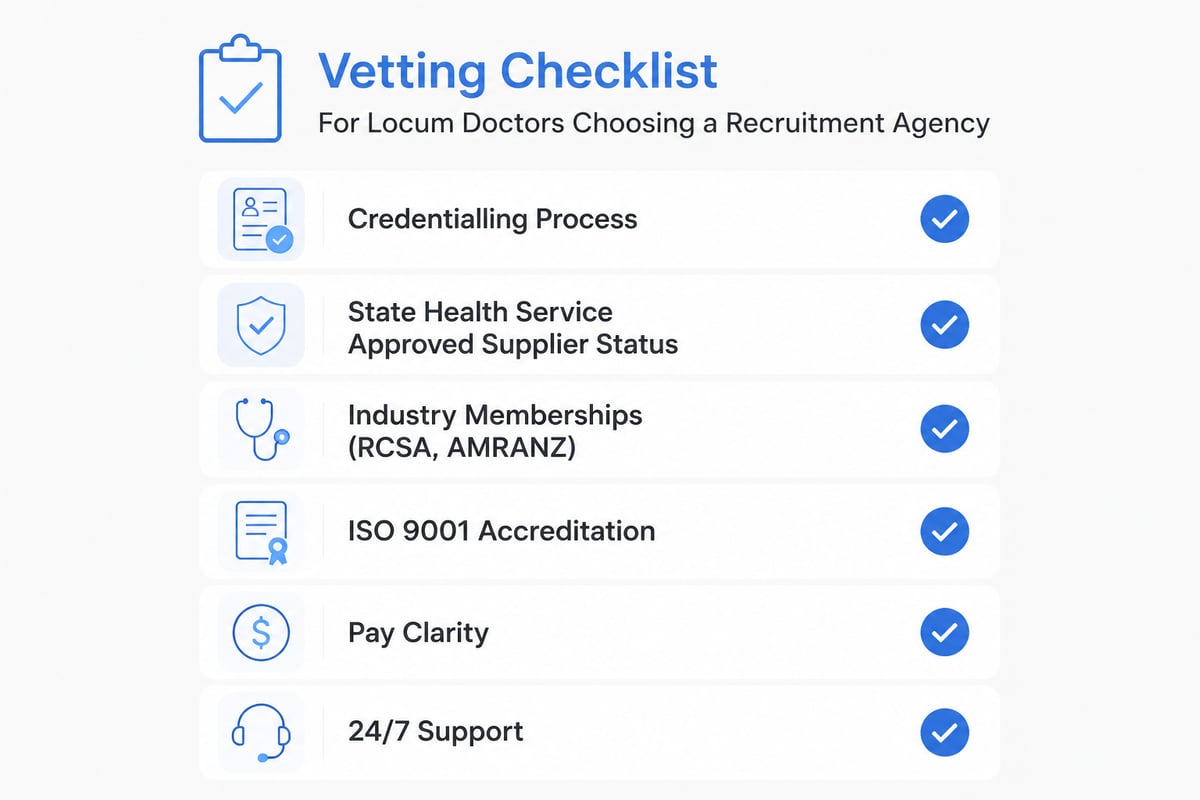
Approved supplier status with state and territory health services is the clearest verifiable signal that an agency has already passed a government procurement process.
Public hospitals in each jurisdiction buy locum cover through panels, and an agency that is not on the relevant panel cannot place you there, however confident the sales pitch. So the useful question is concrete: which health services are you approved to supply, and can you place me in them this quarter?
For context, Best Practice Medical is an approved supplier for NSW Health, Tasmanian Health, WA Country Health Service, NT Health, Vic Health, QLD Health and ACT Health, and supplies major private providers including Ramsay Health Care, Healthscope and St Vincent's Health. If you want a mix of public and private work, that breadth matters more than a long list of specialties on a website.
Memberships are a second, weaker signal that still helps. Look for the Recruiting, Consulting and Staffing Association (RCSA) and the Association of Medical Recruiters Australia and New Zealand (AMRANZ), and for a quality management certification such as ISO 9001:2015. None of these guarantees good service, but they tell you the agency is willing to be audited.
Match the agency to your grade and specialty
The agency needs to understand your level of practice, because a JMO, a registrar and a specialist have different credentialling needs, different rosters and different pay structures.
JMOs and registrars usually want predictable rosters, supervision clarity and a path that supports training or exam commitments. A consultant who understands the college requirements and term structures will save you from placements that do not suit your stage. If you are mid-training, the practical advice in how to make locuming work for you is a useful companion to any agency conversation.
Specialists and Visiting Medical Officers have the highest bar. Specialist placements need a more specific credentialling check than junior doctor cover, covering scope of practice, procedural privileges and facility requirements. Best Practice Medical's Specialist and VMO Placement service places VMOs and specialists across Anaesthetics, Surgery, O&G, Psychiatry, Paediatrics, ICU and other hospital disciplines, with clinical oversight so the match is right before a booking is confirmed. When you speak to any agency, ask who reviews your scope of practice and whether that person is a clinician.
Ask about pay, contracts and what happens when a shift falls through
Before you register, get the pay structure, payment timing and cancellation process in writing, because this is where most locum disputes start.
Questions worth asking:
- What rate applies to my grade and specialty, and is it the facility's rate or the agency's rate after its margin?
- How is travel handled, and who pays for flights and accommodation up front?
- What is the process if a facility cancels at short notice?
- How and when am I paid, and who do I call if a payment is wrong?
- Are there any exclusivity clauses or restrictions on working through other channels?
Do not accept verbal assurances on any of these. A good agency will send you the terms without being chased. If a consultant avoids putting numbers on the table, the rate is probably not one you will like.
Regional work is where logistics bite hardest. Flights, accommodation and a contact who picks up at 2am on a Sunday are the difference between a good placement and a stranded one. Best Practice Medical covers placements end to end, including shift confirmation, travel and accommodation. The preparation side is covered in medical staffing in regional areas.

Compare agencies side by side before you commit
A short comparison across the same criteria shows quickly which agencies deserve your time.
| Criterion | What to look for | Red flag |
|---|---|---|
| Credentialling | Written process, clinician involvement, rechecks | "We'll sort it later" |
| Approved supplier status | Named state and territory health services | No named panels |
| Industry memberships | RCSA, AMRANZ, ISO 9001 certification | None listed |
| Pay clarity | Rates and payment timing in writing | Rates "depend" |
| Support hours | Named consultant, after-hours access | Office hours only |
| Travel and accommodation | Booked and confirmed for you | Left for you to arrange |
Registering with more than one agency is normal and sensible, as long as your contract does not say otherwise. The aim is not loyalty to one name but a small group of consultants who know your availability and call you first when something suits.
Why leadership and longevity are worth asking about
An agency's ownership and track record tell you whether the person on the other end of the phone understands what you do.
Some agencies are run by recruiters who have never worked a ward round. Others are led by clinicians who know what a bad roster costs. Best Practice Medical has provided over 15 years of continuous service to one facility partner, and is accredited to ISO 9001:2015 Quality Management. Long relationships like that are worth looking for in any agency, because facilities do not stay with suppliers that burn their locums.
A few other signs of a stable agency:
- Consultants who have been in the role for years, not months
- Regular updates from a dedicated consultant, without you having to chase
- Facilities that return for repeat cover
- A clear answer when you ask who owns the business
Workforce data shows why agencies are busy and why consistency matters. The Australian Government's National Health Workforce Dataset reported a 97.4% response rate for medical practitioners in 2024, which means the numbers describing the profession are unusually complete. The broader pressure is explained in why Australia's medical workforce is under increasing pressure.
Test the relationship with a short first conversation
The fastest way to judge a consultant is a 20-minute call where you ask for specifics and see whether they have them.
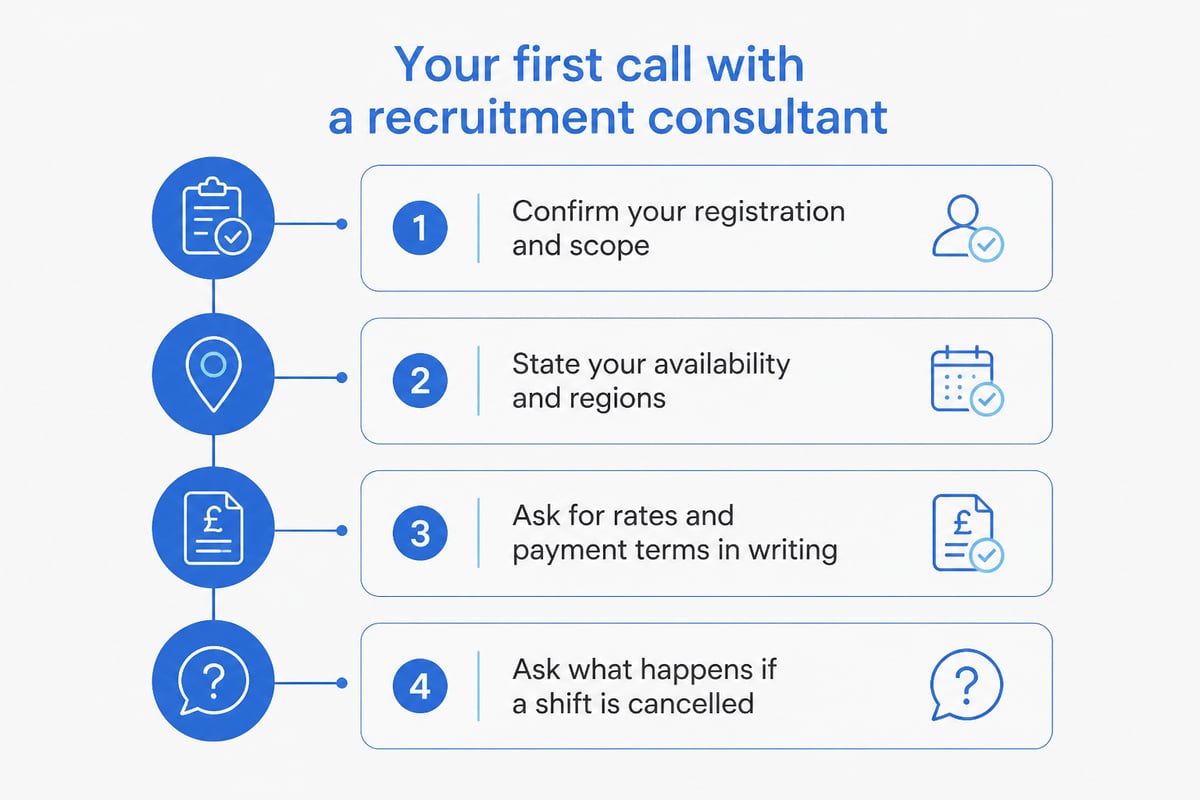
Come with your registration details, your availability for the next three months, the states you will work in and your minimum acceptable rate. Then listen for three things. Does the consultant ask about your scope of practice and preferences before talking about vacancies? Do they name real facilities and real dates? Do they follow up in writing when they say they will?
If you want a sense of how a clinician-led agency describes its own approach, the about page sets out who runs the business and how it operates. Reading that kind of page for any agency you are considering takes two minutes and tells you more than a job board listing.
Warning signs that should end the conversation
Some behaviour is reason enough to walk away, whatever the shift on offer looks like.
- Pressure to sign before you have seen the terms
- Reluctance to name the facility until after you commit
- Requests for documents you cannot link to a specific placement
- No clear answer on who pays for travel or accommodation
- A consultant who cannot explain how your credentials were checked
- Pay that is "sorted after the shift"
Health recruitment specialists differ widely in quality, and the good ones welcome these questions. An agency that bristles at a request for written rates is telling you how a pay dispute would go.
Work through that list on your first call with each agency, keep notes, and compare them against the table above. Within a week you will know which two or three are worth keeping on your phone.
Your next step is to write down your registration details, availability and minimum rate, then put the questions from this article to two or three agencies and compare their written answers. If you want a doctor-led team to take that call, contact us at Best Practice Medical to talk through the locum work that fits your grade, specialty and the states you want to cover. Our consultants can walk you through credentialling, shift confirmation and travel before you commit to a single placement.