

Healthcare recruitment agencies in Sydney place doctors into permanent, contract and locum roles at public hospitals, private hospitals and regional facilities, and for a locum doctor the useful ones handle credentialling, shift matching, travel and accommodation so you can work when and where you choose. The differences between agencies are real, though, and they show up in who owns the business, which health systems they are approved to supply, and what happens when a shift falls through at 2am. This guide is written for JMOs, registrars and specialists who want flexible work across Australia, not a permanent full-time post.
What healthcare recruitment agencies in Sydney actually do
A medical recruitment agency sits between a doctor and a facility that has a gap in its roster, and its job is to fill that gap with someone who is registered, credentialled and available.
For a facility, the agency checks documents, confirms a doctor can work in the right specialty, and sends someone who can start. For you, it finds shifts that fit your availability, handles the paperwork that would otherwise take days, and negotiates the terms of the engagement.
Sydney has a large market for this. The Australian Government Department of Health's workforce statistics show a large registered medical workforce in NSW, spread across metropolitan teaching hospitals, private day surgeries and rural sites hours from the CBD, and every one of those sites has rosters that go short through leave, illness, vacancies and seasonal demand.
Agencies exist because those gaps appear at short notice. A locum doctor who can say yes to a block of weeks in Orange or a single Saturday night in an emergency department is useful to a roster manager in a way a permanent hire cannot be.
Locum, contract and permanent: pick the right type of agency
Not every agency in Sydney does locum work well, so check what the agency's day-to-day business really is before you register.
Some agencies are built around permanent placement. Their consultants spend their weeks on long searches, interviews and contract negotiation, and a candidate who wants a three-week block in January is a side issue. Others are built around shift fulfilment, where the whole operation is set up to confirm a doctor onto a roster within hours.
If flexible work is what you want, look for an agency where locum placement is the core product. Signs of that include consultants who ask about your availability windows before your career history, a process for last-minute shifts, and support outside business hours. Hospitals do not stop needing doctors at 5pm on a Friday.
You can read more about how the locum model works in practice in this piece on how to make locuming work for you.
Registration and credentialling come before any shift
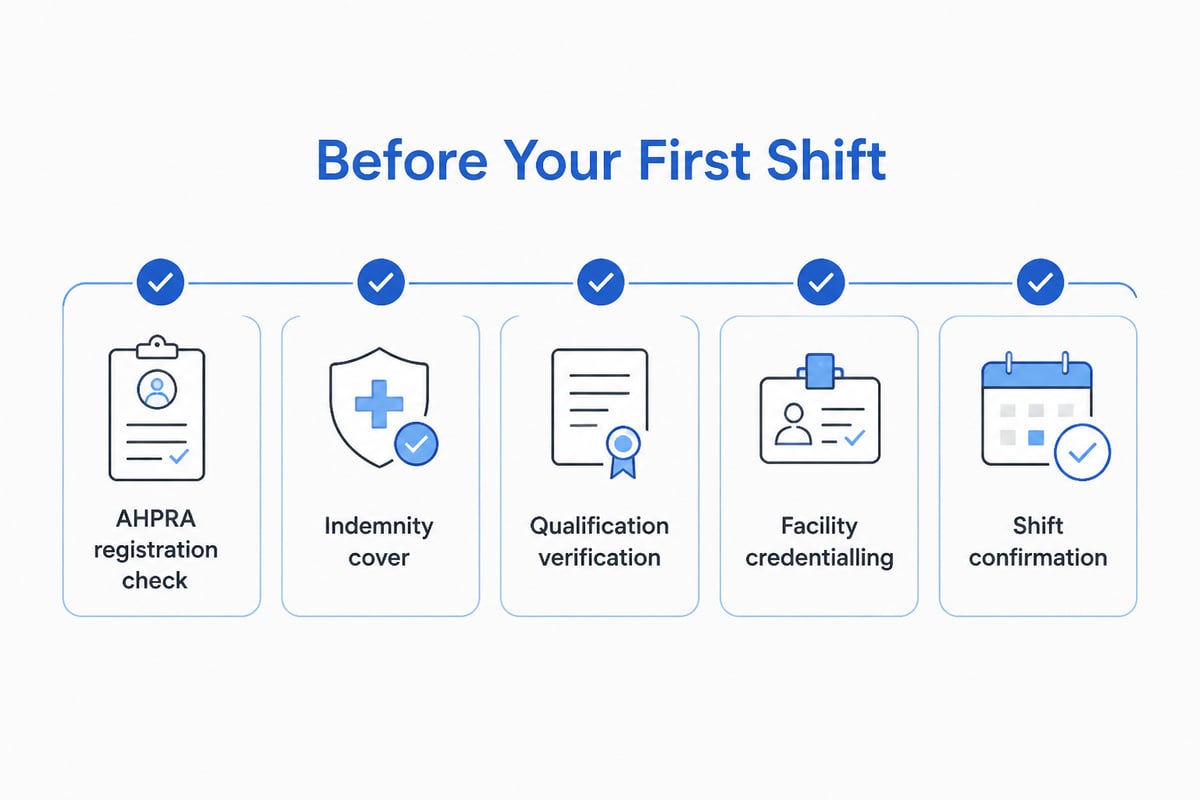
No agency can place you until your registration and credentials are in order, and the speed of that process is often what separates a good agency from a slow one.
Before you work, you need current registration with the Medical Board of Australia through AHPRA, and the facility needs to be satisfied about your qualifications, indemnity cover and any mandatory checks. NSW Health's own recruitment FAQ explains that candidates must meet registration and licensing requirements before starting work, and that conditional offers may depend on AHPRA registration and other mandatory checks. The wording is for a different profession, but the principle applies to doctors too.
What a good agency does here:
- Collects your documents once and keeps them current, so you are not re-sending the same certificates for every shift
- Tells you early which facilities will accept your credentials and which need extra steps
- Flags expiring documents before they cost you work
Ask any agency how it handles this. Best Practice Medical credentials every locum to the highest standards before placement, and a documented, audited quality management process is a useful signal that the process is rigorous rather than improvised.
How to compare healthcare recruitment agencies in Sydney
When you compare healthcare recruitment agencies in Sydney, the most useful comparison is how each one behaves when something goes wrong, not what its website promises when everything goes right.
The table below sets out the questions worth asking and what a good answer looks like.
| Question to ask | What a good answer sounds like |
|---|---|
| Who owns and runs the agency? | A named owner, ideally someone with clinical and recruitment experience |
| Which health systems are you approved to supply? | A specific list of state health services and private providers |
| What professional bodies do you belong to? | RCSA, AMRANZ or equivalent, with a membership you can verify |
| Who do I call for an urgent shift? | A named consultant, reachable outside business hours |
| What is covered after I accept a shift? | Confirmation, travel and accommodation arranged, in writing |
| How will I hear about changes? | Regular updates from one consultant, not a rotating inbox |
Treat vague answers as an answer. An agency that cannot tell you which health services it supplies, or who you would ring at midnight, probably cannot do either well.
Ownership and clinical credibility matter more than you'd expect
An agency led by a practising doctor tends to understand what you are asking when you say a shift needs to suit your registrar training, your family or your next interstate block.
Best Practice Medical is doctor-owned and operated, led by a practising doctor with decades of medical recruitment experience. That background shapes practical things: how consultants talk to you about specialty fit, how they read a roster, and how they judge whether a shift is realistic before they offer it.
You can read more about the people behind the agency on the about us page, and the piece on doctors for doctors covers why clinical leadership changes the quality of the service.
Ownership is not the only thing that counts, but it is one of the few signals you can check in a minute and it tells you who is accountable.
What to look for if you are a JMO or registrar
JMOs and registrars have a different set of needs from established specialists, and an agency should be able to speak to them directly rather than treating every doctor the same.
If you are a junior doctor, you may be weighing locum work against training requirements, rotation dates and the need to build a procedural log. A short-term block can help you test a specialty, earn between rotations, or work somewhere regional for a few weeks. The questions that matter are whether the shifts count towards what you need, whether the facility will supervise appropriately, and whether the agency will be honest about what is a good fit.
If you are a registrar, ask whether the agency has access to the specialty you are training in and at what level. A busy tertiary emergency department needs something different from a rural hospital that wants a registrar who can cover anaesthetics and some obstetrics.
The post on what to do after graduating is a useful starting point for early-career doctors thinking about locum work, and the specialities page shows the range of areas where placements are available.

Specialists and the case for short-notice work
Specialists tend to use locum agencies for control over their calendar, and the best agencies respect that by sending only what fits.
An anaesthetist might want a fortnight in a regional hospital between private lists. An emergency physician might want a run of weekend shifts. A psychiatrist might want a block that lets them travel. The consultant's job is to know your preferences and filter, not to forward every vacancy and leave you to sort through them.
For short-notice cover, Best Practice Medical offers Short-Term Medical Locum Placements across Emergency Medicine, Anaesthetics, ICU, O&G, Paediatrics, Psychiatry and Surgical specialties. Placements range from a single shift to a block of weeks, matched on specialty, credentialling status and availability, and backed by 24/7 consultant support.

Approved supplier status and why it opens doors
Approved supplier status with state health services determines which public hospitals an agency can actually send you to, so it is worth checking before you register.
Public health systems in Australia generally buy locum cover through approved panels. An agency that is not on the panel cannot place you in those facilities, however good its candidate list is. Best Practice Medical is an approved supplier for NSW Health, Tasmanian Health, WA Country Health Service, NT Health, Vic Health, QLD Health and ACT Health. It also supplies major private providers including Ramsay Health Care, Healthscope and St Vincent's Health.
For a Sydney-based doctor, this matters in two ways. You get access to public and private work in NSW, and you can take the same registration and credentialling across state lines when you want regional or interstate blocks. Doctors who work across several states often want one agency relationship rather than five.
Regional work in particular is where locums make the biggest difference. The piece on why regional healthcare relies on locum doctors explains the pressures on rural rosters and why short-term cover is often the only way a small hospital keeps its emergency department open.
Logistics: who arranges travel, accommodation and confirmation
The practical side of locum work, meaning flights, accommodation and shift confirmation, should be handled by the agency, and you should know before you accept what is covered.
This is where a lot of frustration starts. A shift is offered, you accept, and then you are left chasing a booking reference or finding out that accommodation is not included. Agencies differ widely, so get the details in writing.
Best Practice Medical covers placements end to end, including shift confirmation, travel and accommodation. A dedicated consultant also gives regular updates to both doctors and facilities, so you are not guessing whether a roster change has happened. For the specific terms of any placement, speak to a consultant directly rather than relying on a general description.
Memberships are another way to check an agency's standards. Best Practice Medical is a member of the Recruiting, Consulting and Staffing Association (RCSA) and the Association of Medical Recruiters Australia and New Zealand (AMRANZ).
Questions to ask before you register with any agency
Registration with an agency is free to start, but your time is not, so a short list of questions up front saves weeks of wasted contact.
Ask who your consultant will be and whether it is the same person each time. Ask how quickly the agency can confirm a shift once you say yes. Ask what happens if a facility cancels, and whether you have any protection. Ask how rates are communicated and whether you will see the full terms before you commit. Ask what the agency needs from you to be placement-ready, and how long that usually takes.
Be wary of agencies that push you to commit to exclusivity, that cannot name the facilities they supply, or that go quiet after registration. Doctors who register with two agencies for the sake of choice are doing nothing wrong, and a good agency will not penalise you for it.
Workload, wellbeing and the reasons doctors turn to locum work
Many doctors move to locum work because of hours, culture or burnout, and a good agency treats that as a reason to take your limits seriously rather than a problem to be managed.
Long rosters and unpaid overtime remain a feature of hospital medicine, and the piece on doctors still working too many hours covers the data and the consequences. Bullying in hospitals is a related issue, discussed in this article on addressing a widespread problem. Locum work can give you distance from both, because you choose where you work and you are not locked into a team that is not working for you.
That freedom only holds if the agency respects your boundaries. If you say you will not work more than five consecutive nights, a good consultant will remember that. If you say you want metropolitan sites only, they will not send you regional offers.
Locuming is not a fit for everyone. If you want the stability of one workplace, a fixed team and a permanent contract, a recruitment agency focused on locum placement is the wrong tool, and you are better served by applying directly to hospital vacancies.
If you are a JMO, registrar or specialist weighing up locum work, start by listing your available weeks, your preferred specialties and any states you will work in, then ask each agency you speak to how quickly it can match you against that list. To discuss what shifts are available and how credentialling would work for you, Best Practice Medical has consultants you can reach to talk through your options, so contact us with your availability and we will tell you what is realistic. If you prefer to look around first, the Best Practice Medical homepage sets out the services in more detail.