

Hospital and health care in Australia is delivered through a mix of public hospitals run by state and territory governments, private hospitals run by for-profit and not-for-profit operators, and a smaller layer of regional and rural facilities that depend heavily on visiting and locum doctors. For a locum, that structure decides where the work is, who pays, and what credentialling you need. For a manager, it decides how quickly you can fill a gap and what the cover will cost you.
This guide is written for doctors who want flexible work across the system and for the managers who need that cover. It covers how the system is split, how much activity it handles, how credentialling works, and where locum doctors actually fit.
How Australian hospital and health care is structured
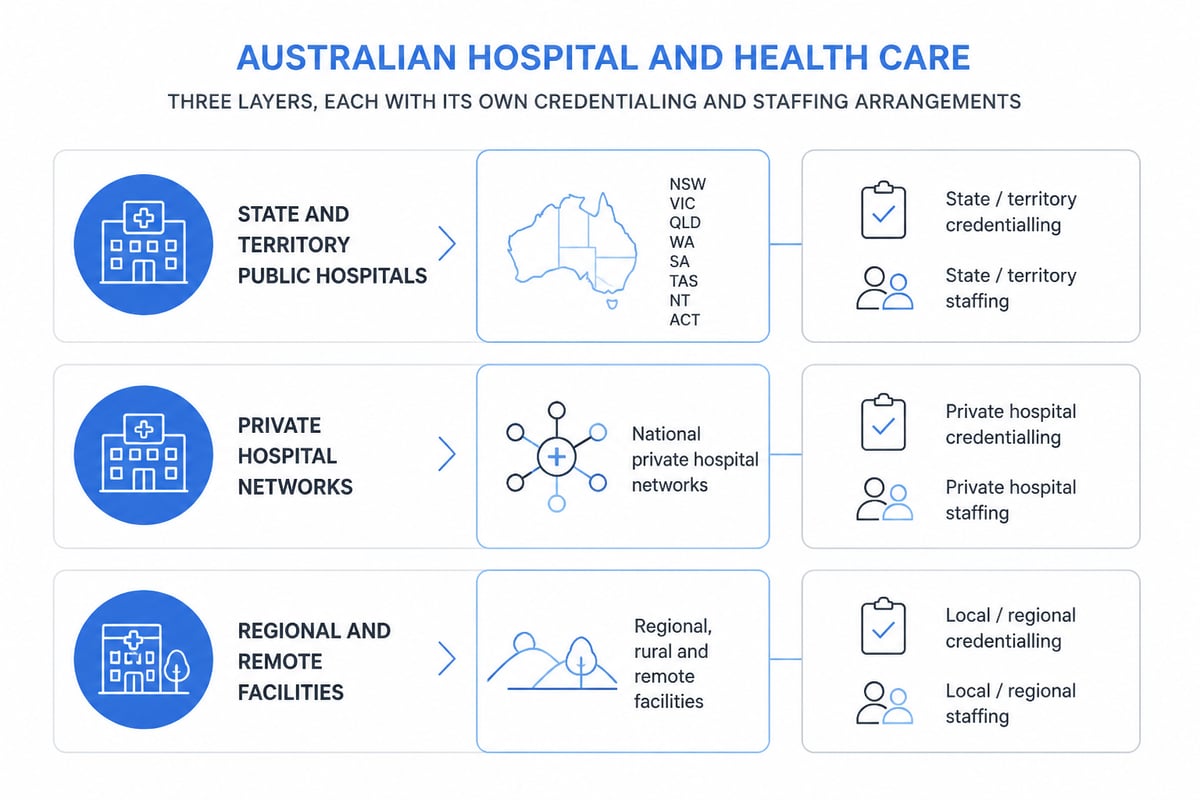
Australian hospitals fall into three groups: public hospitals funded and run by each state or territory, private hospitals, and a mixed group of regional, rural and remote facilities that can be either.
Public hospitals sit under state and territory health departments, which is why the rules, pay rates and onboarding steps change when you cross a border. NSW Health, Queensland Health, WA Country Health Service and Vic Health each run their own procurement and credentialling. A doctor who works in Newcastle one month and Townsville the next is dealing with two separate employers on paper.
Private hospitals operate differently. Large operators such as Ramsay Health Care, Healthscope and St Vincent's Health run networks of facilities with their own credentialling committees and their own rosters. Many private hospitals use visiting medical officers rather than salaried staff, so locum arrangements look different from the public side.
Regional and remote hospitals are a category of their own. They often have small medical teams, broad scope of practice and little margin when one doctor goes on leave. Why regional healthcare relies on locum doctors sets out why that dependence has become structural rather than occasional.
How much work the system handles
Australian hospitals handle a very large volume of activity each year, and the numbers explain why staffing gaps appear so quickly.
According to the AIHW's Hospitals at a glance, Australia recorded 12.8 million hospitalisations in 2024-25, equivalent to 416 per 1,000 people. In the same year, hospitals saw 9.1 million emergency department presentations, or 328 per 1,000 people. Public hospitals admitted 791,000 patients from elective surgery waiting lists, and hospitals delivered 43.6 million non-admitted patient services, including outpatient care.
Those figures matter for two reasons. First, demand is spread across every specialty, so a gap in anaesthetics or paediatrics is felt as fast as a gap in emergency medicine. Second, a lot of that activity is predictable in volume but not in timing. A roster that looks adequate on Monday can have three holes by Thursday once leave, illness and fatigue limits are counted.
For more detail on how the busiest front door of the system performs, the AIHW's emergency department data covers presentation volumes, timeliness of care and how performance differs among patient groups.
Who works in a hospital and where locums fit
A hospital runs on layers of medical staff, and locums are used at nearly every layer to cover leave, vacancies and seasonal peaks.
The standard medical workforce looks like this:
Interns and resident medical officers. These are the junior doctors who carry much of the ward and on-call load. Rosters here are tight, and unplanned absences are hard to absorb.
Registrars. Trainee and non-trainee registrars staff the emergency department, theatre lists, ICU and specialty units. Unaccredited registrar locums are common in emergency medicine, anaesthetics and psychiatry.
Career medical officers and senior medical officers. These doctors hold the day-to-day senior cover that keeps a department functioning without a consultant on site.
Specialists and consultants. Locum specialists cover leave, fill vacant posts while recruitment runs, and keep elective lists moving.
For a doctor, the useful point is that locum demand is not limited to one grade. A JMO wanting flexibility, a registrar between training posts and a specialist who has stepped back from a permanent role can all find work. For managers, the useful point is that you can match cover to the exact gap. Doctors in hospitals and hospital staff go further into how those roles divide up.
Credentialling and onboarding before a first shift
Credentialling is the step that decides whether a locum can start on the date agreed, and it is the most common cause of delay.
Before placement, a facility will typically need to verify:
- AHPRA registration and any conditions on it
- Qualifications and training history
- Referee checks and recent employment history
- Immunisation status and health screening
- Working with children checks and criminal history checks where required
- Indemnity cover
- Facility-specific orientation, system access and rostering sign-off
Public systems often add their own paperwork on top. A doctor approved in one state does not automatically clear another, so a locum planning to work across borders should expect to repeat parts of the process.
The practical advice is to keep your documents current and in one place. Registration certificates, immunisation records, indemnity certificates and referee contacts should be ready to send within a day. Doctors who do this get offered shifts faster because the facility can see they are placeable. If you are still working out whether you qualify, am I eligible to become a locum doctor covers the baseline requirements.
For managers, the lesson runs the other way. Facilities that hold a pool of already-credentialled locums can fill a short-notice gap in hours. Those starting from scratch usually can't.
What flexible hospital work looks like for a doctor
Flexible hospital work ranges from a single shift to a block of several weeks, and the right pattern depends on your specialty, your career stage and how much travel you will accept.
Short blocks suit doctors who want to keep a base and pick up cover around it. A registrar might take two weeks of emergency cover between rotations. A specialist might take a fortnight of theatre lists in a regional centre, then return home. Longer blocks suit doctors who want to live in a location for a while, or who want to trial a hospital before committing to a permanent role.
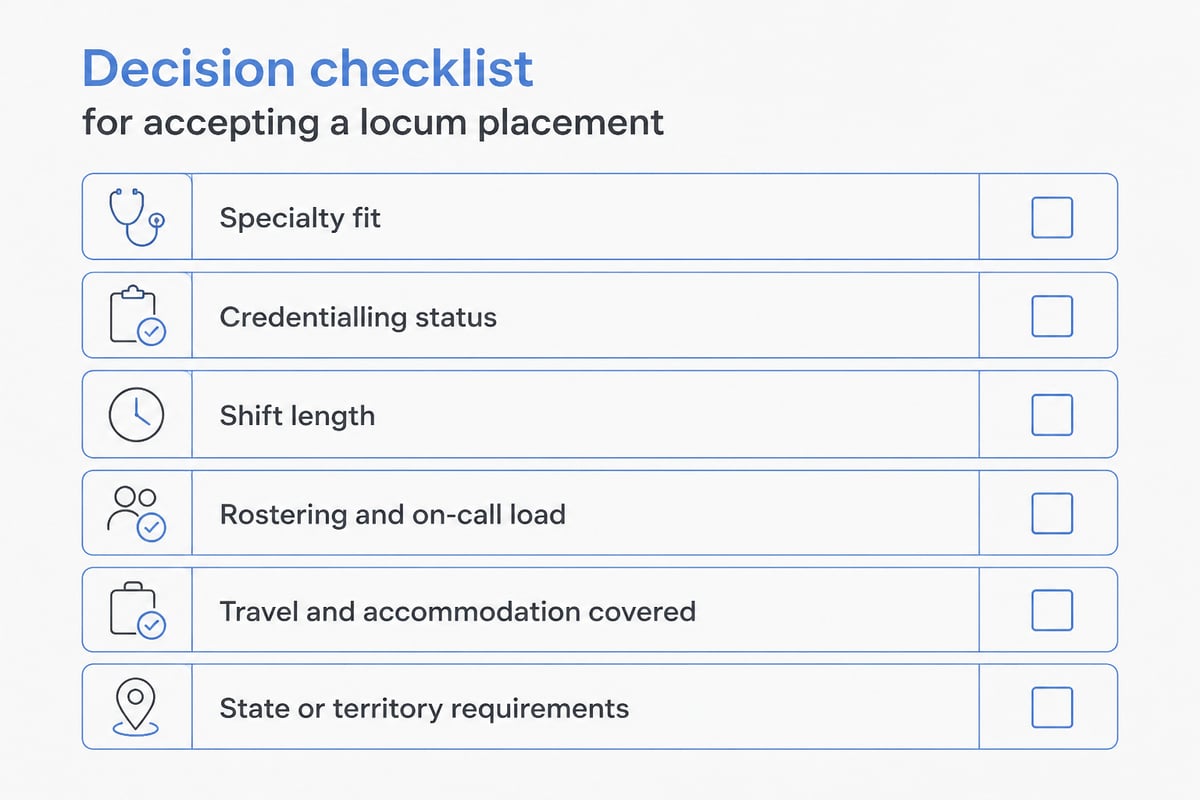
Some points are worth thinking through before you accept work:
Travel and accommodation can swing the real value of a placement. A higher hourly rate in a remote town means little if you are paying for flights and a motel. Check what is covered before you say yes.
Rostering rules differ by facility. Ask about on-call load, rest periods and the expected case mix. Junior doctor working hours is useful background if you are early in your career and weighing up hours against income.
Sustainability matters over the long run. Doctors who take every shift offered tend to burn out. How to build a sustainable locum career covers pacing, and mental health in doctors covers the risks that come with irregular work.
Hospital and health care staffing from a manager's side
For a hospital manager, locum cover is a planning tool, and it works best when you treat it that way rather than as an emergency measure.
Most facilities that struggle with cover share the same pattern. They wait until a gap is two days away, then ask for the same specialty at the same rate and expect a placement to appear. A better approach is to look at your roster over the next quarter, note the known leave and vacancies, and book cover for those gaps early. That leaves your urgent budget and your urgent contacts free for the shifts you genuinely could not predict.
Some things to settle in advance:
Your credentialling pathway. Know what your facility needs and how long it takes. Share it with your agency so candidates arrive with the right paperwork.
Your specialty priorities. Emergency medicine, anaesthetics, ICU, obstetrics and gynaecology, paediatrics, psychiatry and surgery are the areas where gaps tend to hurt first.
Your escalation route. Decide who can approve a short-notice booking at 10pm, and make sure your agency knows who to call.
Your onboarding quality. A locum who gets system access, an orientation and a named contact on day one performs better and is more likely to return. Recruitment in healthcare and what makes a good locum doctor both cover what to look for and what to prepare.
Retention of locums is also worth planning. Doctors return to facilities where they were treated well, rostered fairly and paid on time. A hospital that builds that reputation spends less time and money filling the next gap.

Short-notice cover across specialties
When a shift opens with little warning, speed depends on having a recruiter who already knows your credentialling requirements and the doctors who meet them.
Best Practice Medical's short-term medical locum placements cover ad hoc and short-notice shifts across emergency medicine, anaesthetics, ICU, obstetrics and gynaecology, paediatrics, psychiatry and surgery, with doctors matched on specialty, credentialling status and availability.
Quality, accreditation and who you are dealing with
Whoever supplies your locums is part of your clinical governance, so it is reasonable to ask how they are accredited and who stands behind them.
A few things are worth checking with any medical recruiter: whether they hold a recognised quality management certification, whether they belong to industry bodies, whether they are on approved supplier panels for the health departments you work with, and whether the people running the business understand clinical work.
Best Practice Medical has held ISO 9001:2015 Quality Management accreditation since 2009 and is a member of the Recruiting, Consulting and Staffing Association (RCSA) and the Association of Medical Recruiters Australia and New Zealand (AMRANZ). It is an approved supplier for NSW Health, Tasmanian Health, WA Country Health Service, NT Health, Vic Health, QLD Health and ACT Health, and it supplies major private providers including Ramsay Health Care, Healthscope and St Vincent's Health.
For doctors, the same questions apply from the other side. Ask who your consultant will be, how often you will hear from them, and what happens when a shift changes at short notice. Doctors and facilities working with a dedicated recruitment consultant can expect regular updates, which means you are not chasing for information.
Culture, safety and the working environment
The working environment in a hospital affects retention and patient safety, and locums see it more clearly than most because they move between sites.
A locum arrives without the history and relationships that help permanent staff absorb a difficult culture. That makes poor orientation, unclear escalation pathways and unprofessional behaviour more visible, and more costly. Bullying and harassment remain a documented problem in Australian hospitals, and bullying in hospitals addresses how it shows up and what can be done about it.
For doctors, it is reasonable to ask a recruiter what they know about a facility before you accept. Ask about supervision, handover quality and whether previous locums have returned. For managers, the way you treat a locum in their first week is a good test of your wider culture. If a doctor can raise a concern and get a straight answer, they are more likely to speak up when it matters for a patient.
Mandatory reporting obligations apply to locums as they do to everyone else, and it is worth knowing how they work before a situation arises. Mandatory reporting for doctors covers the legislative background.
Where to find out more about the wider health system
Hospitals are one part of a wider system, and locums who understand the surrounding services work more effectively.
Patients arrive at hospital through emergency departments, referrals from community services and transfers from smaller facilities. They leave to rehabilitation, community nursing, allied health and primary care. Walk-in and urgent care clinics show how community-level services can take pressure off emergency departments for lower-acuity presentations. Allied health services also form part of the post-discharge pathway for musculoskeletal problems.
For doctors who want to understand the training pathways behind the workforce, postgraduate programs in business, law and related fields can matter for those moving into clinical leadership.
A working knowledge of those surrounding services helps with discharge planning, referrals and patient conversations, and it makes a locum more useful to the team from the first shift.
If you are a doctor, start by gathering your registration, immunisation, indemnity and referee details into one folder so you can be credentialled quickly when a shift appears. If you manage a hospital or clinic, list the gaps you can already see in the next quarter and decide who can approve urgent cover. Either way, Contact Us at Best Practice Medical to talk through the specialties, states and shift patterns you need, and a consultant can take it from there.