

A hospital medical officer is a registered doctor who works in a hospital under the supervision of senior clinicians, usually at intern, resident or senior resident level, before training as a registrar or specialist. To become one in Australia you need a recognised medical degree, registration with the Medical Board of Australia, a completed or in-progress internship, and a hospital that will employ you, either directly or through a locum agency.
The title is used loosely, so it helps to know what a job advertisement means by it before you apply.
What a hospital medical officer actually does
A hospital medical officer is a doctor employed in a hospital who manages patients on wards, in emergency departments or in theatres, working under a registrar, staff specialist or consultant. Most of the work is the same regardless of the label: clerking admissions, ordering and following up investigations, writing discharge summaries, reviewing patients overnight and escalating when something is outside your scope.
The day-to-day depends heavily on the department. A medicine RMO might carry a ward list of 15 to 20 patients with a registrar covering the team. An emergency department RMO sees undifferentiated patients, performs procedures like suturing and joint reduction, and learns to decide fast who needs admission. A surgical RMO spends the day split between wards, clinics and theatre, with a long run of after-hours reviews.
If you want a wider picture of the hospital doctor workforce, our piece on doctors in hospitals covers how the roles fit together.
Hospital medical officer grades and titles explained
Hospital medical officer grades run from intern through to senior registrar, and the titles vary by state. The same job can be called an HMO in Victoria, an RMO in NSW and a junior medical officer (JMO) in Queensland.
Here is how the common titles line up:
| Title | Typical stage | What it usually means |
|---|---|---|
| Intern (PGY1) | First year after graduation | Provisional or general registration with supervised practice, rotating through approved terms |
| RMO / HMO (PGY2) | Second year | Fully registered, rotating or in a single specialty term |
| Senior RMO / SRMO / HMO3+ | Third year and beyond | More autonomy, often applying for specialty training |
| Registrar | Specialty training or service role | Accredited training post or unaccredited service registrar |
| Career medical officer | Non-training senior role | Experienced doctor in a service role, no specialty program attached |
The abbreviation SRMO is used for a more senior resident medical officer, a doctor a few years out of graduation who is working with more independence.
The highest post a medical officer can hold in the hospital hierarchy sits well above these grades. Staff specialists, directors of departments and directors of medical services hold the senior clinical and management roles, and a medical superintendent or chief medical officer sits at the top of the administrative line. The grades in the table are the entry and middle rungs.
The pathway: from medical degree to your first hospital job
The pathway to becoming a hospital medical officer has four steps: complete an approved medical degree, register with the Medical Board of Australia, finish an internship, then move into resident-level work.
- Complete a medical degree. In Australia this is typically a six-year undergraduate programme or a four-year graduate-entry degree accredited by the Australian Medical Council.
- Register. All doctors practising medicine in Australia must be registered with the Medical Board of Australia. Graduates of Australian and New Zealand medical schools receive provisional registration for the internship year.
- Complete your internship. This is a supervised year of rotations through medicine, surgery, emergency and other terms. It is allocated through state-based intern matching rounds, which open in the year before you graduate.
- Move to resident level. After general registration you apply for RMO or HMO positions, either through the state's annual recruitment campaign or by direct application to individual hospitals.
Most of the competition sits at step 4 in the larger metropolitan teaching hospitals. Regional and rural hospitals often struggle to fill their rosters, which is part of the reason they use locums.
Pathways for internationally qualified doctors
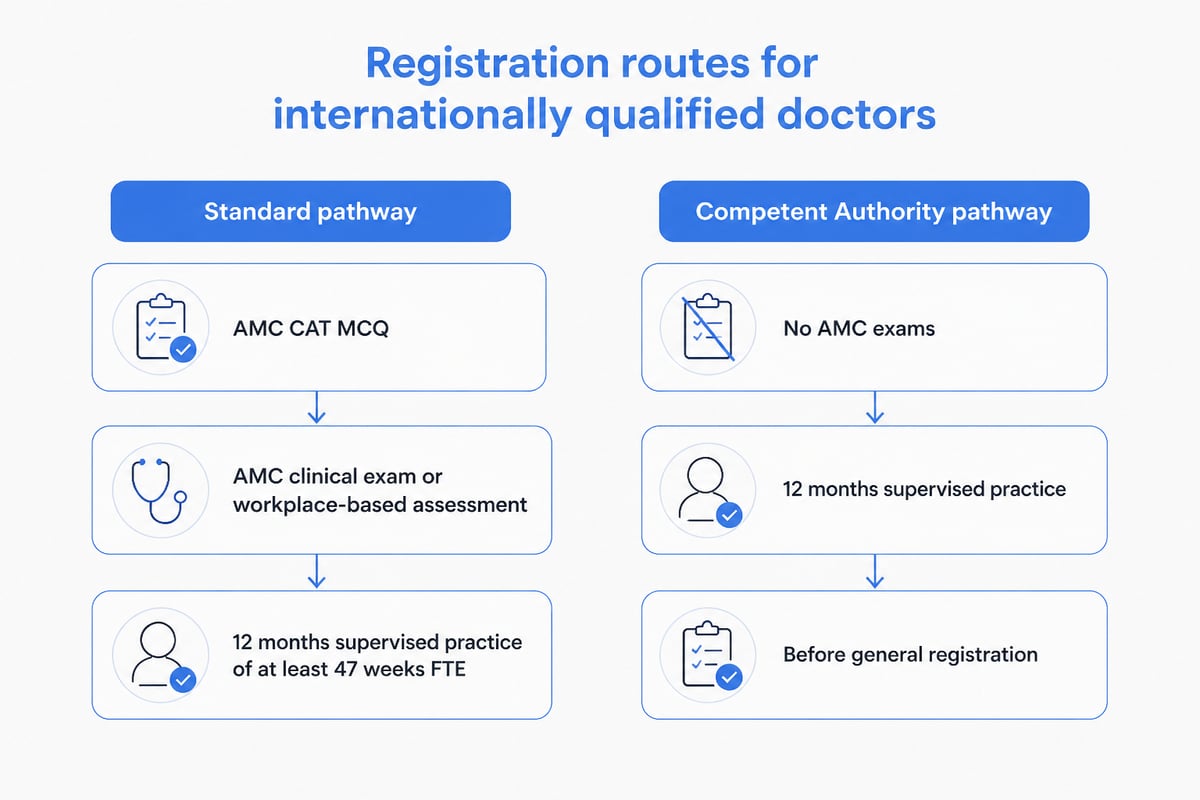
Internationally qualified doctors reach a hospital medical officer role through one of the Medical Board's pathways for international medical graduates, and the right one depends on where you trained. The Board lists all of them on its international medical graduates page, including eligibility checks and application forms.
The two you are most likely to meet:
- Standard pathway. It requires the AMC CAT MCQ exam, then either the AMC clinical exam or a workplace-based assessment, plus 12 months of specified supervised practice. The supervised practice must total at least 47 weeks full-time equivalent within that 12 months, per the Medical Board's Standard pathway guidance.
- Competent Authority pathway. Applicants do not sit AMC examinations, but they must complete 12 months of supervised practice before applying for general registration, according to the Competent Authority pathway page.
Whichever route you take, your first Australian hospital role is normally a supervised one, and the quality of that supervision matters. Ask about the clinical lead, the sign-off process and how your hours count toward the requirement before you accept an offer.
What a hospital medical officer earns
Pay for a hospital medical officer is set by state public sector awards for permanent and fixed-term roles, and by hourly rates for agency and locum shifts. The figures differ by state, year of experience, specialty and whether the shift is a weekday, night or weekend.
Locum job boards show how wide the spread is. Locum shift rates vary widely by specialty, location and shift type. Advertised shift rates are not guaranteed earnings, and they do not account for tax, super or the unpaid gaps between bookings.
For a permanent role, check the relevant state award and your specific grade, since overtime, penalty rates and professional development leave change the real figure considerably. For locum work, ask the agency for the full rate card and compare it against what a rostered role would pay once you add leave and super.
Where the work is: current hospital medical officer jobs
Hospital medical officer jobs are advertised in every state, with the heaviest demand in emergency medicine, general medicine, surgery, paediatrics and psychiatry. Vacancies are advertised in every state, and the volume tends to peak in the lead-up to the new clinical year and again mid-year.
A few patterns hold across the country:
- Metropolitan public hospitals recruit most of their RMOs in an annual campaign, typically opening mid-year for the following clinical year.
- Regional and rural hospitals recruit continuously and often offer relocation support, accommodation and a wider scope of practice.
- Private hospital groups hire for surgical and medical wards on a rolling basis, and often use agency staff to cover leave and unfilled posts.
- Short-notice vacancies appear all year when a rostered doctor leaves or goes on leave.
For more on what is available, our overview of doctor jobs in Australia goes through the main routes in.

Working as a locum hospital medical officer
Locum work lets a hospital medical officer pick up shifts or short contracts across hospitals without committing to a single permanent roster. It suits doctors who want to control their hours, test different specialties, work in regional areas for a few weeks, or fit work around study and family.
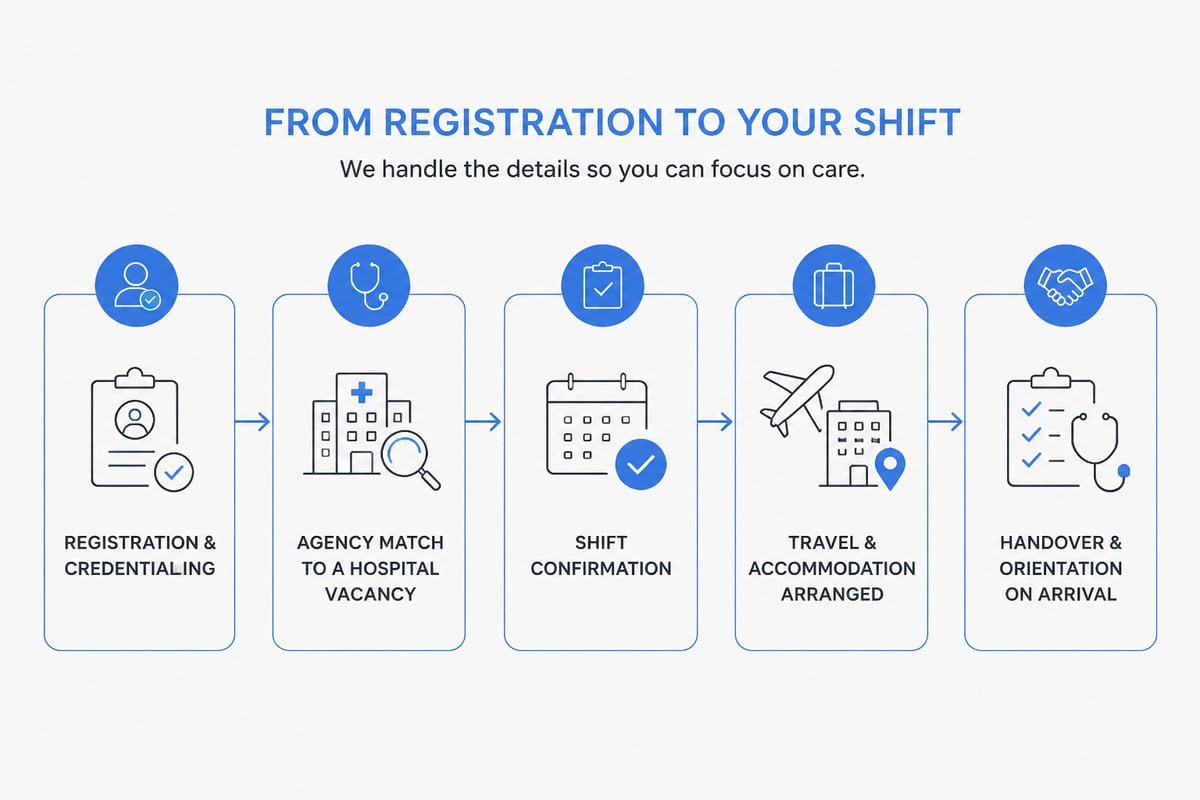
Agencies typically need your registration and references, plus checks such as immunisation records and a police check, before you can be placed. The hospital then confirms the shift, and you are credentialled to its requirements. Our article on whether you are eligible to become a locum doctor covers what is usually asked for.
The trade-offs are real. You lose paid leave and a predictable roster, and the induction at each new hospital is shorter than a permanent employee would get. In return you can lift your hourly income, avoid hospital politics and learn how different systems run. Our guide to the benefits of going locum goes through both sides.
Registrar and JMO placement through Best Practice Medical
Best Practice Medical places hospital Registrars and Junior Medical Officers across NSW metropolitan public and private hospitals, with secondary coverage across regional and interstate facilities. Its consultants understand the difference between a metropolitan teaching hospital and a regional base hospital, and brief doctors on that difference before they start.
Some details from the business that matter if you are weighing up a locum agency:
Best Practice Medical credentials every locum before placement, gives doctors and facilities regular updates from a dedicated consultant, and covers placements end to end, including shift confirmation, travel and accommodation. Its consultants are available around the clock for urgent shift needs. The business is doctor-owned and operated.
What hospitals need from a medical officer, and how to stand out
Hospitals hire medical officers who are safe, reliable and easy to roster, and the strongest applications show all three early. The qualities that tend to separate candidates are practical rather than abstract.
Procedural and clinical breadth. Recent experience in emergency, general medicine or surgery makes you placeable in more departments. Documentation habits. Clear handovers and complete discharge summaries save registrars time. Escalation judgement. Knowing when to call for help, and calling early, matters to supervisors. Availability. Doctors who can cover nights, weekends and short-notice gaps are in demand. Fit with the setting. A regional base hospital often wants broad skills and willingness to cover multiple wards. A metropolitan teaching hospital often wants someone who works well inside a large team and a defined chain of command.
Workplace culture also affects who stays. Bullying and unsafe hours are well documented problems in junior doctor rosters, and it is worth reading about how bullying in hospitals is being addressed before you accept a term, so you know the questions to ask at interview.
Is there an easy medical job that pays well?
No hospital medical officer role is both easy and well paid, because the pay premium in hospital medicine goes to unsociable hours, high acuity or hard-to-fill locations. The shifts with the highest advertised hourly rates are usually night cover, emergency departments and rural posts where the hospital struggles to recruit.
If your priority is balance, the better question is which settings offer predictable hours and a manageable patient load. Day-time ward cover in a well-staffed hospital, outpatient-based roles and some day-surgery posts tend to be steadier, with lower hourly rates in exchange. Our article on junior doctor working hours looks at how those trade-offs play out in practice.
FAQ
What are the current medical jobs available in Australia?
Hospitals are recruiting RMOs, senior RMOs, registrars, career medical officers and specialists in most states, with the heaviest demand in emergency, general medicine, surgery, paediatrics and psychiatry. Public hospital campaigns open mid-year for the next clinical year, and agencies fill short-notice gaps all year round.
Do I need to be a specialist to work as a hospital medical officer?
No. Most hospital medical officers are not specialists. They are doctors in their first years after graduation, or career medical officers in non-training service roles, who work under the supervision of registrars and consultants.
Can I work as a hospital medical officer part-time or casually?
Yes, many hospitals roster part-time and casual doctors, and locum arrangements through an agency are common for short-term cover. Availability depends on the department and the hospital's roster needs, so ask about minimum commitments before you accept a booking.
If you are working out your next step, check your registration status on the Medical Board's site and list the specialties and states you would be willing to work in, because that list shapes every offer you will get. If you want shifts, contracts or an RMO-to-registrar move lined up with someone who knows the NSW hospital market, Best Practice Medical is the place to contact us and talk through what is available for your experience and availability.