

If you searched for an Interact medical locum agency, the first thing to know is that the name "Interact" is associated with a different field, workplace rehabilitation, rather than doctor-focused locum agencies, so doctors looking for shift work will usually need a specialist medical recruiter instead. This guide explains how medical locum agencies work in Australia, what to check before you register, and how to match an agency to your career stage.
It is written for doctors who want flexible work (JMOs, registrars and specialists) and for managers who need to fill gaps in a roster at short notice.
What is an Interact medical locum agency, and what should you look for instead?
An Interact medical locum agency, as most people mean the phrase, is a recruiter that places doctors into short-term shifts at hospitals and clinics. The name "Interact" turns up in search results for workplace rehabilitation services, which is a different field. If you want locum shifts, you need an agency that credentials doctors, holds supplier approvals with health services, and has consultants who understand your specialty.
The label matters less than what sits behind it. Before registering with any agency, ask four questions:
Who are they approved to supply? State health departments keep panels of approved suppliers. If an agency is not on the panel, it cannot place you in the public hospitals that use it.
Who runs it? Some agencies are owned by clinicians, others by large staffing groups. Neither is automatically better, but you should know who makes the decisions.
What happens when a shift falls through? A good agency has a person you can ring at 2am, not a ticketing system.
What do they cover? Shift confirmation, travel and accommodation are where agencies differ most, and where doctors lose the most time if it is left to them.
How do locum agencies in Australia actually work?
A locum agency in Australia holds the relationship with the facility, checks your credentials, offers you shifts, and handles the paperwork around each placement. You do not pay to register. The facility pays the agency, and the agency pays you or your company.
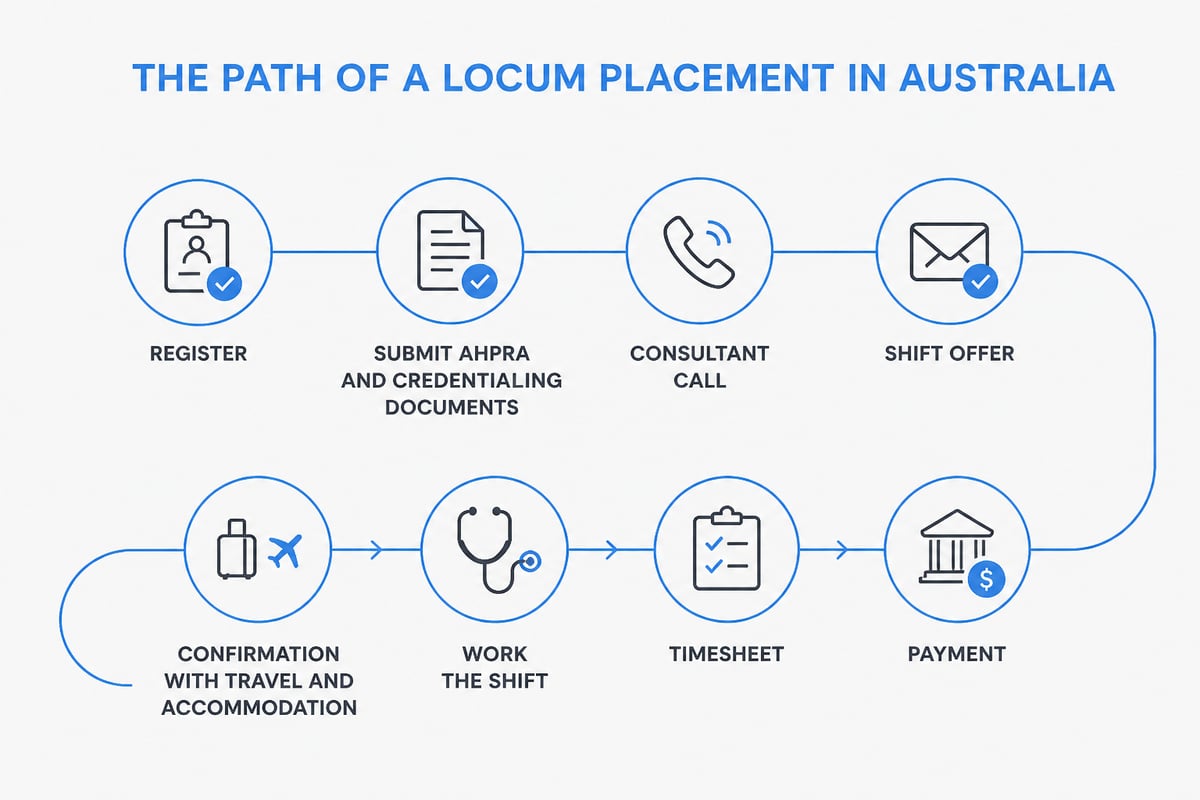
The usual sequence looks like this:
- You register and submit your AHPRA registration, qualifications, immunisation records, police checks and references.
- The agency credentials you against the standards each facility or health service requires.
- A consultant learns your specialty, availability, preferred locations and rate expectations.
- Shifts are offered, often at short notice, and you accept or decline.
- The agency confirms the booking with the facility and arranges travel and accommodation where needed.
- You work the shift, submit timesheets and get paid.
Credentialling is the slow part. Doctors who register in a quiet month and are fully documented are the ones who get the first call when an urgent gap opens. Incomplete files wait.
Which locum agency is best for doctors?
The best agency for a doctor is the one that holds supplier status with the health services you want to work in and has a consultant who knows your specialty. There is no single winner, because a rural emergency registrar and a metropolitan anaesthetist need different things.
Judge an agency on checkable points rather than marketing:
- Quality accreditation, such as ISO 9001:2015, which tells you the agency's processes are audited.
- Membership of industry bodies. In Australia that means the Recruiting, Consulting and Staffing Association (RCSA) and the Association of Medical Recruiters Australia and New Zealand (AMRANZ).
- Approved supplier status with the state health departments in the regions you want to work.
- Whether you deal with the same consultant each time or a rotating desk.
- How quickly someone answers outside business hours.
Registering with two or three agencies is normal and sensible. It widens your pool of shifts, and you can compare rates for the same facility. Keep track of which agency submitted you to which facility, because duplicate submissions cause friction and can cost you the booking.
What do locum doctors earn, and what affects the rate?
Locum rates in Australia vary widely by grade, specialty, location and notice period, so any single hourly figure would mislead you. Rural and remote shifts, after-hours work and short-notice requests generally pay more than planned metropolitan day shifts. Specialists in areas with persistent shortages, such as anaesthetics, psychiatry and obstetrics, can command higher rates than JMOs covering a ward.
When comparing offers, look past the headline rate:
- Travel and accommodation. If the agency books and pays for these, your effective rate is higher than a similar rate with you covering costs.
- Payment terms. Find out how quickly timesheets are paid and whether you are paid as an employee or contractor.
- Cancellation terms. Ask what happens if the facility cancels a confirmed shift.
- Superannuation and insurance. Contractors carry their own indemnity and super arrangements, and these need to be priced in.
Ask the agency to put the rate, the inclusions and the cancellation terms in writing before you accept. A rate that looks lower but includes flights and a furnished apartment can beat a higher rate that leaves you paying out of pocket.
Is locum work drying up?
Locum work is not drying up in Australian hospitals, but the way it is bought is changing, and doctors should expect more structure around it. Health services are tightening their supplier panels and credentialling requirements, which favours agencies that can show approvals and audited processes.
Overseas figures give some context on scale. A 2024 NIHR study of locum use in the NHS found locums make up a small share of medical staffing, which is nonetheless the share that keeps rosters running when someone is sick or a post is vacant.
Regulation is also tightening elsewhere. NHS trusts covered by the agency rules must procure agency staff, including doctors, through NHS England-approved framework agreements, and an agency rules update took effect in November 2025. Australian states do not follow that model, but the direction is similar: approved suppliers, price scrutiny and documented compliance. For doctors, that means choosing agencies already on those panels is a safer bet than relying on informal arrangements.

What should a hospital or clinic manager expect from a locum agency?
A manager should expect an agency to supply a credentialled doctor who matches the specialty and shift, confirm it quickly, and stay reachable if anything changes. The agency's job is to take the chasing off your desk.
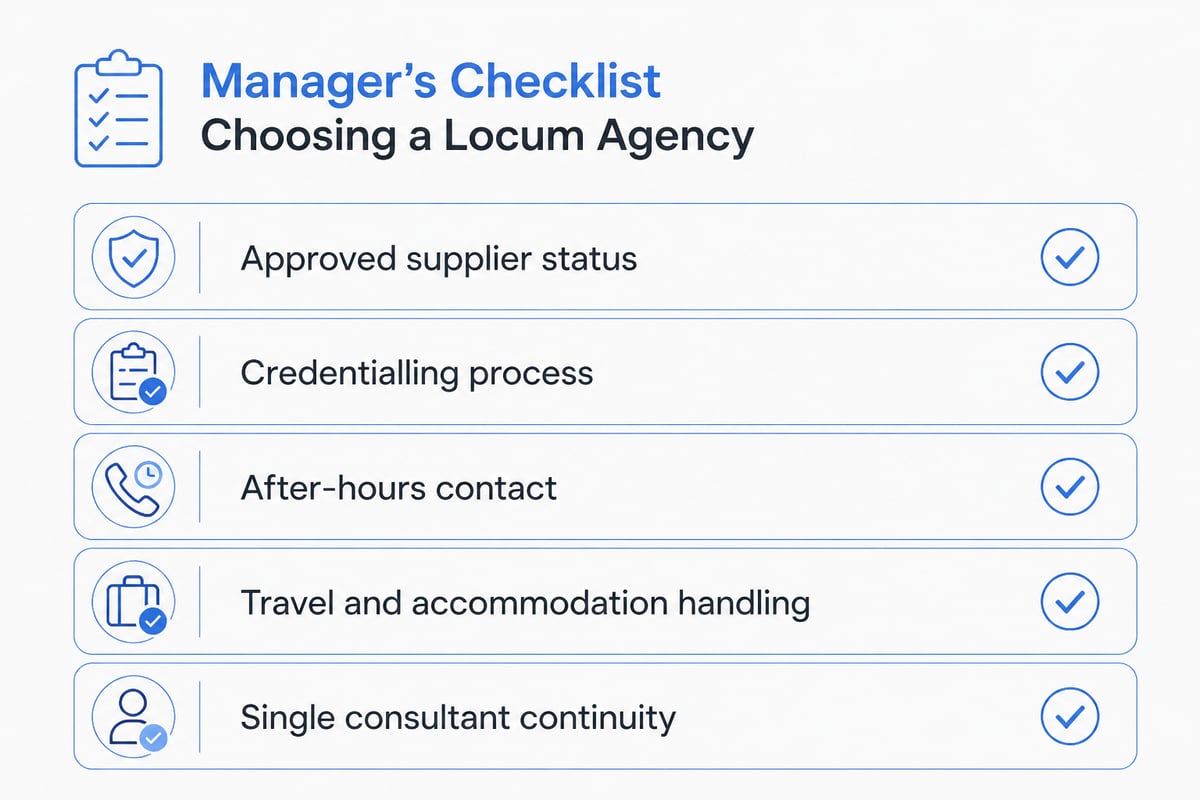
Ask any prospective supplier these questions:
- Are you an approved supplier for our health service or private group?
- How do you credential doctors, and can you show us the checklist?
- Who do we call after hours when a doctor does not arrive?
- Do you arrange travel and accommodation, or do we?
- Will we deal with one consultant who knows our roster?
Continuity matters more than most contracts acknowledge. A consultant who has filled your emergency department roster for years knows which doctors fit your culture and which shifts are hard to cover. That knowledge is hard to replace when a facility changes suppliers.
For a gap you need covered this week, check whether the agency can offer ad hoc and short-notice shifts across the specialties you run, such as Emergency Medicine, Anaesthetics, ICU, O&G, Paediatrics, Psychiatry and surgical lists. Best Practice Medical's Short-Term Medical Locum Placements service matches doctors to facilities for ad hoc and short-notice shifts across hospital specialties, with consultant support behind it.
How do you protect yourself when working through an agency?
You protect yourself by confirming terms in writing, keeping your own records, and checking that your credentials and indemnity are current before each placement. Most problems with locum work come from vague arrangements, not from bad faith.
Keep these habits:
- Get the booking in writing. Dates, hours, site, rate, inclusions and who pays for what.
- Keep your own copy of every timesheet. Chasing payment is far easier with a record.
- Check your registration and indemnity dates. An expired document can void a placement at the last minute.
- Know your supervision and scope. Registrars and JMOs should confirm who supervises them on site before accepting.
- Ask who to call. A named consultant and an after-hours number should be on your booking confirmation.
Workforce data can also help you read the market. NHS England Digital publishes workforce statistics, which show how staffing is distributed across doctor grades. The data is English, so use it as background rather than a guide to Australian demand, but it illustrates a pattern that holds locally too: pressure concentrates in certain grades and specialties, and those are where locum demand is highest.
What does a doctor-led agency offer?
A doctor-led agency is run by a practising clinician rather than a general staffing group, and the practical benefit is that the person making decisions understands the work. Best Practice Medical is doctor-owned and operated, led by a practising doctor with over 30 years in medical recruitment.
Its published credentials give you things to verify rather than take on trust:
- Accredited to ISO 9001:2015 Quality Management.
- Member of the RCSA and AMRANZ.
- Approved supplier for NSW Health, Tasmanian Health, WA Country Health Service, NT Health, Vic Health, QLD Health and ACT Health.
- Supplies major private providers including Ramsay Health Care, Healthscope and St Vincent's Health.
- Consultants available 24/7, 365 days a year for urgent shift needs.
- Placements covered end to end, including shift confirmation, travel and accommodation.
- Long-standing service relationships with facility partners.
Whatever agency you choose, test claims like these by asking for the detail. An accreditation should have a certificate and a scope. A supplier approval should be something the facility can confirm. Agencies that are confident in their record will answer without fuss.
FAQ
What are the largest locum companies in the US?
That question concerns the US market, which is outside what this article covers. For work in Australia, the more useful measure is which agencies hold approved supplier status with the state health services where you want to work.
How much does a locum doctor earn per hour in Australia?
It depends on your grade, specialty, location and how much notice the facility gives, so a single figure would not hold up. Ask any agency for the rate, inclusions and cancellation terms in writing for the specific shift, and compare offers on the full package rather than the hourly number alone.
Do I have to pay to register with a locum agency?
No. In Australia the facility pays the agency, and registering as a doctor should not cost you anything. If an agency asks for a fee to register or to be placed, treat that as a red flag and check their accreditation and memberships before going further.
Your next step is to gather your AHPRA registration, indemnity certificate, immunisation records, police check and referee details into one folder, because a complete file is what gets you the first call when a shift opens. From there, a conversation with a consultant who knows your specialty will tell you quickly whether the work and the rates fit. Best Practice Medical connects doctors with locum opportunities across Australia and works with facilities that need a credentialled doctor fast, so contact us to talk through your availability or your roster gaps.