

Medlo's 2025 data puts the average locum consultant hourly rate in Australia at A$242.20 per hour, but the reported specialty range runs from A$143 to A$417 depending on your specialty, the state and the contract terms. That figure comes from Medlo, which reports an average of A$242.20 per hour in 2025 across 16,971 shifts in five states, or A$1,937.61 per day. Treat it as a starting point for negotiation, not a promise, because the number on a shift offer can mean very different things once you read the fine print.
What is a typical locum consultant hourly rate in Australia?
Published averages put locum consultant hourly rates in Australia at around A$242 per hour, but rates vary widely by specialty and state. The Medlo average of A$242.20 per hour for 2025 is based on 16,971 shifts across five states.
Two cautions apply before you anchor on any figure. First, published averages mix metropolitan and rural work, short single shifts and multi-week blocks, and on-call and rostered hours. Second, AU Locums Direct is explicit that its indicative rates are not verified national averages, and that a quoted rate may include or exclude superannuation, GST, loading and on-call payments depending on the contract.
So a headline hourly figure is only meaningful once you know what sits inside it. A rate of A$250 per hour that excludes super and carries no on-call payment can be worth less than A$230 per hour that includes both.
How the rate varies by specialty
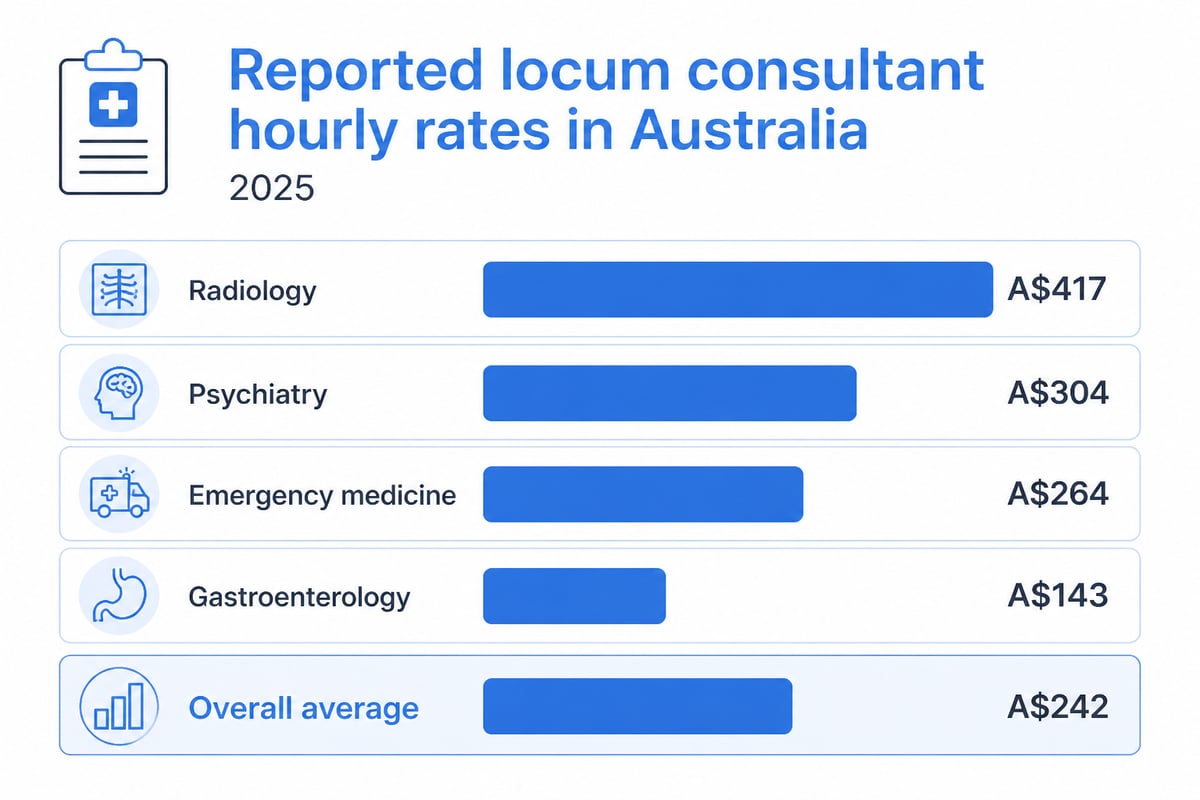
The rate varies more by specialty than by any other factor, with Medlo's 2025 figures ranging from A$143 per hour in gastroenterology to A$417 per hour in radiology. That is nearly a threefold gap within the same consultant grade.
Here is how the specialties Medlo lists compare:
| Specialty | Reported rate (A$ per hour, 2025) |
|---|---|
| Radiology | 417 |
| Psychiatry | 304 |
| Emergency medicine | 264 |
| Gastroenterology | 143 |
Source for all four figures: Medlo.
These differences reflect how the work is structured as much as how scarce the specialty is. Specialties differ in how their work is structured and how hard they are to staff, and that shapes what facilities pay.
If your specialty isn't in the table, don't assume it sits near the A$242 average. Ask the agency or facility what comparable consultants in your discipline have been offered in your target state over the last six months.
State-by-state differences
State matters almost as much as specialty, with Medlo reporting a high of A$269.19 per hour in Western Australia and a low of A$131.64 per hour in South Australia. That is a gap of more than A$137 per hour on the state average alone.
Several things drive this. Medlo's state averages differ, with Western Australia highest and South Australia lowest, and the reasons for the gap are not established by the source.
Be careful reading too much into a single state average. A state mean blends a Perth tertiary hospital shift with a remote Kimberley or Pilbara placement, and those are not the same job. Within any state, regional and remote work usually pays above metropolitan work, and often comes with travel, accommodation and sometimes a higher loading.
For doctors planning work across jurisdictions, the practical point is that moving from one state to another for the same specialty can change your hourly rate substantially, even before you count travel costs.
Why public and private rates are not the same
Public hospital locum rates are often set within a framework, while private rates may be negotiated more freely. State health departments publish policy on locum engagement and pricing, including NSW Health's IB2022_051 information bulletin, which is worth reading if you plan to take public-system shifts in that state.
Public engagements may run through approved suppliers and defined rate structures, so the room to negotiate can be narrower, though this varies by provider.
Neither route is automatically better. Public work often offers more predictable terms and clearer conditions. Private work can pay more per hour but may carry fewer inclusions. What you need is the comparison on the same basis, which brings us to the contract.
What a locum consultant hourly rate may or may not include
A quoted rate can bundle in or leave out superannuation, GST, loadings, on-call payments and travel, so you need to ask what is in it before you compare two offers. This is the single most useful check you can make, and it is where many doctors lose money without noticing.
Work through these questions with every offer, and write the answers down:
- Is super included? If the rate is quoted "inclusive of super", your take-home is lower than an exclusive rate of the same number.
- Is GST included, and are you operating as a sole trader or through a company? Your tax structure changes what a gross hourly figure means for you. Speak to your accountant before accepting contracts, because this article is not tax advice.
- How are on-call hours paid? Some contracts pay a flat on-call allowance, some pay a reduced hourly rate while on call, and some pay nothing until you are called in.
- Are there weekend, public holiday or after-hours loadings? These can lift an effective rate meaningfully across a week of mixed shifts.
- Who pays for travel and accommodation? On a remote placement, this can be worth hundreds of dollars a day.
- Is there a minimum shift length or cancellation protection? A high rate on a shift that can be cancelled the day before is worth less than a lower rate with guaranteed hours.
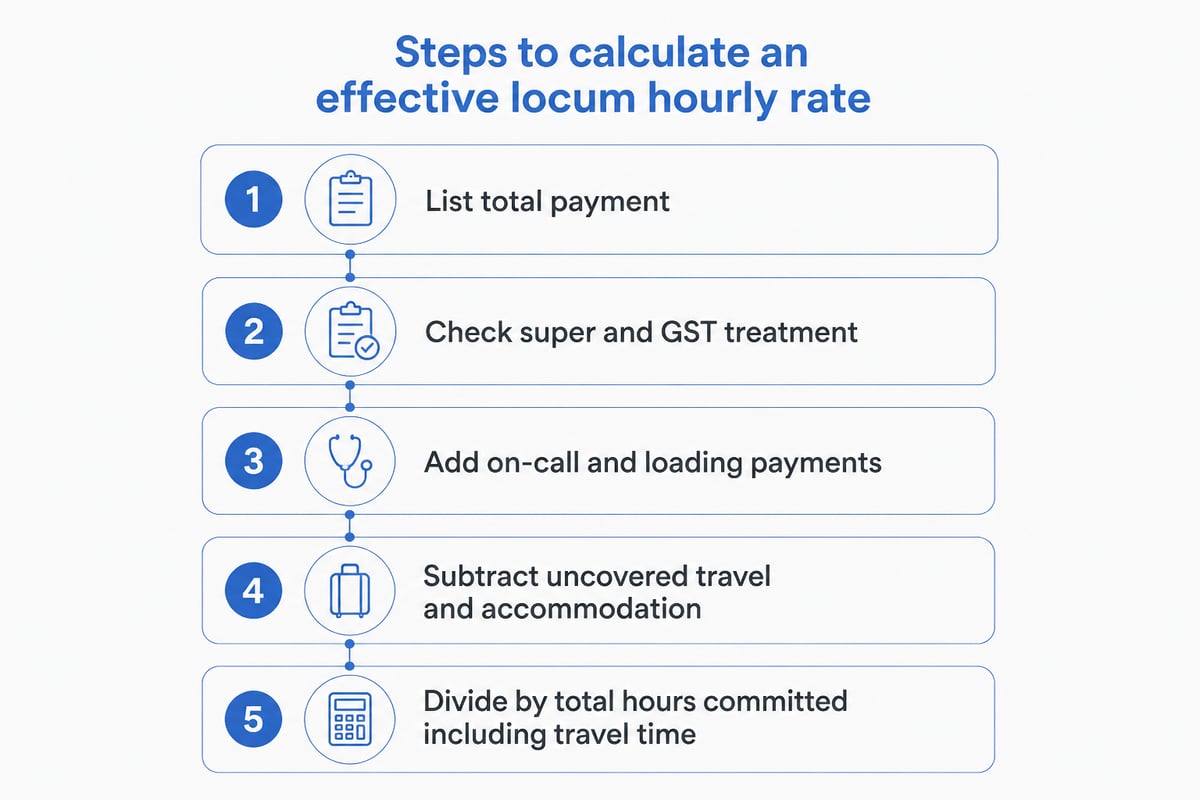
The same hourly figure can sit on top of very different packages. Convert each offer to an effective hourly rate, meaning total payment divided by total hours worked including on-call and travel time, and compare those numbers rather than the headline.

Converting an offer into your real hourly rate
The cleanest way to compare offers is to calculate your effective rate for a whole engagement, not a single shift. Add up everything you will be paid, subtract costs you will carry yourself, and divide by every hour you will actually commit.
Hypothetical example: two offers can carry the same headline rate but differ once super, travel and on-call are counted, so run the numbers in your own contract rather than trust the headline.
Include travel time when it takes you out of your normal week. A four-hour drive each way to a regional hospital is eight unpaid hours if the contract does not recognise it.
Factors that push your rate up or down
Beyond specialty and state, a handful of practical factors move the number you can ask for, and most of them are within your control.
Urgency is the biggest. Urgency can affect the rate a facility is willing to pay. Length of commitment cuts the other way: a longer block can justify a slightly lower hourly rate in exchange for certainty, and some doctors prefer it for that reason.
Location and conditions matter too. Regional and remote placements may pay more or add inclusions. Your credentialling status counts: a doctor who is fully credentialled, with registration, indemnity and referee checks in order, can be placed faster, and speed is something facilities pay for. Flexibility on dates and sites gives you more offers to choose between, which is itself negotiating leverage.
Seniority and subspecialty interest also play a part. A consultant with a scarce skill set may be able to ask for more than one covering a standard roster.
Using an agency to find and negotiate rates
An agency can show you what comparable shifts are paying, and handle credentialling, shift confirmation and logistics so that you spend your time working rather than chasing paperwork. The value is greatest when you want a spread of shifts across several facilities or states and don't want to negotiate each one cold.
For short-notice and ad hoc cover across emergency medicine, anaesthetics, ICU, obstetrics and gynaecology, paediatrics, psychiatry and surgery, Best Practice Medical's short-term locum placements match doctors to facilities on specialty, credentialling status and availability, with consultants available around the clock for urgent needs. The company is doctor-owned and operated, led by a practising doctor with over 30 years in medical recruitment, and is accredited to ISO 9001:2015 Quality Management.
When you speak to any agency, ask the same questions you would ask a facility directly: what the rate includes, how on-call is treated, who covers travel and accommodation, and what happens if a shift is cancelled. If you are weighing up whether locum life suits you at all, this overview of three things you need before you start covers the groundwork.
Questions worth asking before you accept a shift
Before you say yes, get the full terms in writing and check them against your own numbers. A short list of questions covers most of the risk.
Ask for the rate in writing, stating whether it is inclusive or exclusive of super and GST. Ask how many hours are guaranteed and what the cancellation terms are. Ask how on-call is paid, and whether afterhours callbacks are paid at the base rate or a loaded rate. Ask who arranges and pays for travel and accommodation, and whether that is reimbursed or booked for you. Confirm your credentialling requirements and timeline so that the shift doesn't fall through for an administrative reason. And ask how quickly you will be paid and by whom, because payment timing affects cash flow for doctors working as sole traders.
If an offer is vague on any of these points, treat the vagueness as information. A clear contract is usually a sign of a facility or agency that runs placements properly.
Start by listing your specialty, your preferred states and the dates you are available, then work out the effective hourly rate you would accept once super, on-call and travel are accounted for. With that in hand, you can compare offers on the same basis instead of reacting to a headline number. If you would like help finding shifts that fit those terms, with credentialling, shift confirmation, travel and accommodation handled, Best Practice Medical is the place to make contact, so get in touch and tell them what you are looking for.