

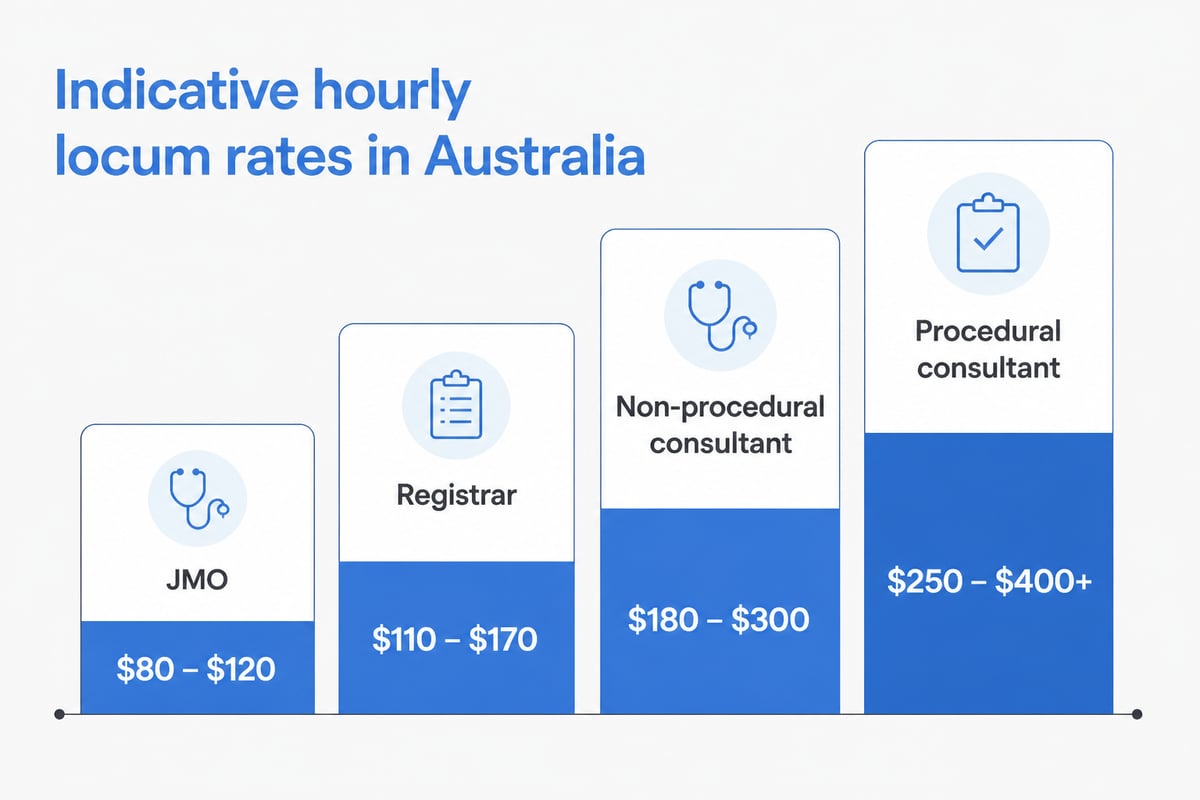
Locum tenens physician hourly rates in Australia run from roughly $80 to $120 an hour for a junior medical officer to $200 to $400 or more for a consultant in a procedural specialty, with rural and after-hours work pushing the figure higher. Those ranges are indicative only. The rate you are actually offered depends on your registration level, your specialty, where the facility is and how urgently they need someone.
In Australia, "locum tenens" is usually shortened to locum, and the work is paid in different ways depending on the setting. Some facilities quote an hourly rate, others a daily or per-shift rate, and some pay a sessional rate for a half day. Converting everything to an hourly figure is the cleanest way to compare offers, so that is the approach here.
What locum doctors typically earn per hour
Typical hourly rates for locum doctors in Australia sit in bands tied to career stage, and the gaps between those bands are wide. Rates are indicative only and move with demand. Treat them as a starting point for a conversation, not a quote.
| Career stage | Indicative hourly range (AUD) | Common arrangement |
|---|---|---|
| JMO (intern to RMO/HMO) | Indicative range only | Hourly or per shift, often with overtime loadings |
| Registrar (non-college or training) | Indicative range only | Hourly or daily rate |
| Consultant specialist (non-procedural) | Indicative range only | Sessional or hourly |
| Consultant specialist (procedural, anaesthetics, ICU) | Indicative range only | Daily or sessional, often with on-call component |
Two cautions on that table. First, a daily rate looks large until you divide it by the hours actually worked, including handover and ward time. Second, these are gross figures. Whether the number is before or after super, and whether it is paid to you as a contractor or through an agency payroll arrangement, changes what you take home.
How career stage and specialty shift the rate
Career stage sets the base rate, and specialty then moves it up or down depending on how hard the role is to fill. A resident medical officer in a metropolitan emergency department competes with a large pool of other junior doctors. A registrar with advanced life support skills and a few years in anaesthetics or emergency medicine is much harder to replace on a Friday night.
Specialties that tend to command higher locum rates include:
- Anaesthetics, where the pool of available locums is small relative to theatre demand.
- Intensive care, particularly outside major city hospitals.
- Obstetrics and gynaecology, where after-hours cover and emergency caesarean capability matter.
- Psychiatry, especially in regional services with persistent vacancies.
- Emergency medicine, where short-notice gaps are common and facilities pay to fill them.
- Paediatrics and surgical specialties, which vary widely with the facility and the on-call burden.
I won't put a precise number on each, because published figures for individual specialties are patchy and tend to go stale. What holds up is the pattern: the fewer doctors who can safely do the job, the higher the rate.
Location, shift type and urgency
Where the shift is and when it falls often matters as much as who you are. Rural and remote facilities generally pay more for the same work because they struggle to attract doctors, and many add travel and accommodation on top of the hourly rate. A town hospital three hours from the nearest city will usually offer more per hour than a metropolitan site, though the gap varies by state and by how long the vacancy has been open.
Shift type adds another layer:
Night shifts, weekends and public holidays commonly attract loadings, either built into a higher base rate or paid as a percentage on top. On-call arrangements are paid differently again, sometimes as a flat availability allowance plus an hourly rate for time actually called in. Short-notice cover, where a facility needs someone within 24 to 48 hours, can attract a premium because the alternative for the facility is a closed bed or a cancelled list.
Duration cuts both ways. A single shift may carry a higher hourly rate than a month-long block, because the facility is paying for flexibility. A longer block, on the other hand, gives you certainty and sometimes a better package once accommodation and travel are counted.
Public hospital versus private provider rates
Public and private facilities tend to pay differently, and the difference is partly structural. State health services often work to set bands or panel arrangements for agency locums, while private operators negotiate more case by case. Best Practice Medical is an approved supplier for several state health services and supplies major private providers, so the same doctor can be placed across both sectors.
For you, the practical point is that two offers at the same nominal hourly rate can differ in value. A public health service may cover credentialling costs and process payment on a predictable cycle. A private hospital may offer a higher rate but expect you to be available for a less predictable roster. Ask what is included before you compare.
Reading an offer: what the hourly figure leaves out
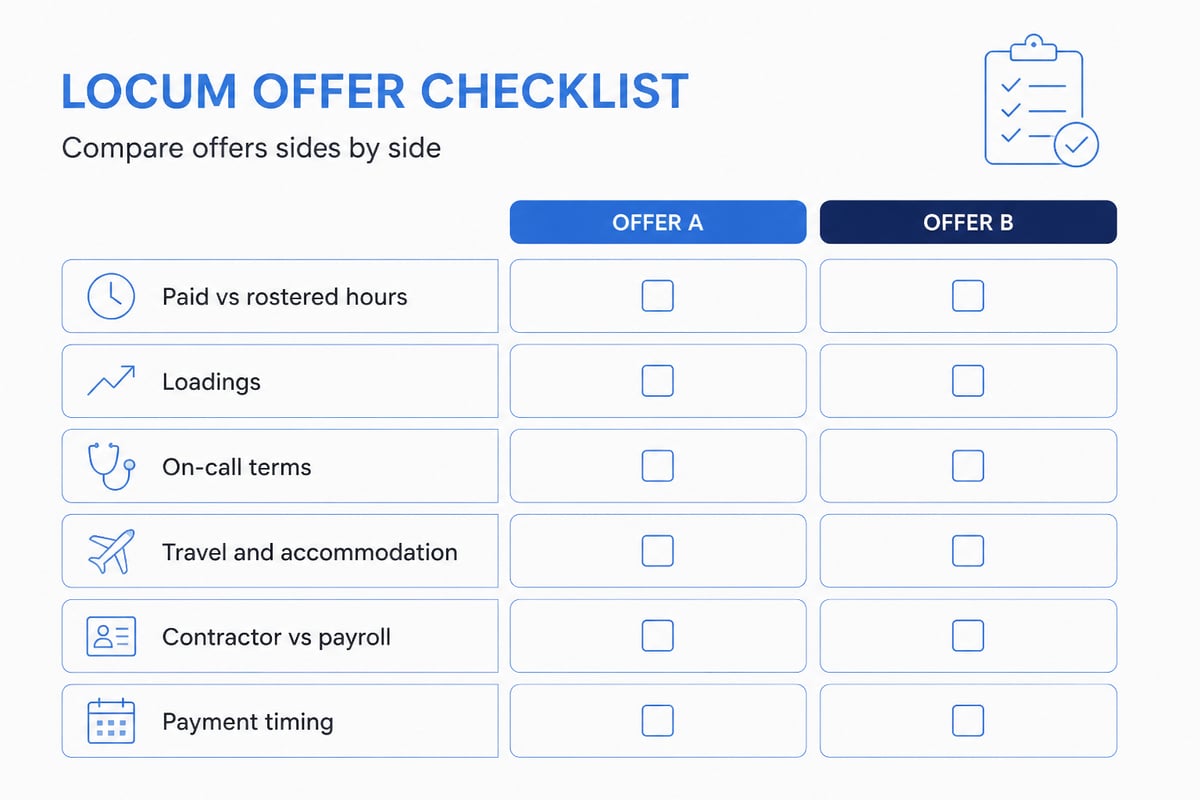
An hourly rate on its own does not tell you what you will earn, so check the rest of the offer before you accept. Work through these items for each shift or block:
- Paid hours versus rostered hours. Confirm whether handover, ward rounds and documentation are paid or absorbed into the shift.
- Loadings. Find out how nights, weekends and public holidays are paid and whether the quoted rate is already loaded.
- On-call terms. Ask whether there is an availability allowance, and what the call-out rate is.
- Travel and accommodation. Check who books and pays, and whether it is reimbursed or arranged for you.
- Super and tax treatment. Establish whether you are engaged as a contractor or through payroll, because the gross rate means different things in each case.
- Payment timing. Facilities and agencies differ on how quickly invoices are paid.
Contractors also carry costs that an employee does not: indemnity cover, registration and college fees, and the gaps between bookings. A $200 hourly rate with unpaid downtime between placements can end up below a lower rate that keeps you working consistently. Working out your annualised figure, not just the per-hour number, is the more honest comparison.
Registration, credentialling and why they affect your rate
Your registration status and credentialling determine which rate band you can be offered, and delays here cost you shifts. A doctor with full AHPRA registration and current credentialling at a facility can usually start quickly. A doctor whose paperwork is incomplete may miss the short-notice work that pays best.
Facilities will check registration, indemnity, immunisation status, working with children and police checks, and references, and public health services add their own onboarding requirements. International medical graduates may face additional steps depending on their registration pathway and any conditions attached. Getting credentialled for several facilities in advance means you can say yes when a high-rate, short-notice shift appears, rather than watching it go to someone who is already cleared.
If you are weighing locum work against other options, tools built for other parts of the profession can help you think about workload. For doctors who also manage practice paperwork and patient communication, CuraMe Pro is a platform that streamlines non-urgent requests and documents for general practice doctors.

Negotiating your locum rate
You can negotiate a locum rate, and the strongest position comes from knowing what the shift is worth to the facility. Most facilities have a range in mind and an offer will often come in below the top of it.
A few approaches hold up in practice. Be clear about what you bring that is hard to replace: a procedural skill, a specialty qualification, availability across a holiday period or willingness to go to a remote site. Be flexible on dates where you can, because a facility with a vacancy next week will pay more than one planning for next quarter. Ask for the whole package rather than only the hourly rate, since accommodation, travel and a guaranteed minimum number of hours can be worth more than an extra $10 an hour.
A recruiter who knows the facility can tell you what has been paid for similar shifts. That inside knowledge is one of the more practical reasons doctors use an agency rather than approaching hospitals directly.
Finding short-notice and ad hoc shifts
Short-notice shifts are where flexibility earns its premium, and they are available across hospital specialties. Best Practice Medical's Short-Term Medical Locum Placements cover ad hoc and short-notice shifts in Emergency Medicine, Anaesthetics, ICU, O&G, Paediatrics, Psychiatry and Surgical, matching doctors to facilities by specialty, credentialling status and availability. Consultants are available 24/7, 365 days a year for urgent shift needs, and placements are covered end to end, including shift confirmation, travel and accommodation. Specific rates for a given placement are best discussed with a consultant, since they depend on the facility and the shift.
Keeping your income steady between placements
Locum income can swing, so planning for the quiet weeks matters as much as chasing the highest rate. Many locums build a base of regular facilities they return to and fill gaps with short-notice work. Others block out annual leave and study time in advance and treat the rest of the calendar as bookable.
Setting aside money for tax, super (if you are not receiving it), indemnity and registration is part of the job when you are a contractor. It is also worth tracking your effective hourly rate across a quarter, including unpaid travel days and downtime, so you know whether a placement is paying what it appears to. Fitness and routine also affect how well you manage back-to-back shifts and travel, and some programs offer custom fitness and mindset coaching for busy professionals who want structure around demanding rosters.
Questions doctors ask about locum pay
Is a daily rate better than an hourly rate?
Not automatically. A daily rate suits long, variable days because you are not penalised when a shift runs over, but divide it by the hours you will actually work before comparing it with an hourly offer.
Do rural locums really earn more?
Usually, yes, and the hourly rate is often only part of it. Accommodation, flights and vehicle hire may be covered, which raises the value of the placement beyond the headline figure.
Are locum rates pre-tax?
Quoted rates are generally gross. Your tax position depends on whether you are engaged as a contractor or paid through payroll, so confirm that with your accountant before you accept a placement.
Can a JMO do locum work?
Yes, subject to your registration, supervision requirements and the facility's credentialling. Rates for JMOs sit at the lower end of the scale, but short-notice and after-hours shifts can attract loadings.
Your next step is to list your registration details, indemnity and the facilities you could be credentialled for, so you can say yes quickly when a well-paid shift appears. If you want a consultant to talk through current opportunities and what your specialty is likely to be offered, Best Practice Medical is doctor-owned, led by a practising doctor with over 30 years in medical recruitment, and Contact Us is the place to start that conversation about your next locum placement.