

A medical locum agency finds and credentials doctors to fill temporary gaps in hospitals and clinics, and it finds paid shifts for doctors who want flexible work. The agency handles the matching, paperwork and logistics so a facility gets a qualified doctor on the roster and the doctor gets a confirmed shift without chasing it. This guide covers how that works in Australia, what you need before your first placement, and how to judge an agency whether you are filling shifts or taking them.
What a medical locum agency actually does
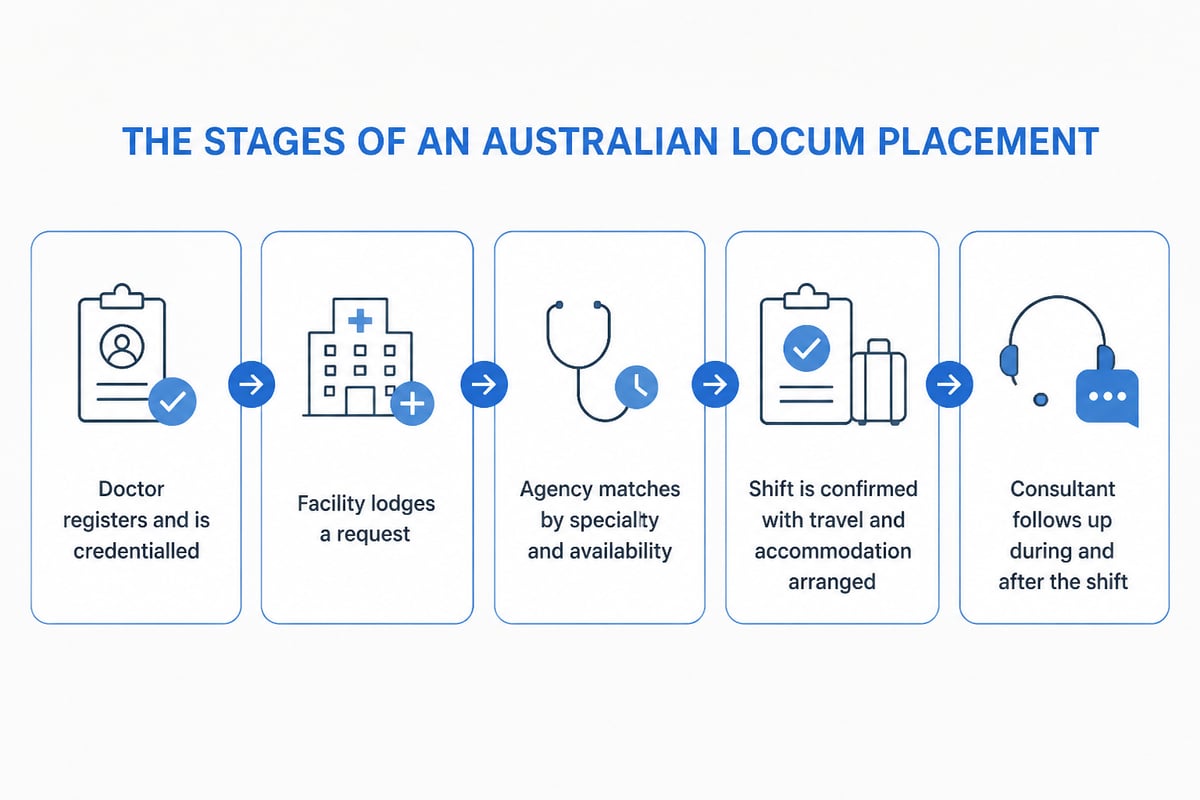
A medical locum agency sits between two parties with opposite problems: facilities with a roster gap and doctors with open calendars. It verifies the doctor, understands the facility's need, and makes the match.
For doctors, the work usually includes:
- Checking registration, qualifications and references before you are put forward
- Matching you to shifts by specialty, seniority, location and availability
- Confirming shift details, and arranging travel and accommodation where the placement is away from home
- Staying in contact during and after the placement
For facilities, it covers sourcing candidates who are already credentialled, so a manager is not reading résumés at 4pm for a night shift. A good agency also knows what each setting needs. A regional emergency department that needs a registrar who can work with limited backup is a different request from a metropolitan private hospital short one anaesthetist for a fortnight.
The main thing to understand is that the agency is paid by the facility. A reputable agency does not charge doctors to be registered or placed, so if one asks you for money upfront, ask why.
Who uses locum agencies in Australia
Locum agencies serve a wider range of doctors than the word "locum" suggests. JMOs and registrars use them to pick up extra shifts around rotations or to try different hospitals. Specialists use them to build a flexible portfolio alongside a public appointment or private rooms. Some doctors use locum work to travel, cover family commitments, or step back from a fixed roster without leaving medicine.
On the facility side, the buyers are hospital medical workforce units, clinic owners and practice managers covering leave, vacancies, seasonal peaks and unplanned absences. The pressure behind that demand is well documented. Best Practice Medical has written about why Australia's medical workforce is under increasing pressure and why regional healthcare relies on locum doctors, and the short version is that rural and regional sites often rely heavily on locum cover to keep rosters running.
What you need before your first locum placement
You need current registration, evidence of your qualifications and experience, and the right provider number arrangements for where you will work. Agencies can guide you through most of this, but you should know the outline before you apply.
Registration and credentialling
You need current registration with the Medical Board of Australia through AHPRA, with no conditions that would stop you doing the work on offer. Beyond that, expect to supply identity documents, proof of qualifications, a current CV, referee details, immunisation records and indemnity cover details. Facilities set their own credentialling requirements, so a doctor who is cleared for one hospital may still need extra steps for another. Doing the paperwork once, properly, with an agency that keeps it current is what makes short-notice shifts possible later.
Medicare provider numbers
Provider numbers trip up more first-time locums than anything else. Under the Medicare Benefits Schedule, a locum who will work at a practice for more than two weeks, or for less than two weeks on a regular basis, should apply for a provider number for that location. For a one-off placement of less than two weeks, the locum should contact Services Australia to discuss provider-number options. Hospital-employed doctors working in public hospital settings are generally in a different position from doctors billing in community practice, so check your own situation with Services Australia before you accept a block of work.
Indemnity and tax
Confirm that your indemnity cover applies to locum work and to the states and settings you intend to work in. Most locums work as contractors, which means managing your own ABN, tax, super and GST position. A short conversation with an accountant who works with doctors is cheap insurance.
For more on whether you qualify, see Best Practice Medical's piece on whether you are eligible to become a locum doctor.
How to choose a medical locum agency
Choose on verifiable credentials, how quickly a human answers the phone, and how much of the logistics the agency takes off you. Marketing language is the least useful signal.
Questions worth asking any agency:
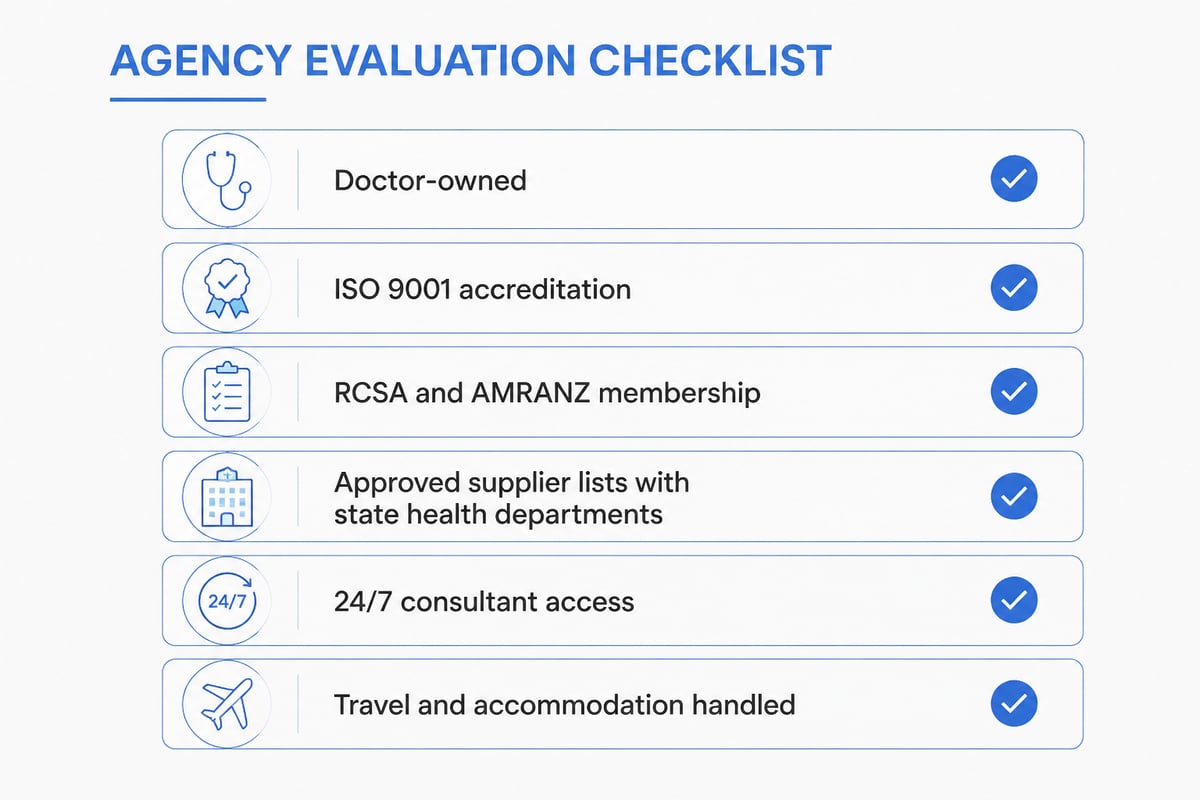
Who owns it, and who answers? A doctor-owned agency understands rostering, credentialling and what a bad handover costs. Ask who your consultant will be and whether they will still be your consultant next month.
What accreditations and memberships does it hold? Look for ISO 9001 quality management accreditation and membership of industry bodies such as the Recruiting, Consulting and Staffing Association (RCSA) and the Association of Medical Recruiters Australia and New Zealand (AMRANZ). These are checkable, which is the point.
Which health services does it supply? Approved-supplier status with state health departments means the agency has already passed procurement and compliance checks that hospitals care about. Ask for the list.
What happens at 2am? Emergency and anaesthetic rosters do not fail during business hours. Find out whether you can reach a consultant overnight and on public holidays.
Who arranges travel and accommodation? For regional placements this is half the job. An agency that confirms the shift but leaves you to sort flights and a room has done half the work.
Is there a conflict between what you want and what it sells? An agency should be able to say no to a shift that does not fit your skills or a facility request that cannot be safely filled.
What a good agency looks like for facilities
For managers, a good agency saves time on the first call and reduces risk on the first day. You want a doctor who arrives credentialled, oriented and matched to the work, and a consultant who tells you early when a shift is at risk rather than the night before.
Practical things to check as a buyer:
- Whether the agency pre-screens for registration, qualifications, references and right to work, and can show you what it checked
- How it handles last-minute cancellations, because they will happen
- Whether you get regular updates from one named consultant instead of a rotating inbox
- Whether it is an approved supplier for your state health service or your hospital group
- How it manages cost transparency, including what is in the rate and what is extra
Plan ahead where you can. Facilities that share the rotation, leave dates and likely gaps early get better matches than those that send a request the day before. Regional sites in particular benefit from lead time, and Best Practice Medical's notes on medical staffing in regional areas cover how to prepare.

Short-notice and short-term cover
Short-notice cover is where agencies earn their fee, and it is the reason many facilities keep more than one relationship active. Sudden sick leave, a resignation mid-term or a surge in presentations can leave a department a doctor short within hours.
Best Practice Medical's short-term medical locum placements cover ad hoc and short-notice shifts across emergency medicine, anaesthetics, ICU, obstetrics and gynaecology, paediatrics, psychiatry and surgical specialties. The match is made on specialty, credentialling status and availability, and placements can be a single shift or a block of weeks. Consultants are available 24/7, 365 days a year for urgent shift needs.
Rates, contracts and the questions to settle early
Rates vary by specialty, location, shift type and how urgent the request is, so treat any figure you read online as a starting point and not a quote. Rural and remote work, nights, weekends and hard-to-fill specialties typically pay more than metropolitan weekday work. What matters is that you know the rate, the payment terms and the cancellation conditions before you accept.
Settle these in writing before the shift:
- The rate, how it is calculated and whether it includes on-call or call-back
- Payment terms and who pays you, the agency or the facility
- Travel, accommodation and meal arrangements, and who books them
- Cancellation terms from both sides
- Orientation, access to systems and who your point of contact is on the day
Doctors new to contracting should also check whether a contract positions them as a contractor or an employee, because payroll tax rules affect how some facilities structure engagements. Best Practice Medical has a summary of what clinics need to know about recent payroll tax changes that is useful background even if you are on the doctor side.
Making locum work sustainable
The doctors who last in locum work treat it as a system, not a string of favours. They keep their documents current, say yes to settings where they are well matched, and say no to ones that are not.
A few habits help:
- Keep a digital folder with registration, indemnity, immunisation, identity and CV documents so you can send them in minutes
- Block out unavailable dates early, so your consultant offers you work that fits
- Give honest feedback after a placement, both ways, so matches improve
- Build in rest. Back-to-back regional blocks with long travel wear people down quickly
If you are weighing it up, Best Practice Medical's pieces on the benefits of going locum and three things to have in place before you start are a practical starting point.
How Best Practice Medical approaches placements
Best Practice Medical is a doctor-owned and operated agency led by a practising doctor with over 30 years in medical recruitment. Every locum is credentialled to the highest standards before placement, and doctors and facilities receive regular updates from a dedicated consultant. Placements are covered end to end, including shift confirmation, travel and accommodation.
On the quality side, the agency holds ISO 9001:2015 Quality Management accreditation and is a member of the RCSA and AMRANZ. It is an approved supplier for NSW Health, Tasmanian Health, WA Country Health Service, NT Health, Vic Health, QLD Health and ACT Health, and it supplies major private providers including Ramsay Health Care, Healthscope and St Vincent's Health. It has also served one facility partner continuously for over 15 years, which says something about how it handles the unglamorous work of keeping rosters filled.
Start by gathering your registration, indemnity and identity documents into one folder, or if you are a manager, write down the next three roster gaps you expect over the coming quarter. With that in hand, you can get in touch with Best Practice Medical to talk through available shifts or cover for your facility with a consultant who can answer day or night.