

A Medrecruit locum is a short-term doctor placement arranged through Medrecruit, an agency that lists locum jobs across Australia and New Zealand, and the main thing to know before you register is that the agency matters less than whether you are correctly registered, insured and credentialled for the shifts you take. This guide covers how locum work is structured in Australia, what you need in place before your first shift, how pay and travel usually work, and how to compare agencies on points that affect you day to day.
It is written for JMOs, registrars and specialists weighing up flexible work, not for doctors looking for a permanent full-time post.
What a Medrecruit locum placement involves
A locum placement means you cover a gap in a roster for a defined period, from a single shift to several weeks, at a hospital or clinic that cannot fill it with its own staff. Medrecruit advertises locum jobs, and the pattern is the same as with any agency: a facility lists a need, the agency finds a doctor who fits, and the facility confirms the booking.
What changes between placements is the setting. A metropolitan tertiary hospital might need an emergency registrar for a fortnight of night shifts. A regional hospital might need a specialist anaesthetist for a block of theatre lists. A rural facility may need a doctor who can cover emergency, inpatient and outpatient work in the same week.
Before you commit, work out which of these you are actually after:
- Short single shifts to fit around a rotation or fellowship
- Fixed blocks of one to several weeks in a single location
- Repeat bookings at the same facility, which build familiarity with the systems and staff
- Travel placements in regional, rural or remote areas, usually with travel and accommodation arranged
Knowing which pattern suits you narrows the field quickly, because agencies differ in how much of each they carry.
Who can work as a locum doctor in Australia
You can work as a locum in Australia if you hold current registration with the Medical Board of Australia, have the right to work in the country, and meet the credentialling requirements of the facility you are covering. Registration is the non-negotiable part. The The Medical Board of Australia requires all doctors practising medicine in Australia to be registered, and registration and renewal applications can be made online.
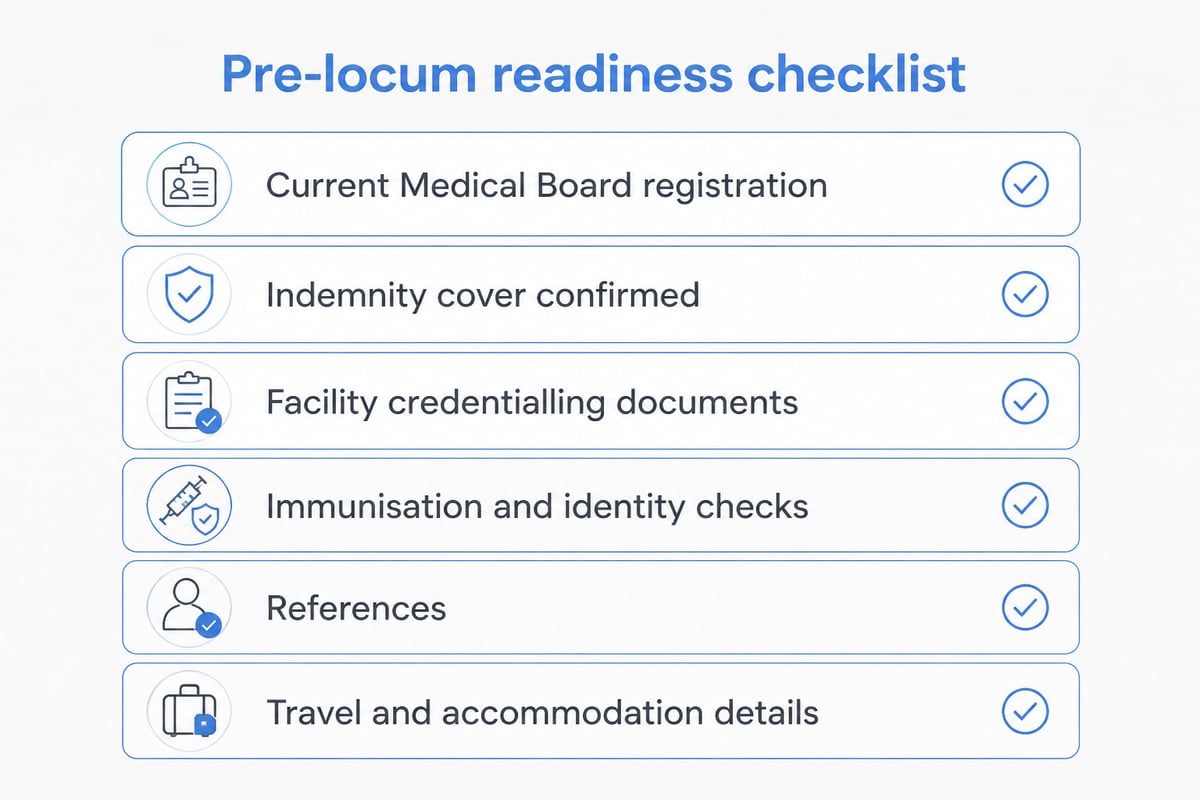
Beyond registration, facilities typically ask for evidence of your qualifications, current immunisation records, identity and working-with-vulnerable-people checks, references and proof of indemnity. The exact list varies by state and by employer. Public health services in different states have their own credentialling processes, and private hospital groups have theirs.
Your career stage shapes what is realistic. JMOs in their first years often find locum work limited by supervision and training requirements. Registrars can usually cover registrar-level shifts in their discipline, and specialists with fellowship status have the widest choice. If you are unsure where you stand, the BPMed article on whether you are eligible to become a locum doctor sets out the usual requirements.
Indemnity cover for locum work
Indemnity cover for locum work depends on your career stage, your employer and the terms of your policy, so confirm it in writing before you accept a shift rather than assuming it carries over from your usual job. This is the area where doctors are most often caught out, and it is worth ten minutes on the phone with your insurer.
Two examples show how much the detail matters. MDA National says doctors with general registration after internship may receive automatic cover for unlimited private locum work and surgical assisting, subject to conditions, including doing most of their work in an employer-indemnified position or within a fellowship training program. Avant describes civil-liability cover of up to $20 million under its doctor-in-training policy, and notes that cover is subject to policy terms, conditions and exclusions.
Those are summaries from the insurers' own pages, not advice for your situation. Ask your insurer these questions directly:
- Does my current policy cover locum work in the state and setting I am considering?
- Does it cover private hospital shifts as well as public?
- Are there conditions about how much of my work must be in an employer-indemnified role?
- Does my cover change when I move from training to a fellowship or consultant role?
Public hospitals often provide their own indemnity for work done within the facility, which can change what you need personally. Ask the agency what the facility covers, then check that against your insurer's answer.
Pay, travel and accommodation
Locum rates in Australia vary by specialty, seniority, location and how urgent the need is, and a published headline rate tells you little until you know what is included. Compare offers on the full package rather than the hourly or daily figure alone.
When you are assessing an offer, work out:
- Whether the rate is quoted before or after tax and how you will be paid (as a contractor or through a payroll arrangement)
- Who books and pays for flights, car hire and accommodation
- Whether on-call and overtime are paid separately
- How quickly invoices are paid
- What happens if a facility cancels at short notice
Travel placements to regional and remote sites often look more lucrative because of the rate, but the saving or loss comes down to logistics. A placement with accommodation and travel arranged for you removes a lot of friction. One where you organise everything yourself can eat into the margin and your time off.
If you are building a locum income around a main role, the BPMed piece on how to make locuming work for you covers the practical side of fitting shifts around other commitments.
Choosing between locum agencies
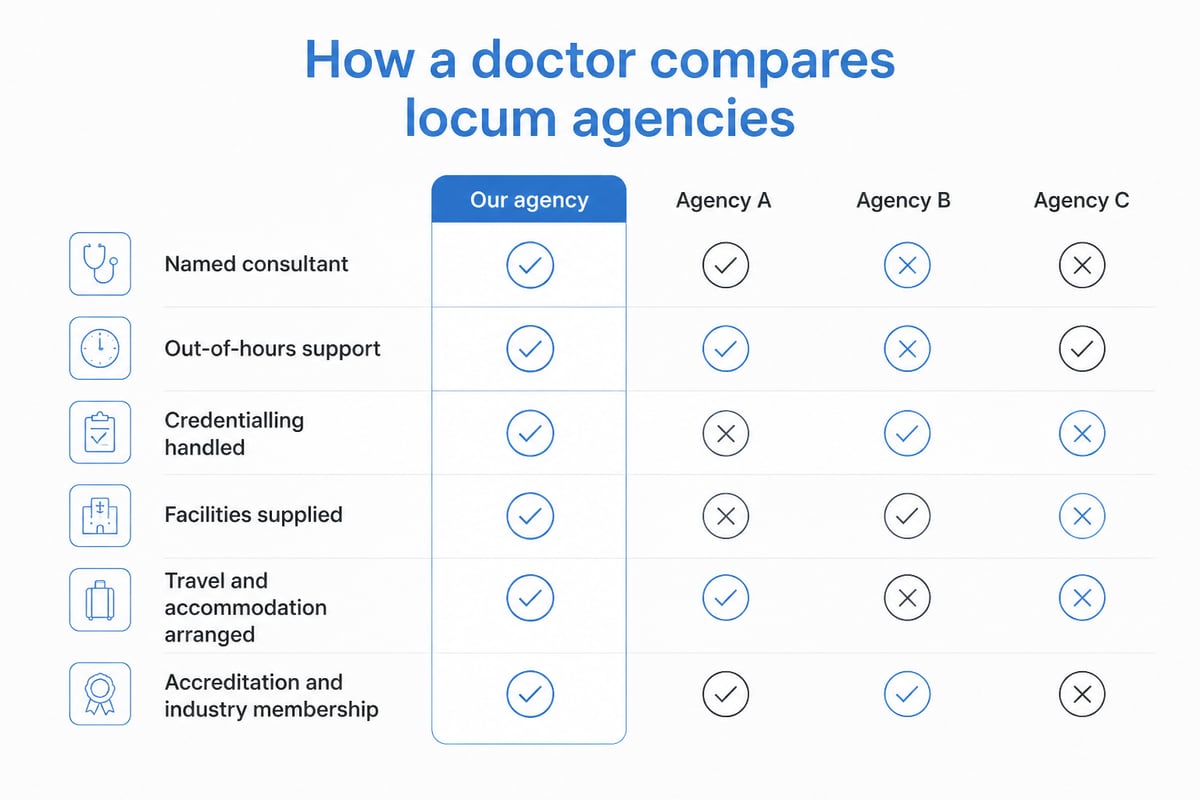
Choose an agency by what it will do for you once a shift is booked, not by how many jobs appear on its website. Job boards look similar across providers. The differences show up when a shift changes, a flight is delayed or a credentialling form is missing.
Questions worth asking any agency, Medrecruit included:
- Will I have a named consultant who knows my specialty and availability?
- Can I reach someone out of hours if a shift falls through?
- Who handles credentialling paperwork, and do you reuse my documents across placements?
- Which health services and private groups do you supply, so I know where work is likely to come from?
- Is travel and accommodation arranged and paid by you or by me?
- What quality or industry accreditations do you hold?
The last question is easier to check than most people expect. Accreditation to a quality management standard, and membership of industry bodies such as the Recruiting, Consulting and Staffing Association (RCSA) and the Association of Medical Recruiters Australia and New Zealand (AMRANZ), are publicly verifiable and say something about how an agency is run.
Registering with more than one agency is common and sensible, since different agencies hold different facility relationships. Keep a single folder of your registration, indemnity certificate, immunisations and references so that each new registration takes minutes rather than days.
Medrecruit locum jobs by state
A Medrecruit locum search usually starts with location, because state health systems differ in how they credential, pay and roster locums. Treat the state as your first filter and the specialty as your second.
Locum work is available across the states and territories, including metropolitan, outer-metro and regional sites. Regional and remote placements usually make travel a bigger part of the package, and smaller systems tend to see more repeat bookings with the same facility.
Credentialling is often state-based. A doctor who has been credentialled for one state's health service may still need to complete a separate process for another. Ask any agency whether it can carry across documents you have already supplied, and whether it holds approved-supplier status with the health service you want to work for.
Demand can also shift with the season, and many doctors find that flexible calendars let them choose between busier periods and quieter ones.

Specialties that use locums most
Locum demand is often strongest in hospital specialties where rosters are hardest to cover with permanent staff, such as emergency medicine, anaesthetics, intensive care, obstetrics and gynaecology, paediatrics, psychiatry and surgery. These are the areas where a single vacancy can close a service or push remaining staff past safe hours.
For doctors, this means the specialty you hold is a real asset. A specialist anaesthetist or an O&G registrar with current skills can often choose between metropolitan and regional options and negotiate on conditions. For JMOs and earlier-stage registrars, emergency and general inpatient cover tend to be more available than narrow subspecialty work.
If you are weighing specialties, the BPMed specialties page shows the areas it staffs. For a wider look at why hospitals fill gaps this way, why facilities turn to locum recruitment explains the facility side of the arrangement.
Short-notice shifts and how agencies handle them
Short-notice work is where agencies earn or lose your trust, because a facility needing cover tomorrow morning wants a doctor who is already credentialled and available. If your paperwork is current and you tell your consultant when you are free, you are the doctor they can call.
For ad hoc and short-notice shifts across hospital specialties, Short-Term Medical Locum Placements from Best Practice Medical match doctors to facilities on specialty and availability, and consultants are available 24/7, 365 days a year for urgent shift needs.
To be useful at short notice, keep these in order:
- Registration current and renewal dates diarised
- Indemnity confirmed for the setting
- Credentialling documents saved in one place and in date
- A clear message to your consultant about availability, including travel limits
Doctors who prepare this way tend to get more offers, since the agency can place them without chasing paperwork.
Making locum work sustainable
Sustainable locum work depends on planning breaks and boundaries as deliberately as you plan shifts. Back-to-back placements, long drives between sites and unfamiliar systems add fatigue that is easy to underestimate when the rate is attractive.
Practical habits that help:
- Build rest days around travel, not after it
- Set a minimum notice period for accepting shifts
- Keep a short list of facilities you are happy to return to
- Track income and expenses from your first shift if you work as a contractor, and speak to an accountant about tax and super
Working hours are a real consideration for earlier-career doctors in particular.
Technology can also take some of the admin out of a locum life. Rosters, mileage, document storage and invoicing can all be handled by apps, and BPMed's five apps for locum life is a practical starting list. For downtime between placements, a media setup you can take with you helps: for a streaming option on the road, Promax TV Player offers an IPTV player with live channels and on-demand content. And if you digitise old family videotapes in your time off, VCR Supply rents and repairs professional tape decks for that purpose.
Questions doctors ask before signing up
Is a Medrecruit locum role right for a JMO? It can be, depending on your year level, your hospital's policies and the supervision available at the facility. Check what your employer permits and what your indemnity covers before accepting outside shifts.
Do I need to register with the Medical Board for each state? Registration with the Medical Board of Australia is national, but individual health services run their own credentialling, so expect separate paperwork for each.
Can I take locum work alongside a training post? Often yes, subject to your college and employer rules and your indemnity terms. Ask your training supervisor and your insurer first.
How fast can I start? It depends mostly on how complete your documents are and how quickly the facility credentials you. Having everything ready in advance is the biggest factor you control.
What should I do if a shift is cancelled? Ask the agency what notice and compensation applies before you accept, and get it in writing.
Start by gathering your registration, indemnity certificate, immunisation records and references into one folder, then confirm in writing with your insurer that your cover extends to the locum work you have in mind. Once that is done, you can compare agencies on the questions above rather than on job listings alone. Best Practice Medical is doctor-owned and operated, led by a practising doctor with over 30 years in medical recruitment, and its consultants are available 24/7 for urgent shift needs, so if you want to talk through placements that suit your specialty and availability, contact the team at Best Practice Medical and ask what is available now.