

The term staff hospital doesn't refer to a category of hospital in Australia. It describes a workforce model where medical officers are employed directly by the facility rather than operating as independent practitioners with admitting rights. Understanding how this model functions matters for anyone managing rosters, procuring locum cover, or making decisions about medical workforce deployment. The staff hospital structure shapes everything from how shifts are filled to what happens when someone calls in sick at 0600.
What defines a staff hospital workforce model
A staff hospital employs its doctors as salaried employees or contractors under direct facility control. The hospital determines the roster, assigns shifts, and manages clinical deployment across departments. Doctors work under employment contracts rather than visiting medical officer (VMO) arrangements where they retain independent billing rights and practice autonomy.
Most public hospitals in Australia operate predominantly on a staff model for junior medical officers, registrars, and career medical officers. Emergency departments, intensive care units, anaesthetics, and obstetrics typically run staff rosters because continuity and immediate availability matter more than individual practitioner billing arrangements. Private hospitals run a hybrid approach, particularly in surgical and procedural specialties, where VMOs admit their own patients but staff anaesthetists and intensivists cover the hospital's operational requirements.
Employment vs VMO arrangements
The distinction affects credentialling, rostering, and locum procurement. Staff doctors are credentialled as employees by the hospital, with payroll taxes, superannuation, and indemnity covered under enterprise agreements or individual contracts. VMOs credential themselves, hold their own indemnity, and invoice the facility for sessions worked or procedures performed.
When a staff hospital needs additional cover due to leave, vacancy, or demand surge, the procurement pathway is different from a VMO-model facility. The hospital books a locum doctor as a temporary employee or contractor to fill a defined roster gap. The locum works the same shifts, uses the same systems, and reports through the same clinical governance structures as the permanent staff member they're replacing. Before any doctor is placed, credentialling and compliance verification confirms AHPRA registration, indemnity insurance, and facility-specific requirements, ensuring the temporary placement meets the same standards as permanent appointments.

Rostering challenges in a staff hospital environment
Staff hospital rosters are built around fixed shift patterns, after-hours coverage, and minimum safe staffing levels. A typical metropolitan emergency department might roster three or four senior medical officers per shift across 24 hours, with registrar and JMO coverage layered underneath. Anaesthetics rosters cover theatres, obstetrics, ICU, and retrieval services simultaneously, often requiring six to eight doctors on site during daytime hours and two to three overnight.
When a gap appears in the roster, whether from unplanned leave, resignation, or extended sick leave, the facility has limited options. Internal overtime becomes expensive quickly and risks fatigue-related incidents. Cancelling elective procedures or reducing service capacity affects hospital revenue and community access. Leaving gaps unfilled breaches safe staffing policies and creates clinical risk.
The procurement window for temporary cover
Most staff hospitals maintain a preferred supplier panel for locum procurement, allowing them to access pre-approved agencies without running a new tender each time a gap appears. In Australia, state health departments maintain their own panels. NSW, Queensland, Victoria, ACT, Western Australia, Tasmania, and the Northern Territory all operate procurement frameworks where approved locum agencies can supply doctors to public facilities within that jurisdiction.
Research from the UK Health Services Safety Investigations Body examined how temporary staff integration affects patient safety, identifying that credentialling delays and unclear onboarding processes contributed to adverse events in hospitals relying heavily on agency doctors. The findings align with what Australian facilities report: temporary staff perform as safely as permanent staff when credentialling is rigorous and onboarding is structured, but shortcuts in either process increase risk.
The American Hospital Association's 2024 workforce scan found that vacancy rates for hospital-employed physicians reached 7.3% across surveyed facilities, with anaesthesiology, emergency medicine, and psychiatry showing the highest gaps. Australian data isn't directly comparable, but metropolitan public hospitals report similar pressure points, particularly in anaesthetics and emergency medicine where shift work and after-hours requirements make recruitment difficult.
How locum integration works in practice
A locum doctor arriving at a staff hospital for a two-week block needs the same access, orientation, and support as a new permanent employee, just compressed into the first few hours. The hospital provides IT credentials, swipe card access, an orientation to the department layout, and an introduction to the local escalation pathways. The locum reviews recent clinical incidents, departmental protocols, and any site-specific procedural variations that differ from their previous workplaces.
The staff hospital model makes this integration simpler in some ways and harder in others. Simpler because the locum slots into an existing roster with defined responsibilities, handover structures, and senior cover already mapped out. Harder because the locum doesn't have established relationships with nursing staff, allied health, or the on-call specialty teams they'll need to consult overnight.
Continuity across multiple locum placements
When a staff hospital uses locum doctors repeatedly, either the same individuals returning or a rotating group covering ongoing gaps, the facility benefits from familiarity without the commitment of permanent employment. A registrar returning to the same emergency department for the third time already knows the triage process, the radiology referral system, and which consultant prefers a phone call before a formal referral.
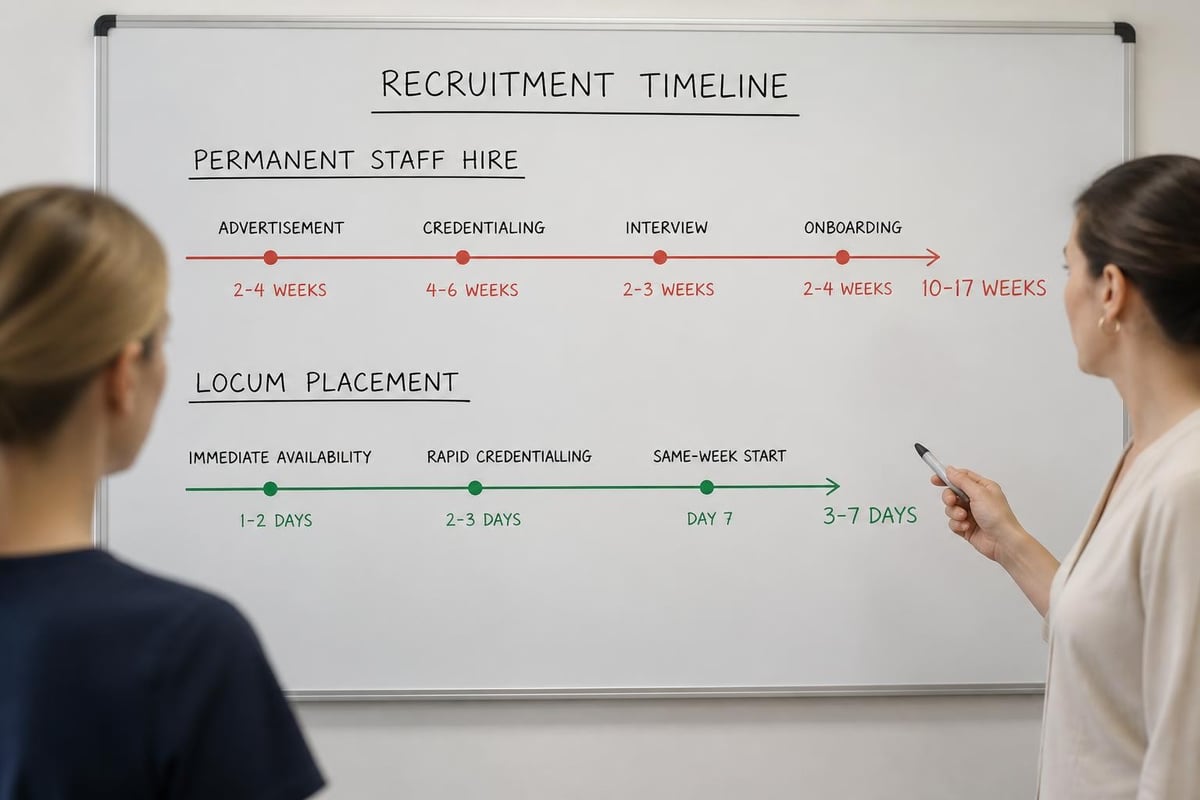
Why facilities turn to locum recruitment to fill gaps comes down to speed and flexibility. Permanent recruitment for a hospital-employed specialist can take six to twelve months from advertisement to start date, assuming a suitable candidate applies. Locum cover can be arranged in days or weeks, allowing the facility to maintain service levels while the permanent recruitment process continues in parallel.
Credentialling requirements for staff hospital locums
Every locum placement in a staff hospital goes through credentialling before the doctor's first shift. The facility verifies current AHPRA registration, specialist college membership where applicable, medical indemnity insurance adequate for the scope of practice, and immunisation status. Specific departments add their own requirements: anaesthetics departments may require proof of advanced airway management training, emergency departments may mandate APLS or EMST certification, and obstetrics units often require current fetal monitoring course completion.
The credentialling process isn't optional or abbreviated for short placements. A doctor covering a single weekend shift in a staff hospital intensive care unit completes the same verification as a doctor covering three months of parental leave. The risk to patients and the facility remains identical regardless of how long the locum will be there.
CMS guidance on hospital staffing assessment from the United States outlines regulatory expectations for hospitals to demonstrate sufficient staffing across all departments. While Australian regulations differ, the principle is the same: hospitals must document that every practitioner working in the facility holds appropriate credentials for the work they're performing. Locum doctors don't operate under a different standard.
Who manages credentialling in a staff hospital
Larger staff hospitals employ dedicated medical workforce units that handle credentialling for both permanent and temporary doctors. Smaller facilities may assign credentialling to a nurse unit manager, a senior medical officer, or an administrative coordinator who manages it alongside other duties. The variation in internal capacity affects how quickly a locum can be credentialled and cleared to start.
Some locum agencies manage credentialling on behalf of their placed doctors, maintaining up-to-date records of registration, indemnity, and specialty certifications that can be provided to facilities on request. This shifts the administrative burden away from the hospital's internal team and speeds up the placement process, particularly for repeat placements where the doctor's credentials were verified recently.
Rostering models and temporary staffing
Staff hospitals use different rostering models depending on department size, case volume, and the predictability of workload. Emergency departments often work on fixed shifts with defined start and finish times. Anaesthetics departments build rosters around theatre lists, with on-call cover layered over for after-hours emergencies. Obstetrics units roster for both scheduled procedures and unpredictable labour ward demand, requiring more doctors on site than the scheduled workload alone would suggest.
When a gap appears in any of these rosters, the solution depends on how much notice the hospital has. A planned parental leave six months away allows time for a structured locum booking, possibly the same doctor covering the entire period. An unplanned resignation with two weeks' notice forces a more reactive approach, often filling the roster one week or one month at a time until a longer-term solution appears.
Operational research on nurse scheduling examined how hospitals can optimise rosters under demand uncertainty, using supply chain modelling to balance staffing costs against service continuity. The findings apply equally to medical rosters: rigid rosters with no buffer capacity become fragile when unexpected absences occur, while rosters built with deliberate flex capacity absorb minor disruptions without requiring external cover.
Matching locum doctors to staff hospital requirements
A staff hospital emergency department looking for a registrar to cover night shifts for two weeks needs someone with Emergency Medicine training, ACEM progression or equivalent international training, and recent experience in a similar-sized department. The hospital doesn't need a consultant, doesn't need someone with procedural credentials beyond what's standard for the level, and doesn't need subspecialty expertise in toxicology or paediatric emergency medicine unless the department routinely handles those cases without calling for backup.
The matching process involves understanding both the facility's minimum requirements and the locum doctor's current practice scope. A doctor who hasn't worked in a high-acuity resuscitation area for three years may not be the right fit for a tertiary trauma centre's emergency department, even if their credentials technically meet the hospital's stated requirements. What makes a good locum doctor and how to find one involves assessing clinical capability, adaptability, and recent practice patterns, not just checking boxes on a credentialling form.
Financial and operational impacts of staff hospital locum use
Locum medical officers cost more per hour than salaried staff, but the comparison isn't straightforward. A salaried emergency physician in a NSW public hospital earns between 180,000 and 250,000 dollars annually depending on seniority, plus superannuation, leave entitlements, and professional development allowances. A locum emergency physician might charge 150 to 250 dollars per hour depending on shift timing, location, and notice period, equating to 300,000 to 500,000 dollars annually if worked full-time.
The difference matters less when the locum is filling a genuine gap rather than substituting for a position that could be filled permanently. If the hospital can't recruit a permanent emergency physician despite repeated advertising, the locum becomes the only way to maintain service capacity. If the hospital is using locums to avoid committing to a permanent headcount increase, the cost differential becomes harder to justify.
Budget allocation for temporary medical staffing
Most staff hospitals maintain a separate budget line for locum and agency medical costs, distinct from permanent salary budgets. The locum budget fluctuates based on actual usage rather than fixed annual costs, giving finance teams visibility into where temporary staffing is being used most heavily. Departments that consistently exceed their locum budget trigger workforce planning reviews: is the permanent headcount insufficient, is turnover higher than expected, or is the department's service demand growing beyond what the current establishment can cover.
AAMC workforce studies track physician supply and demand across specialties, projecting future shortages and surpluses based on population growth, retirement rates, and training pipeline capacity. Australia's medical workforce follows different patterns, but the methodology applies: hospitals need to forecast demand several years ahead and adjust permanent staffing levels accordingly, using locums as a bridge rather than a permanent solution.

Integration with permanent workforce planning
A staff hospital using locums strategically treats them as part of the broader workforce plan rather than an emergency fallback. The hospital identifies predictable gaps: parental leave, long service leave, exam leave for trainees, and annual leave during school holiday periods. Those gaps get booked months in advance with locum doctors who commit to defined blocks, giving the hospital continuity and the locum doctor certainty.
Unpredictable gaps still occur. Sudden illness, family emergencies, and unexpected resignations create holes in the roster with minimal notice. The hospital maintains relationships with locum agencies and individual locum doctors who can respond quickly, even if that means paying a premium for short-notice availability.
Regional and rural staff hospital considerations
Regional and rural staff hospitals face different workforce dynamics than metropolitan facilities. Permanent recruitment is harder, requiring relocation incentives and extended recruitment timelines. Locum use is higher as a proportion of total medical staffing, particularly in smaller facilities where one or two vacancies represent a significant percentage of the department's total headcount.
Why regional healthcare relies on locum doctors explores how rural hospitals use temporary placements to maintain services that would otherwise close due to permanent staffing gaps. A 150-bed regional hospital might run its emergency department, anaesthetics, and general medicine services almost entirely on locum cover while continuing to recruit for permanent positions that take years to fill.
Travel and accommodation logistics become more complex for regional placements. The locum doctor needs flights, rental cars, and short-term housing arranged before they agree to the booking. The hospital or the locum agency coordinates these arrangements, with costs either built into the hourly rate or billed separately depending on the contract structure.
Quality and safety considerations
Locum doctors working in a staff hospital operate under the same clinical governance, incident reporting, and quality frameworks as permanent staff. They're included in morbidity and mortality meetings for cases they were involved in, participate in clinical audits relevant to their practice, and complete mandatory training modules required by the facility.
The challenge comes from the short duration of most locum placements. A doctor working two weeks in a department won't see the outcome of many decisions they made, won't attend the follow-up meetings where complications are discussed, and won't be available for the quality improvement initiatives that arise from incident reviews. The staff hospital needs systems that capture locum contributions to patient care without relying on the individual doctor's ongoing presence.
Feedback loops and performance management
Permanent medical staff receive annual performance reviews, regular feedback from supervisors, and opportunities for professional development aligned with their career goals. Locum doctors receive less formal feedback, if any. The facility might ask the department head for a brief assessment at the end of the placement, but structured performance discussions are rare unless a significant issue arose.
This creates a gap in quality assurance. A locum doctor who performs adequately but not excellently might never receive feedback that would help them improve, and might be rebooked for future placements because they met the minimum standard. A staff hospital committed to maintaining quality across all medical staffing, permanent and temporary, needs mechanisms to provide constructive feedback even to doctors who work there for short periods.
Contract structures and employment models
Most locum doctors working in staff hospitals are engaged either as contractors invoicing for hours worked or as temporary employees on short-term contracts. Contractor arrangements give the doctor more flexibility and potentially higher hourly rates, but shift tax, superannuation, and insurance responsibilities to the individual. Temporary employment provides more structure, payroll tax compliance, and superannuation contributions, but less flexibility and typically lower take-home pay per hour.
The hospital's preference often depends on internal procurement rules and payroll system capabilities. Some state health departments require all medical locums to be engaged through approved agencies as contractors, preventing direct employment relationships. Other facilities prefer direct short-term employment to maintain consistency with how permanent staff are managed.
Hybrid arrangements exist where a locum agency employs the doctor and invoices the hospital, giving the hospital a single point of contact for booking and billing while the doctor receives payroll benefits from the agency. The hospital pays more per hour to cover the agency's margin and employment on-costs, but gains administrative simplicity and access to a broader network of available doctors.
Technology and systems access
A locum doctor arriving at a staff hospital needs immediate access to the electronic medical record, pathology and radiology ordering systems, rostering software, and internal communication platforms. IT departments require advance notice to create user accounts, assign appropriate permission levels, and ensure system access is active before the doctor's first shift.
Delays in system access create clinical risk. A doctor who can't access pathology results from the previous shift, can't see radiology reports, or can't document their own clinical notes properly cannot provide safe care. Staff hospitals with high locum usage develop streamlined IT onboarding processes, sometimes creating template accounts that can be activated and assigned to an incoming locum within hours rather than days.
The same systems need to be deactivated promptly when the locum's placement ends. A doctor who retains access to a hospital's medical records after their contract finishes creates a privacy breach and an audit risk. Automated offboarding workflows tied to contract end dates help prevent this, but require integration between HR systems, IT systems, and the locum booking process.
Staff hospital workforce models depend on balancing permanent employment with temporary placements, maintaining quality and safety across both, and ensuring every doctor, regardless of contract type, meets the same credentialling and clinical standards. Facilities that plan ahead, maintain strong relationships with locum agencies, and integrate temporary staff properly deliver better patient outcomes and spend less time in reactive crisis mode. Best Practice Medical connects hospitals with credentialled doctors across all major specialties, managing everything from initial verification through to placement logistics so clinical teams can focus on patient care rather than workforce administration.