

An aus doctor looking for locum work needs three things sorted before the first shift: current AHPRA registration, credentialling with each facility or health service, and a clear picture of travel and accommodation. Once those are in place, flexible work is available in every state and territory, from single emergency shifts in a metropolitan hospital to multi-week blocks in rural and remote sites.
This guide is for JMOs, registrars and specialists who want to choose when and where they work. It covers how the market is shaped, what paperwork holds people up, how pay and tax differ from salaried work, and how to build a locum calendar that holds together across states.
What locum work looks like for an aus doctor
Locum work for an aus doctor means filling a temporary gap in a hospital or health service roster, from a single shift to a block of several weeks, usually through an agency or directly with a health service.
The size of the pool matters. The Medical Board of Australia recorded 148,185 registered medical practitioners in 2024/25, an increase on the previous year. That growth has not spread evenly. Metropolitan hospitals fill most rosters from their own pools, while regional and rural sites lean on locums to keep emergency departments, anaesthetic lists and obstetric units running.
The work generally falls into three patterns:
- Ad hoc shifts, often at short notice, covering sick leave or unfilled rostered positions.
- Fixed blocks, typically one to twelve weeks, covering planned leave or a vacancy while a permanent recruit is found.
- Recurring arrangements, where you return to the same facility on a regular cycle.
Each pattern suits a different stage of career. A JMO between rotations might take ad hoc shifts to build experience across settings. A registrar waiting on an exam result may prefer blocks with predictable income. A specialist with a private rooms commitment often wants recurring, scheduled cover. If you are working out whether you qualify, the locum eligibility guide sets out the basics.
Registration and credentialling before your first shift
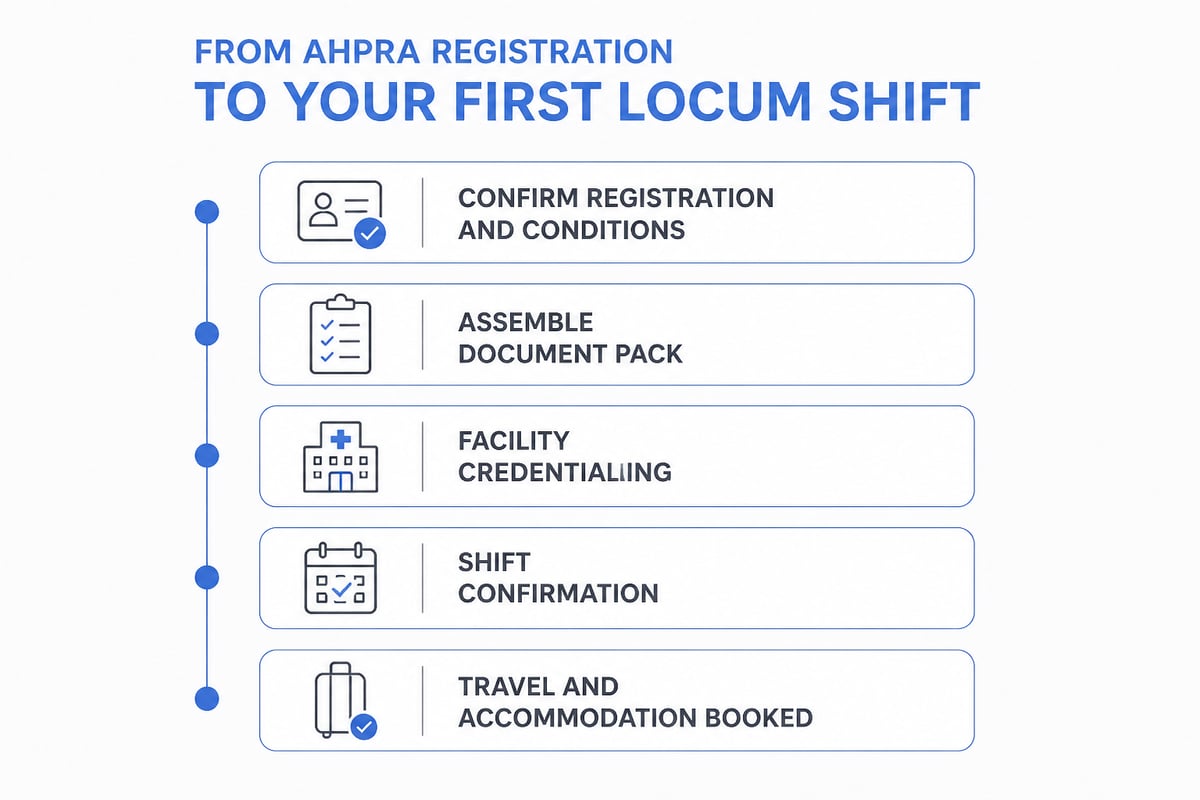
You cannot take a shift until your AHPRA registration is current and the facility has credentialled you, and the second step is usually what delays a start.
Registration is national. A doctor registered in one state can practise in any other, with no separate state registration. Credentialling is local. Each health service checks your qualifications, identity, referees, immunisation status, working-with-children and police checks, and your scope of practice against what it needs. Public systems in different states each run their own process and use their own forms.
The Medical Board's statistics page breaks down registrations by state, territory, registration type and specialty. It is worth a look if you are choosing where to focus, because it shows where the workforce is concentrated.
A practical document pack, assembled once and kept current, saves days on every new placement:
- AHPRA registration and any conditions on your registration
- Current medical indemnity certificate
- Qualification certificates and specialist college fellowship or training status
- Immunisation records, including hepatitis B serology and recent boosters
- Police check and working-with-children clearance for the relevant state
- Referee contacts who can respond within a day or two
- A current CV with dates that account for every gap
International medical graduates face an added layer. The Medical Board recorded 9,072 first-time registrants in 2024/25, a large share of them international graduates. If you are newly registered from overseas, your registration pathway may carry conditions such as supervision or area-of-need requirements, and those conditions decide which locum roles you can take. Check them before you commit to a block.
Choosing a state, setting and specialty
Where you work should follow your specialty, your tolerance for travel and how fast you want to be credentialled, because the demand picture differs sharply between a Sydney teaching hospital and a district hospital in the Northern Territory.
Emergency medicine, anaesthetics, intensive care, obstetrics and gynaecology, paediatrics, psychiatry and surgical specialties all draw regular locum demand. Regional and rural sites are the most consistent buyers, and they tend to offer more variety in scope. A registrar who might see a narrow slice of cases in a large tertiary centre can find a rural emergency department exposes them to the full range, including stabilisation and retrieval decisions with limited backup.
Metropolitan work has its own appeal. Sydney, Melbourne, Brisbane and Perth offer shorter commutes between facilities and the option of stacking shifts across several hospitals once you hold credentials at each. Our overview of doctor jobs in Sydney covers how that market behaves, and the piece on attracting doctors to regional Australia explains why rural sites keep returning to locums.
Some questions help narrow the choice:
- How many weeks a year do you want to be away from home?
- Do you want one base state, or several credentialled states you can move between?
- Is your goal income, experience, or flexibility around study and family?
- Are you comfortable with limited on-site backup in a smaller facility?
Your answers will differ at each stage. A fellow finishing training might accept a remote block for the income and experience, then settle into a metropolitan routine once the loan is paid down.
How the system pays: rates, tax and super
Locum doctors are usually paid per shift or per hour, and most operate as contractors, which changes how tax, superannuation and leave work compared with salaried employment.
Rates vary by specialty, seniority, location, shift type and how urgent the need is. After-hours, weekend and remote shifts generally attract more. Because rates are set by the facility and the market, treat any figure you read online as a rough guide and confirm it against the specific shift offer.
The structural differences matter more than the headline number:
- No paid leave. Annual, sick and professional development leave are not paid when you contract.
- Superannuation is your responsibility. Check whether your engagement is as a contractor or employee, since this changes who contributes.
- Tax is managed by you. Contractors typically need an ABN, set aside tax, and manage GST and quarterly obligations where relevant.
- Indemnity cover must match the work you do, including any procedural or after-hours scope.
A good accountant who works with medical practitioners will pay for themselves. Ask them about structure, deductions for travel and registration, and how to smooth income if your work comes in uneven blocks. Locum income can look excellent in a busy quarter and thin in a quiet one, so a buffer of a few months of expenses is a sensible habit.
Travel, accommodation and the logistics of moving between sites
For work away from home, the practical questions are who books the flights, who pays for accommodation, and what happens if a shift falls over, and they should be settled before you accept.
Remote and rural placements often involve flights, car hire and short-term housing, sometimes in towns with very limited options. Some arrangements cover these costs fully, some partly, and some leave them to you. Get the terms in writing, including what happens if a shift is cancelled after you have travelled.
This is one area where agency support changes the experience. Best Practice Medical covers placements end to end, including shift confirmation, travel and accommodation, so the logistics are organised rather than left for the doctor to chase. Consultants can be contacted for urgent shift needs, which matters when a site loses a roster member overnight and needs cover by morning.

A few habits make moving between sites easier. Keep a standing packing list. Photograph your key documents and store them securely so you can send them from anywhere. Ask each new facility for its orientation material, local protocols, after-hours escalation contacts and IT login process before you arrive, not on the day.
Working with an agency versus going direct
Agencies save time on credentialling, contracts and logistics, while direct arrangements can suit doctors who already have strong relationships with a small number of facilities.
Going direct gives you control and removes the intermediary. It also leaves you doing the paperwork, negotiating rates alone and finding your own cover when you need time off. For a specialist with a stable base and a few repeat clients, that can work well.
An agency suits doctors who want breadth. A recruiter who already holds supplier approval with several health services can place you across states without you re-submitting everything from scratch. Best Practice Medical is an approved supplier for NSW Health, Tasmanian Health, WA Country Health Service, NT Health, Vic Health, QLD Health and ACT Health, and supplies major private providers including Ramsay Health Care, Healthscope and St Vincent's Health. It is accredited to ISO 9001:2015 Quality Management, and is a member of the Recruiting, Consulting and Staffing Association (RCSA) and the Association of Medical Recruiters Australia and New Zealand (AMRANZ).
Ownership and leadership are fair things to ask about. Doctors and facilities get regular updates from a dedicated consultant, and every locum is credentialled before placement.
For ad hoc and short-notice cover across emergency medicine, anaesthetics, ICU, obstetrics and gynaecology, paediatrics, psychiatry and surgical specialties, Short-Term Medical Locum Placements match the right doctor to the right facility based on specialty, credentialling status and availability, whether that is a single shift or a block of weeks.
For more on how the model works from the doctor's side, see the pieces on working with a locum agency and what makes a good locum doctor.

Managing the business side of being a locum
Treating locum work as a small business, with its own records, schedule and boundaries, is what separates doctors who thrive on it from those who burn out in the first year.
Many clinicians already use scheduling and customer-tracking tools in their personal lives. A simple CRM can help you track facilities, contacts, rates quoted, credential expiry dates and follow-ups. A tool such as TheCRM shows the kind of structure that works: one record per facility, with notes on supervisors, orientation requirements and what you were paid last time. A spreadsheet does the same job if you keep it current.
Other habits worth building:
- Diarise expiry dates for registration, indemnity, immunisations and checks at least 60 days ahead.
- Keep a shift log with hours, location and any incidents, since it supports tax records and any later queries.
- Protect rest. Back-to-back blocks across time zones and long drives are a patient safety risk as well as a personal one.
- Decide your non-negotiables, such as a minimum notice period, maximum consecutive nights or no remote work during school holidays.
Doctor wellbeing deserves attention here. Isolation in a small town, unfamiliar systems and the absence of a team that knows you can wear down even experienced clinicians. Build in contact with colleagues, keep a relationship with your own treating doctor, and take real time off between blocks.
Common mistakes to avoid when starting out
Most early locum problems come from rushing credentialling, accepting vague terms and underestimating how different each facility's systems are.
Watch for these:
- Accepting a shift before credentialling is complete. You may be turned away on the day, and the lost travel is yours.
- Skipping the scope-of-practice conversation. Confirm what the site expects you to do and what support exists if a case exceeds your comfort.
- Ignoring the indemnity detail. Check that procedural, obstetric or after-hours work is covered.
- Not asking about handover and escalation. Know who your senior backup is and how to reach them.
- Overbooking. Travel days, jet lag and orientation shifts use more energy than they appear to on a calendar.
Starting with a handful of shifts in a place you can reach easily is a sound way to learn the rhythm. Once you know how your own body and finances respond to the work, extending to interstate and remote blocks is far less stressful.
Building a locum year that fits your life
A workable locum year starts with the weeks you want off, then fills the remaining calendar with the work that suits your specialty and finances.
Block out family commitments, study leave, exams and holidays first. Then decide how much income you need and what mix of metropolitan and regional work gets you there. Doctors who plan this way tend to be the ones who negotiate better terms, because they can say no to shifts that do not fit.
Keep your document pack current, hold credentials in more than one state if you want options, and stay in regular contact with the consultants who place you. They will often know about vacancies before they are advertised.
A chess player studies the board several moves ahead, and locum work rewards the same habit. A well-made set, such as those from Sterling Chess, is a pleasant companion for long evenings in a rural motel, and a good way to switch off between blocks.
Start by assembling your document pack this week, with registration, indemnity, immunisation records and referee contacts in one folder, so you can say yes quickly when a shift appears. When you are ready to talk through specialties, states and availability with a consultant who is available around the clock, Contact Us at Best Practice Medical and we will work out where your locum calendar can start.