

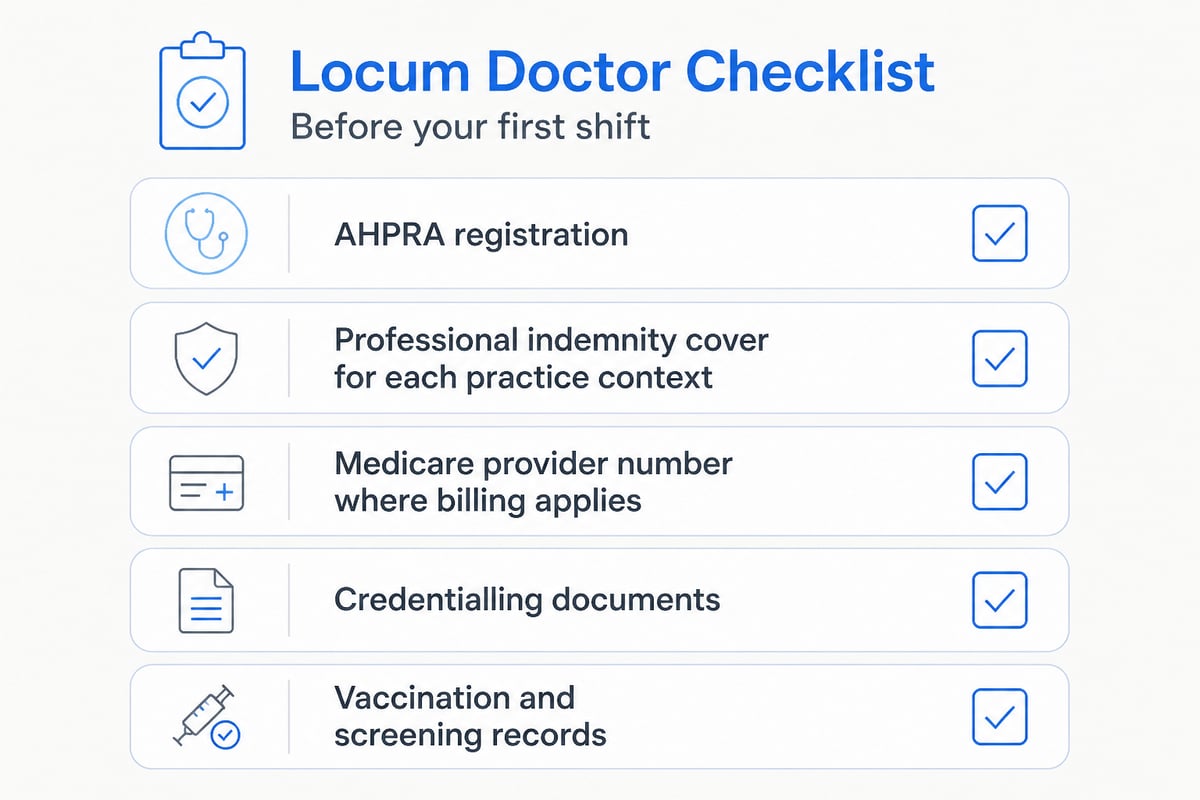
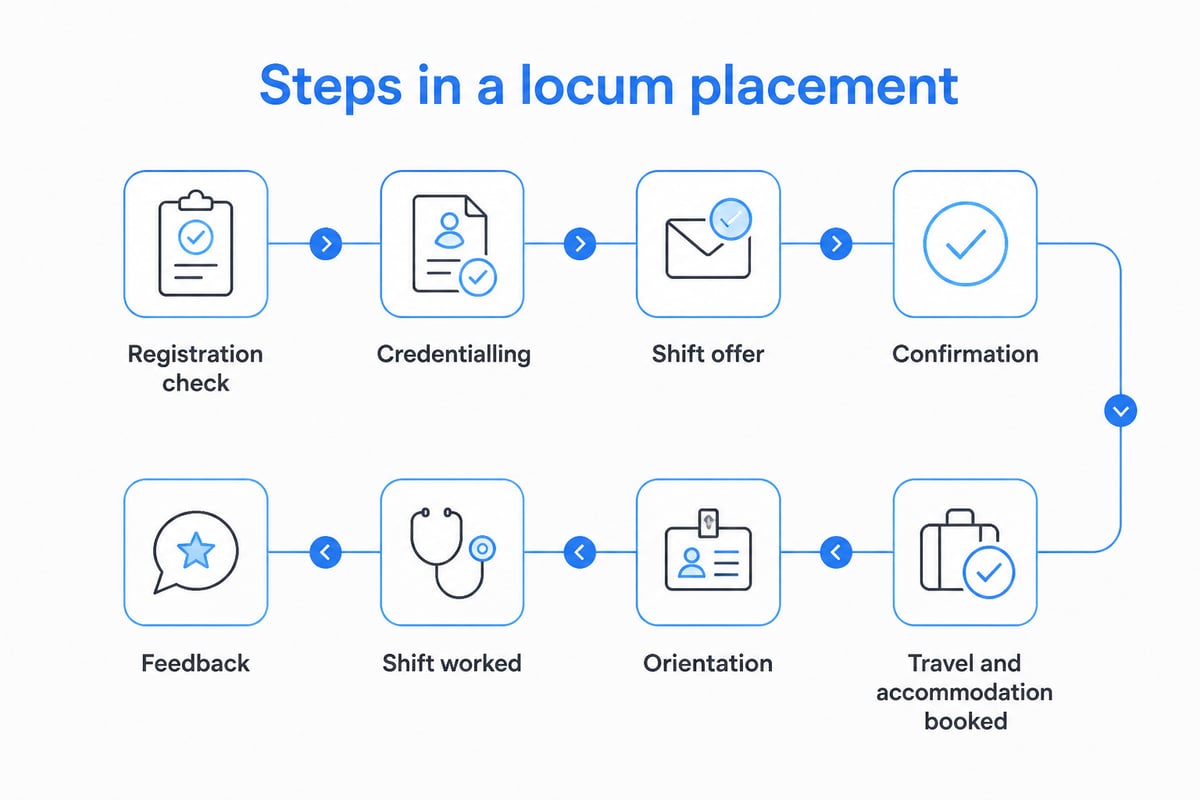
Aus doctors who want flexible work take locum placements: short-term or ad hoc shifts at hospitals and clinics across the country, usually arranged through a medical recruitment agency. To work legally you need current AHPRA registration, professional indemnity cover for each practice context, and a Medicare provider number for the location where you will practise. Credentialling and the shift logistics come after that, and they take the most time to organise.
This guide covers what locum work involves, the paperwork, how pay and travel usually work, and how hospitals and practice managers can fill gaps without chasing last-minute cover.
What Locum Work Means for Aus Doctors
Locum work means covering for a doctor or a gap in a roster, for a single shift, a weekend or a block of several weeks. The word comes from the Latin locum tenens, "holding the place of".
Most locums fall into a few groups. JMOs and registrars use locum shifts to build experience across departments or earn extra income around training. Specialists in emergency medicine, anaesthetics, ICU, obstetrics and gynaecology, paediatrics, psychiatry and surgery use locum work to control their calendar. Some doctors do it for a season between roles, some for years.
The appeal is straightforward. You choose when and where you work, you see different hospitals and teams, and you can build travel into your schedule. The trade-off is that you give up the stability of a permanent post: no guaranteed rosters, no built-in team, and you carry more of the administrative load yourself.
If you are weighing locum work against a substantive role, our overview of locum work for doctors sets out the practical differences.
Registration, Indemnity and Provider Numbers
Before any shift, three things have to be in order: registration, indemnity and billing access.
Registration. You need general or specialist registration with the Medical Board of Australia through AHPRA. Doctors moving from overseas or from a different state should confirm that any conditions on registration permit the type of work they are taking.
Professional indemnity insurance. The Medical Board of Australia states that doctors who provide health care or medical opinions must have professional indemnity insurance or a compliant alternative arrangement covering every aspect of their practice. The registration standard applies to both self-employed doctors and doctors employed by others, and it requires cover for each practice context. A locum who splits time between a public hospital and a private facility should check that each setting is actually covered, rather than assuming one policy or employer arrangement follows them everywhere. The Board also publishes its professional indemnity insurance arrangements, which are worth reading before you sign a contract.
**Medicare provider numbers. Services Australia says a doctor needs a Medicare provider number for each practice location, with a locum-tenens exception applying to the general location rule. It also notes that a provider number does not automatically give access to Medicare benefits. Hospital-based locums working under public employment usually do not bill Medicare directly, but anyone working in a private or outpatient setting should confirm how billing will be handled before the first shift.
Credentialling: The Step That Delays Most Placements
Credentialling is the facility's process of verifying your qualifications, registration, work history and scope of practice before you are allowed to work there. It is the most common reason a placement slips from "this week" to "next month".
Hospitals typically ask for some combination of:
- Proof of identity and current registration
- Specialist qualifications and college fellowship
- Certificates of good standing and referee reports
- Immunisation and health screening records
- Evidence of indemnity cover
- A working with children check or police check, depending on the state
The practical advice is to keep a digital folder with current copies of everything and refresh it every few months. Agencies that credential doctors in advance can place you quickly when a facility rings at short notice. Agencies that credential doctors in advance, such as Best Practice Medical, can confirm short-notice shifts without the paperwork starting from zero.
How Pay, Travel and Accommodation Usually Work
Locum pay is generally an hourly or daily rate that varies by specialty, seniority, location and how urgent the need is. Rural and remote shifts commonly pay more, partly because they are harder to fill. I have not quoted figures here because rates shift by state, facility and contract, and any number would date quickly. Ask for the rate in writing before you accept.
Questions worth settling up front:
- Is the rate paid as an employee or as a contractor, and who handles tax and superannuation?
- Are flights, car hire and accommodation arranged and paid for you, or reimbursed later?
- What are the cancellation terms if the facility cancels or you cannot attend?
- Is there on-call or after-hours work, and how is it paid?
- What orientation will you receive on the first day?
Contractor versus employee status affects your tax position, leave entitlements and insurance, so it is worth a conversation with an accountant who understands medical income. Doctors setting up as contractors often find that business skills matter as much as clinical ones.
Best Practice Medical covers placements end to end, including shift confirmation, travel and accommodation, so those logistics are not left to you to chase.
Where the Work Is: Metro, Regional and Rural
Demand for locums is strongest where permanent recruitment is hardest. Regional and rural hospitals often rely on short-term cover to keep emergency departments, maternity units and anaesthetic services running. Metropolitan hospitals use locums for leave cover, surges and unfilled rosters.
Discussions of rural workforce sustainability, such as this piece on building a sustainable rural workforce, weigh episodic locum cover against continuity-based models. That tension is real. Locums keep services open, but a facility that depends on them entirely loses continuity of care, and communities notice. If you plan to return to the same town or hospital regularly, say so. Many facilities value repeat locums far more than a different face every fortnight, and you will settle in faster each time.
For doctors considering a longer stint outside the capital cities, our piece on attracting more doctors to regional Australia covers what regional facilities are doing to make placements workable.

Choosing a Placement That Suits Your Specialty
Different specialties experience locum work differently, and it pays to be realistic about what you are signing up for.
Emergency medicine and anaesthetics tend to have steady demand, and shifts are well defined. ICU and psychiatry often need doctors who can step into an established model of care with little handover. Obstetrics and gynaecology and paediatrics shifts frequently involve on-call and may require specific credentialled procedures. Surgical locums need facility-specific credentialling for operating lists, which is why advance preparation matters.
JMOs and registrars should check whether locum shifts count toward any training requirements, and whether supervision arrangements meet the college's expectations. Specialists should confirm the scope of practice the facility is crediting them with before they arrive, not on the first morning.
For a fuller picture of how specialties are structured, see this breakdown of the kinds of specialist doctors working in Australia.
Working With a Locum Agency
An agency sits between you and the facility, handling credentialling, contracts, logistics and the awkward conversations about rates. For doctors, the value is access to shifts you would not otherwise hear about and someone to call when something goes wrong at 2am. For facilities, it is a pre-screened doctor who arrives ready to work.
What to look for in an agency:
- Industry accreditation and memberships. Best Practice Medical is accredited to ISO 9001:2015 Quality Management and is a member of the Recruiting, Consulting and Staffing Association (RCSA) and the Association of Medical Recruiters Australia and New Zealand (AMRANZ).
- Approved supplier status. Best Practice Medical is an approved supplier for NSW Health, Tasmanian Health, WA Country Health Service, NT Health, Vic Health, QLD Health and ACT Health, and supplies major private providers including Ramsay Health Care, Healthscope and St Vincent's Health.
- Ownership and leadership. Ask an agency who owns and runs it, and whether its leaders practise medicine.
- Availability. Ask what hours consultants cover for urgent shift needs, and whether you get a dedicated contact.
For hospital teams that need fast cover across specialties, Short-Term Medical Locum Placements from Best Practice Medical match a doctor to a facility based on specialty, credentialling status and availability, for a single shift or a block of weeks. If you are comparing how agencies operate, this explanation of how a locum agency works for doctors is a useful starting point.
For Hospital and Practice Managers: Filling Gaps Without Chaos
If you manage a roster, the problem is rarely finding a doctor in the abstract. It is finding a credentialled doctor with the right specialty who can start in 48 hours and will not need hand-holding on arrival.
A few habits reduce the scramble:
- Keep a standing credentialling pack ready. The faster you can tell an agency exactly what documents and orientation steps you require, the faster they can match someone.
- Write a one-page orientation sheet. Systems access, key contacts, escalation pathways and parking details save a locum's first hour and reduce errors.
- Plan known gaps early. Leave, conferences and school holidays are predictable. Requesting cover weeks ahead widens your choice of doctors.
- Give feedback. A locum who knows the shift went well will return. An agency that knows what went badly can adjust the next match.
Some facilities have worked with a single partner for a very long time, and continuity tends to help both sides. This look at how healthcare providers are finding the right locum fit goes into more detail on the matching side.
Looking After Yourself on the Road
Locum work can be isolating. You arrive somewhere unfamiliar, work with people you do not know, and leave before you have built any relationships. Fatigue, travel and irregular rosters add up.
Practical measures help: block rest days between runs of shifts, avoid stacking long drives on either side of a night roster, and keep a regular GP of your own back home. Every state has a doctors' health service, and the national helpline is available to all doctors regardless of where they are working. If you are weighing the toll of this kind of work, this piece on mental health in doctors is worth reading.
It is also worth being clear with yourself about what you want. Some aus doctors use locum work as a way to rebuild after burnout. Others find that constant movement makes it worse. Neither is wrong, but it helps to notice which one you are.
Doctors who are just starting out can see what doctor jobs in Australia look like across different career stages before committing to a placement pattern.
Your next step is to gather your registration details, indemnity certificate and credentialling documents into one folder, so you can accept a shift the day it is offered. Whether you are a JMO, registrar or specialist looking for flexible locum work, or a facility that needs cover at short notice, Best Practice Medical's consultants can talk through what is available across Australia and what a placement would involve, so contact us to start that conversation.