

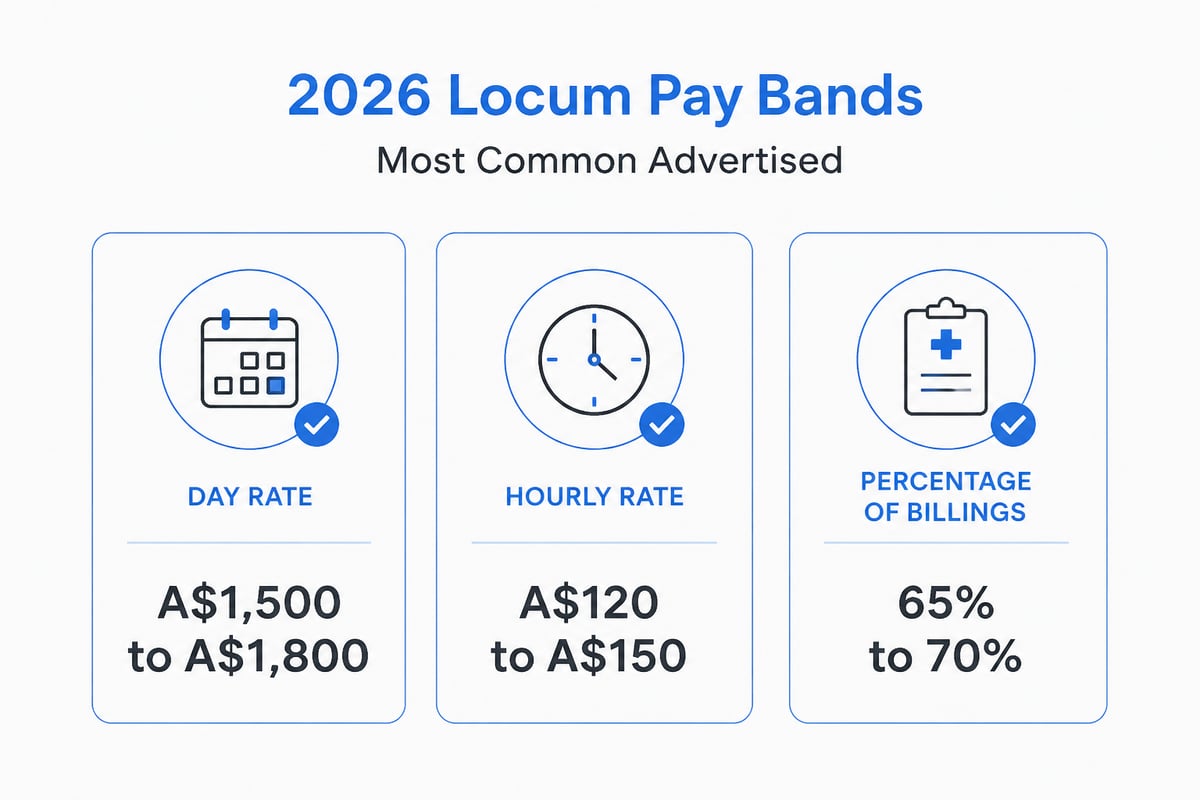
Advertised locum pay for doctors in Australia most commonly falls within bands, with day rates usually quoted between A$1,500 and A$1,800 and hourly rates between A$120 and A$150, according to 2026 job postings. These are posting brackets rather than averages, so the rate you actually negotiate will move with location, session length, billing arrangement and how urgently a practice needs cover.
This guide explains how locum pay is structured, what pushes a rate up or down, and how to compare offers that are written in different formats. It also covers the deductions and costs that sit between a headline rate and what lands in your account.
What are the average GP locum rates in Australia in 2026?
The most common advertised locum day-rate band is A$1,500 to A$1,800, and the most common advertised hourly band is A$120 to A$150. Both figures come from HealthcareLink's 2026 hiring trends report, which is clear that these are employer-selected pay brackets in job ads, not exact observed or median rates.
That distinction matters. A bracket tells you where most advertisers placed their offer. It does not tell you what was finally agreed, and it will not capture the rates negotiated privately through an agency or a repeat arrangement with a practice. It also says nothing about the postings that never state a figure.
The format of the advertising adds another layer. Among postings that included pay information, far fewer listed a daily or hourly locum rate than quoted a percentage of billings. So the day and hourly bands describe a minority of the market, and a doctor who sees mostly billings-based offers will have to convert them before any comparison with these bands is fair.
Treat the bands as a starting reference. A metropolitan weekday booking in a well-served area will often land toward the lower end of the range. A remote, short-notice or weekend booking can sit well above it, sometimes with travel and accommodation added on top. If an offer falls below A$1,500 a day, ask what is bundled in. If it sits above A$1,800, ask what the site is struggling to fill and whether the extra covers a harder roster, longer hours or a location that costs you more to reach. For specialist roles, our guide to the locum consultant hourly rate in Australia shows what to expect by specialty and state.
How is locum pay structured?
Locum pay is almost always written as a day rate, an hourly rate or a percentage of billings, and each one shifts risk between you and the practice in a different way.
A day rate gives you certainty. You are paid a set amount regardless of how many patients walk through the door, which suits quiet sites and short bookings. An hourly rate works similarly but scales with the hours you actually work, so it matters whether the hours are guaranteed or only paid when you are in a consulting room.
A percentage of billings ties your income to what you generate. In the same HealthcareLink data, 65 to 70 percent retained by the doctor was the most common band where a split was specified. That figure usually assumes the practice supplies rooms, nursing support, consumables and administration. A higher percentage with fewer inclusions is not automatically a better deal.
The mix of formats in the market is worth knowing. Of the postings that listed pay information, HealthcareLink found that percentage-of-billings splits were the most common format, ahead of daily and hourly rates. Billings-based offers dominate, which is why so many doctors need to convert them into a day-rate equivalent before they can compare anything.
How do day rates, hourly rates and billings splits compare?
A day rate is the simplest to compare, an hourly rate needs the hours confirmed, and a billings split needs a realistic estimate of daily billings before it means anything.
Pay format comparison: a day rate pays a set amount per day worked, with low risk if hours are clear; an hourly rate pays for each hour worked, with the risk of unpaid gaps or cancelled sessions; a percentage of billings pays a share of what is billed, with the risk of quiet days and bulk-billing mix. Check whether hours are guaranteed, whether there is a cancellation clause, and what costs come out of a split.
To convert a split into a day rate, multiply the practice's realistic daily billings by your percentage. If a site typically bills A$2,400 on a full day and you keep 65 percent, that is A$1,560 before any deductions. Ask the practice for recent billing figures for a comparable doctor rather than relying on a rough guess.
What affects what a locum doctor earns?
Location, timing, notice period and the type of work can all move a rate, and they often stack.
Location. Rural and remote work can pay more per day than a metropolitan booking, and the package often includes travel and accommodation. Regional sites that struggle to recruit tend to compete on rate and inclusions. Our piece on why regional healthcare relies on locum doctors covers why that pressure exists.
Timing. Short-notice cover, weekends, public holidays and school holiday periods lift rates. A practice that needs a doctor tomorrow has less room to negotiate than one booking a block three months out.
Duration. A single day usually commands a premium for the disruption it causes. A block of several weeks can come with a slightly lower daily figure but more predictable income, fewer gaps between bookings and less admin per dollar earned.
Registration and experience. Fellowship, procedural skills and extra qualifications can justify a higher rate, particularly at sites where those skills fill a real gap in the roster.
Do locum doctors get paid more than permanent staff?
Locum doctors often earn more per day than salaried colleagues, because the rate has to cover things a permanent contract provides separately.
The premium is real but it is not pure profit. A salaried role typically includes paid annual leave, sick leave, superannuation, professional development time and a steady income. A locum rate has to fund all of those yourself, along with indemnity insurance, registration, gaps between bookings and travel.
A useful way to think about it is that a locum day rate is not directly comparable to a salary divided by working days. If you work 40 weeks of the year to take extended time off, your annual income is lower than the headline rate suggests. Many doctors choose locum work for flexibility rather than the highest possible earnings, and that trade-off is a legitimate one.
For a broader look at how pay works across the locum market, see our explainer on locum doctor pay.
What costs and deductions sit between the rate and your income?
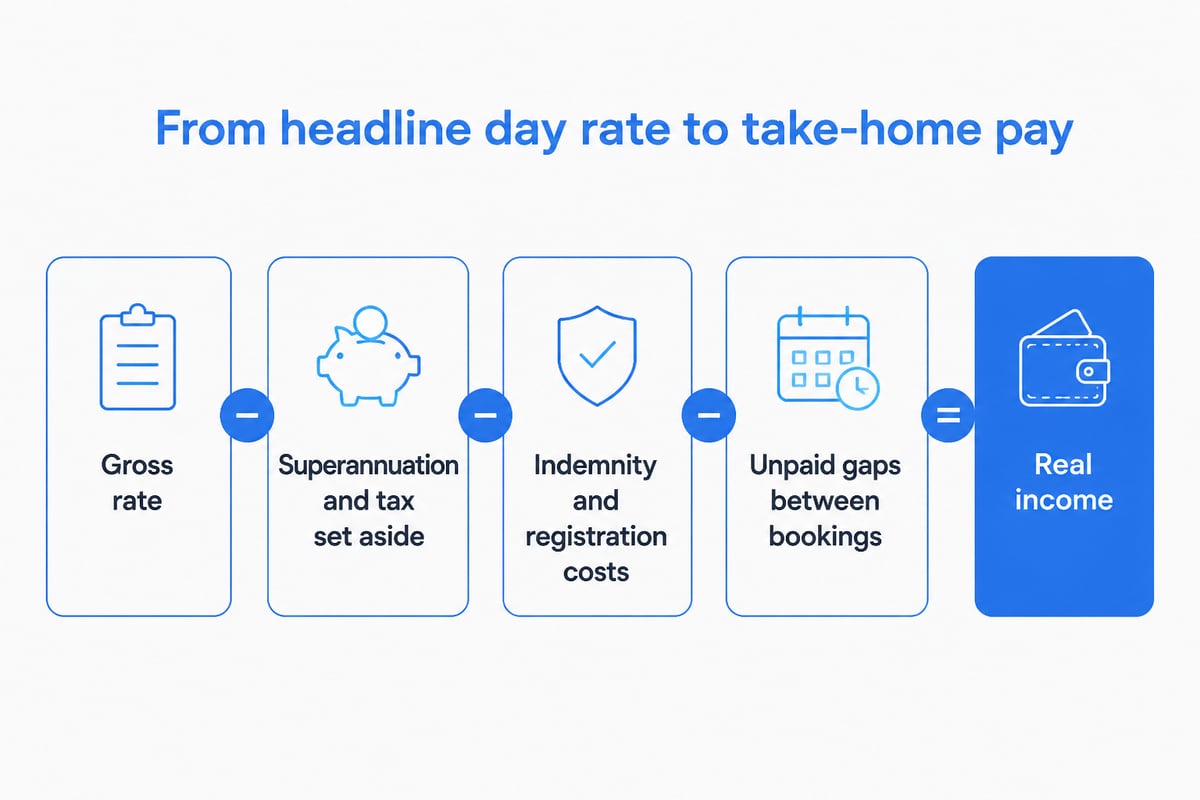
The figure on the booking confirmation is gross, and several costs come out before you see what you have actually earned.
Most locums work as independent contractors, which means tax, superannuation and GST obligations depend on how you are engaged and whether you are registered for GST. Speak to an accountant who works with doctors before your first block, because the structure you choose affects how much you keep.
Common costs to plan for include:
Indemnity insurance that covers locum work, AHPRA registration and any college fees, travel to and from sites, accommodation where it is not provided, and the income you do not earn between bookings. Payroll tax treatment of contractor arrangements can also affect how some sites structure their offers. We unpack that in our article on recent payroll tax changes.
Build a simple annual budget before committing. Work out how many paid days you realistically expect, multiply by your target rate, then subtract the costs above. That number tells you whether a rate is workable far better than the headline figure does.

How do you negotiate a better locum rate?
You negotiate a better rate by knowing your numbers, asking about inclusions as well as the headline figure, and choosing your moments.
Start with what you need to earn per working day after costs, not what feels fair. Then ask what is included: travel, accommodation, meals, a vehicle, and whether cancellation is compensated. A modest rate with full travel and accommodation covered can outperform a higher rate that leaves you paying for both.
Be willing to trade flexibility for rate. Offering to cover a hard-to-fill period, accept a longer block or commit to a repeat booking gives a practice something of value. Doctors who are reliable, communicate well and arrive prepared tend to be asked back, and repeat work is where rates often improve.
Working through a recruiter who knows the market can help, because they see what sites are actually paying rather than what is advertised. If you want to see what is currently on offer, you can find locum work through Best Practice Medical, and our guide to what makes a good locum doctor explains what sites look for when they rebook.
When does a longer placement make more sense than single shifts?
A longer placement makes more sense when you value predictable income, less travel and lower admin over the highest possible daily rate.
Extended cover for leave, parental leave or a vacancy that is being recruited for gives you continuity and often a more settled rate. For facilities, Best Practice Medical's long-term and extended placements apply the same credentialling process regardless of duration, which matters when a doctor will be embedded in a team for weeks or months.
For the doctor, a block removes the repeated cost of finding the next shift. It also lets you build relationships on site, which tends to improve both the working environment and your negotiating position when the block ends or extends.
Blocks also suit certain situations better than others. If you are relocating to a regional town, a six-week booking lets you settle into one set of accommodation rather than moving between short stays, and travel is a single outlay instead of a repeated one. If you are between permanent roles, or planning a gap before a fellowship or overseas stint, a block gives you a defined end date and a clear income window to plan around.
Single shifts still win when your calendar is fragmented, when you want to sample several sites before committing, or when you are chasing short-notice premiums. A reasonable test is to count the days you would otherwise spend finding, confirming and travelling to separate bookings, then ask whether a slightly lower daily rate on a block leaves you with more usable working days across the month.
FAQ
How much does a locum doctor get paid per session?
It depends on the pay format. Under a day rate, the commonly advertised band is A$1,500 to A$1,800 for a full day, while hourly offers commonly fall between A$120 and A$150. Under a billings split, your session income depends on what is billed and the percentage you retain.
Why do advertised locum rates differ so much between sites?
Rates can reflect how hard a site finds it to recruit, how short the notice is and what is included in the package. A remote site offering travel and accommodation will usually quote differently to a metropolitan site with plenty of local supply. Always compare the full package, not only the headline figure.
Before your next booking, write down the daily income you need after tax, indemnity, travel and gaps, and use it as the floor for every offer you compare. If you would rather have someone who knows current market rates handle the comparison, Best Practice Medical is doctor-owned, led by a practising doctor with over 30 years in medical recruitment, and its consultants are available 24/7 for urgent shift needs, so you can contact us to talk through rates and the work available. We cover shift confirmation, travel and accommodation end to end, so the rate you agree is the one you work to.