

If you are searching for a Dr in Australia, the quickest route is the public register run by the Medical Board of Australia, which lists every registered doctor and any conditions on their practice. For doctors reading this, the same register is the first thing a hospital, a credentialling team or a locum agency will check about you.
This article is written from the clinician's side of the desk. It covers who can legally use the title, how registration works, what the work and pay look like, and how a locum doctor finds shifts in the state or town they want.
Who can use the title Dr in Australia?
Anyone with a doctoral degree can call themselves Dr socially, but a registered medical practitioner is the only person who can hold themselves out as a medical doctor. The title "medical practitioner" and the specialist titles are protected under the Health Practitioner Regulation National Law. Using them without registration is an offence, and it is the Australian Health Practitioner Regulation Agency (AHPRA) and the National Boards that enforce it.
So a PhD graduate can be Dr Nguyen in the university directory. They cannot imply they are a medical doctor, prescribe, or sign a medical certificate. Specialist titles such as "surgeon", "physician" or "psychiatrist" need specialist registration in that field, usually via a college fellowship.
For patients and for colleagues, the check is the same: search the name on the Medical Board's register of practitioners. It shows the registration type, the registration status, and whether any conditions, undertakings or reprimands apply.
How to check a doctor is registered
Checking a doctor's registration takes about a minute and should be done before you rely on anyone's credentials, including a colleague you are handing over to.
Search by name on the public register. The entry shows the practitioner's registration type, such as general, specialist, provisional or limited, along with their principal place of practice and the date of registration. If a name does not appear, it may be a spelling variant, a recent name change, or a lapsed registration. Registration renews annually, and doctors who fail to renew drop off the practising list.
For doctors, the register is a mirror. Your own entry should show the correct registration category, your specialty if you hold one, and any conditions that apply. Locum agencies and facilities will compare their credentialling file with it, so a mismatch is worth fixing before you apply for shifts.
How to become a Dr in Australia
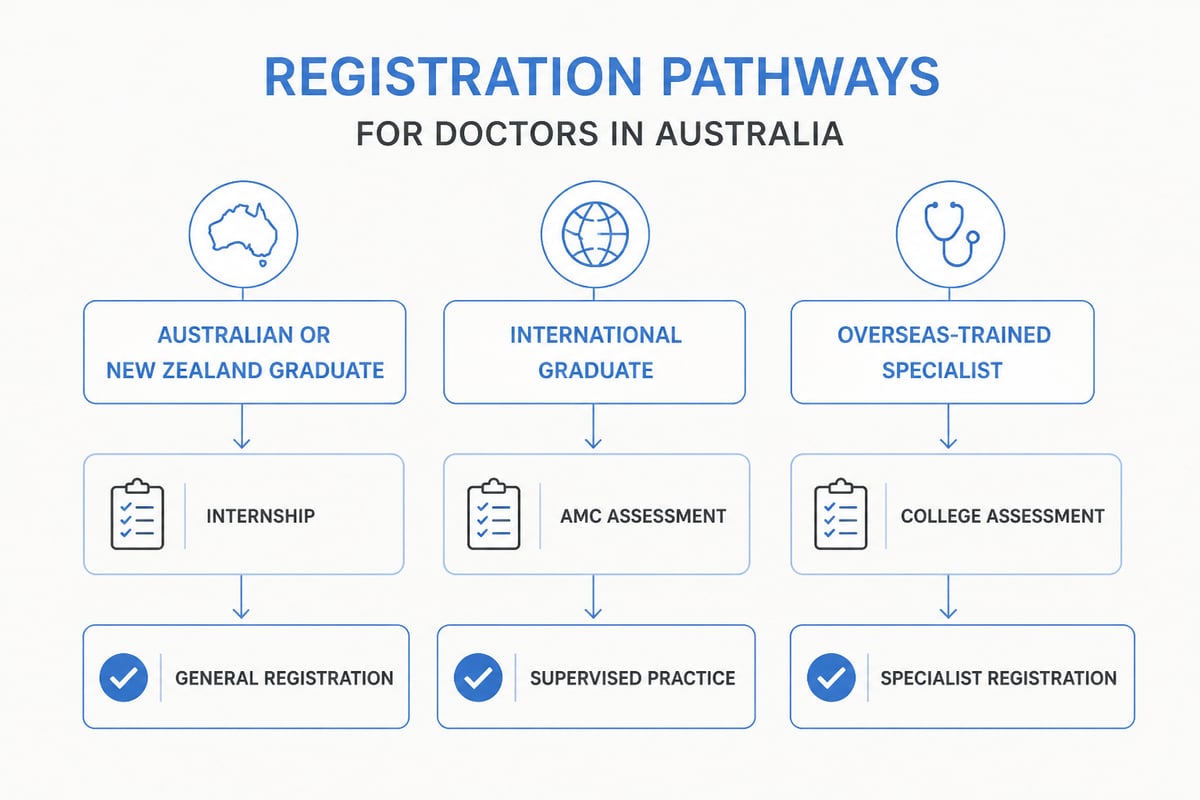
The pathway depends on where you trained, and there are three main routes: an Australian or New Zealand medical degree, an international qualification assessed by the Australian Medical Council (AMC), or a specialist pathway for overseas-trained specialists.
Graduates of Australian and New Zealand medical schools complete a one-year internship, then move through resident and registrar years toward fellowship. Registration for the intern year is provisional, then becomes general.
International medical graduates have a few options. Those with a qualification from a recognised school can sit the AMC examinations or use an accepted alternative pathway such as the competent authority route. The AMC's guidance on practising medicine in Australia sets out the current options and what documents you need. Overseas-trained specialists apply through the relevant college for assessment, and the outcome decides whether they are comparable, partially comparable or not comparable to an Australian-trained specialist.
Visa timing matters as much as registration timing. Many doctors lose weeks because their registration, their visa and their credentialling run in sequence rather than in parallel.
What types of doctor work in Australia?
Doctors in Australia work across a defined career ladder, and each rung has its own registration status and its own type of locum demand.
- Junior medical officers (JMOs) include interns, residents and house officers working in hospitals under supervision.
- Registrars are doctors in a college training program or an unaccredited registrar post, working with growing autonomy in a single specialty.
- Career medical officers and senior medical officers hold substantive hospital posts without being on a training program.
- Specialists and consultants hold fellowship and specialist registration, working in public and private settings.
Locum work exists at every one of these levels. A rural emergency department might need a resident for six weeks, an anaesthetics department might need a fellow for two months of leave cover, and a private hospital might need a consultant for a fortnight. The specialties Best Practice Medical recruits for give a sense of how wide that range is.
How much does a doctor earn in Australia?
Earnings vary far more by specialty, setting and locum arrangement than by title, and a single average hides that spread.
Public hospital salaries are set by state awards, so a resident medical officer in one state is paid under a different scale from a colleague in another. Interns and residents earn salaried rates with penalties for nights, weekends and overtime. Registrars sit higher on the same scales, and senior medical officers and consultants move to specialist pay bands, often with private practice arrangements on top.
Locum rates are usually quoted as a daily or hourly rate, and they typically sit above the equivalent salaried rate to reflect the lack of leave entitlements and the short notice. Rural and remote shifts often add accommodation and travel. Because rates depend on the facility, the specialty and the dates, the honest answer for any one shift is to ask for the rate in writing before you accept. Best Practice Medical's guide to doctor jobs in Australia covers what to compare across offers.
Can you see a doctor for free in Australia?
Yes, for many patients, because Medicare covers part or all of the cost of consultations with bulk-billing doctors, and public hospital emergency departments generally treat patients without a fee.
That is a patient question, and it has a workforce consequence. Bulk-billing and public hospital demand mean many facilities run short of staff, especially outside the capital cities. The pressure shows up as unfilled rosters, which is the reason locum doctors are needed. Best Practice Medical has written on why the medical workforce is under increasing pressure and on how regional areas try to attract more doctors.
Finding locum work as a doctor
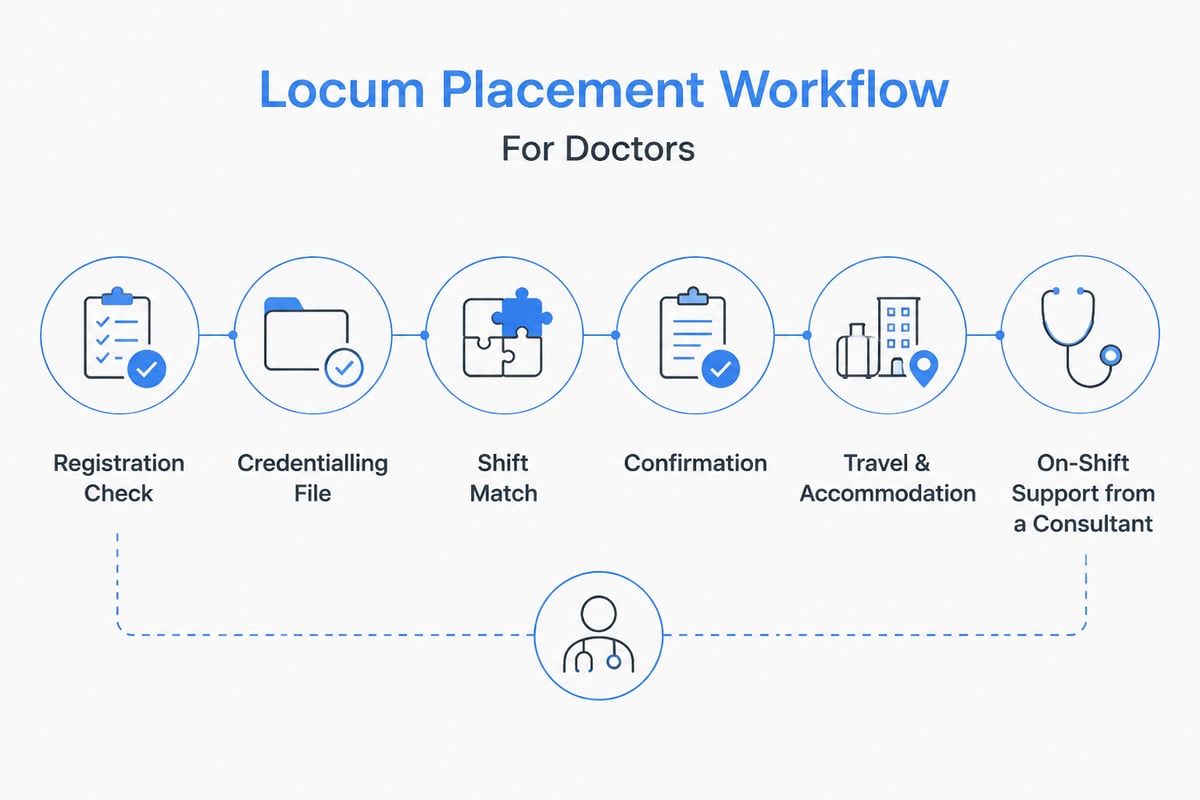
A doctor looking for flexible work in Australia needs four things lined up before the first shift: current registration, a credentialling file, indemnity cover and a clear idea of the locations and specialties they will take.
Credentialling is where most delay occurs. A hospital or private provider will want your registration details, proof of identity, immunisation records, working-with-children or police checks where required, referees and evidence of recent practice. Having these scanned and current means you can say yes to a shift on Monday and start on Wednesday.
There are a few practical decisions to make early:
- Decide whether you want hospital shifts, procedural lists, rural and remote placements, or a mix.
- Decide how far you will travel and whether you want accommodation arranged for you.
- Decide how much notice you need and how much you can give.
Doctors who want a more detailed look at what the arrangement involves can read Best Practice Medical's pieces on whether you are eligible to become a locum doctor and on what to have in place before you start.
What a locum recruiter does for you
A locum recruiter matches your registration, specialty and availability to open shifts, handles the paperwork with the facility, and arranges the logistics so you can concentrate on the clinical work.
Best Practice Medical connects doctors with locum shifts across Australia, screening every candidate thoroughly before placement. Its consultants support doctors and facilities through each placement, from shift confirmation to on-shift needs.
The business is accredited to ISO 9001:2015 Quality Management and is a member of the Recruiting, Consulting and Staffing Association (RCSA) and the Association of Medical Recruiters Australia and New Zealand (AMRANZ). It is an approved supplier for several state health services and supplies major private providers including Ramsay Health Care, Healthscope and St Vincent's Health, so shifts can exist in both public and private settings.
Choosing where to work: metro, regional and rural
The right location depends on what you want from a placement, and regional and rural shifts often offer the broadest scope of practice and the most support with travel and accommodation.
Metropolitan hospitals tend to offer subspecialised rosters, more colleagues on site and easier logistics. Regional centres usually mean a wider case mix, more autonomy and often a shorter path to meaningful responsibility. Remote placements add distance, and with it a need for flexibility and good communication with your recruiter about transport and cover.
Doctors weighing the switch can read Best Practice Medical's discussion of going regional and whether to make the switch from metro. A sensible approach is to take one short regional placement before committing to a longer one, so you learn how you handle the isolation, the on-call load and the community expectations.

Keeping your registration and records in order
Locum work depends on paperwork staying current, and a lapse in any one document can cancel a shift at short notice.
Diarise your annual registration renewal, your indemnity renewal, your continuing professional development (CPD) hours and your immunisation updates. Keep a single folder, digital and backed up, with your registration certificate, identity documents, referee contacts and a current CV with dates of practice. News and CPD content from sources such as AusDoc can help with staying current on clinical and regulatory changes.
If you move states, check whether your principal place of practice on the register needs updating, and tell your recruiter so facility files match. Small mismatches between the register, your CV and your credentialling file are the most common cause of avoidable delays.
FAQ
Do you need to be registered to call yourself a Dr in Australia?
Not to use the title socially if you hold a doctorate, but you must be registered to use the title "medical practitioner" or to practise medicine. Using protected titles without registration is an offence under the National Law.
How long does it take to get registered as an overseas-trained doctor?
It depends on the pathway, the completeness of your documents and the speed of primary source verification, and it can range from a few months to well over a year. Starting the assessment, registration and visa applications together shortens the total time.
Can a doctor do locum work while still in training?
Often yes, depending on your registration category, your employer's rules and your training program's requirements. Check any conditions on your registration and speak to your training program before you accept shifts outside your rotation.
The next step is to open the public register, check that your own entry is accurate, and gather your credentialling documents in one place. When you are ready for shifts, Best Practice Medical is the place to start a conversation about your specialty, your availability and where in Australia you want to work, so contact us and a consultant can match you to suitable locum opportunities.