

A medical recruitment agency in Sydney finds and credentials doctors for short-term and locum work, then matches them to hospitals and clinics that need cover. For doctors, the agency handles the paperwork and shift search. For facility managers, it supplies a vetted doctor when a roster gap opens. This guide covers how that works in New South Wales, what to check before you sign with an agency, and what to ask before you book one.
What a medical recruitment agency in Sydney actually does
A medical recruitment agency sits between doctors who want flexible work and facilities that cannot fill a roster. It screens the doctor, confirms registration and credentials, matches the doctor to a shift, and manages the logistics around it.
The scale of the market explains why agencies exist. In 2025, New South Wales had 37,445 registered and employed medical practitioners, representing 38,523 FTE, with an average age of 46.4 and average weekly hours of 41.2. That is a large workforce, but it is spread across metropolitan Sydney, regional hubs and rural towns, and demand is uneven. A rural emergency department with two vacant weeks has a very different problem from a Sydney private hospital that needs an anaesthetist for a single list.
Agencies fill that unevenness. A good one knows which facilities need which specialties, which doctors are credentialled where, and who is free next Tuesday.
Locum work versus permanent recruitment
Locum recruitment and permanent recruitment are different jobs. Permanent recruitment fills a position for years and involves interviews, contracts and notice periods. Locum recruitment fills a gap for a shift, a week or a few months, often at short notice. The skills overlap, but the speed, the credentialling turnaround and the after-hours availability matter far more in locum work.
If you want a permanent full-time post, a locum-focused agency is the wrong tool. This guide is for doctors who want flexibility and for managers who need cover.
How locum placement works for doctors in NSW
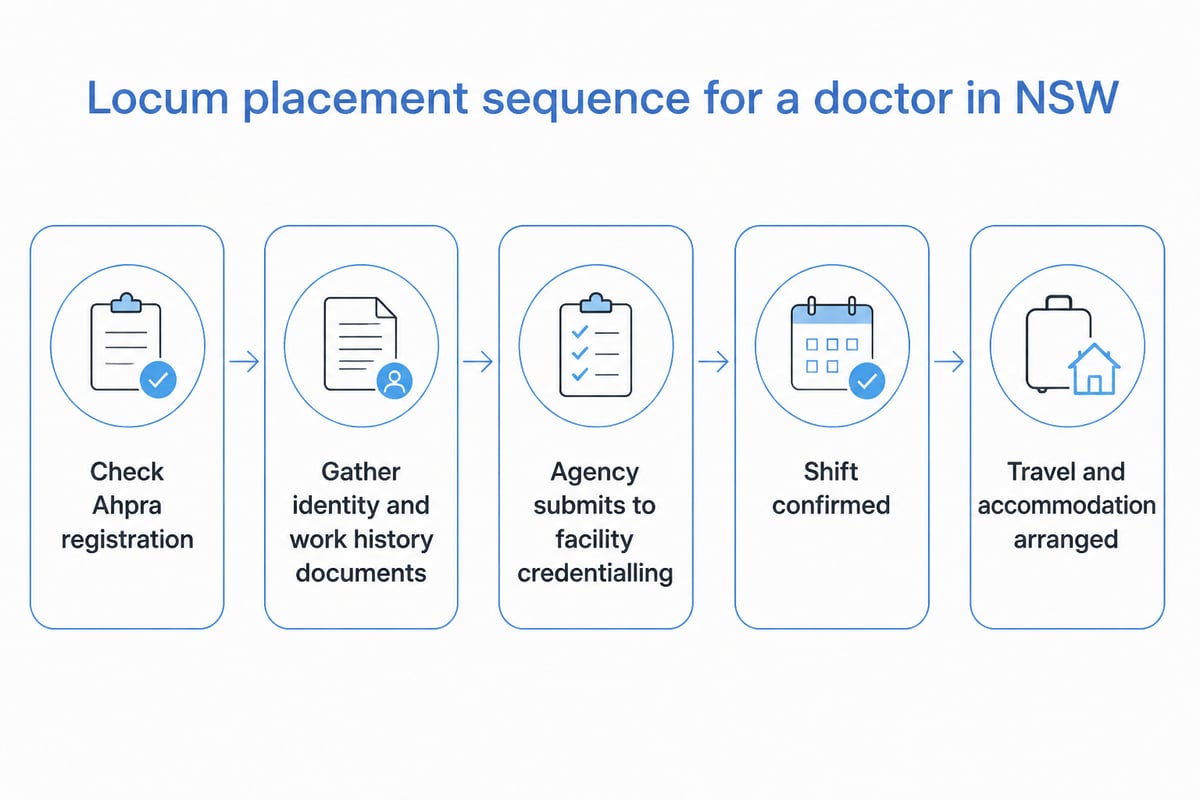
Placement starts with registration and ends with a confirmed shift, and most delays happen in the middle at credentialling. Knowing the sequence lets you prepare documents before you need them.
First, your registration must be current. Ahpra states that medical registration runs annually from 1 October to 30 September, so a lapse around renewal can stall a placement you have already been offered. Check your renewal date before you register with any agency.
Second, expect to supply identity documents and work history. Ahpra says applicants must pay the relevant fee, provide identity documents and supply information such as work history, and internationally registered applicants may also need a certificate of good standing and certified qualifications. Agencies ask for much the same set, plus referees, immunisation records and any facility-specific requirements.
Third, the agency submits your details to the facility for credentialling. Public hospitals under NSW Health have their own processes, and private groups have theirs. A doctor who arrives with a complete, current file moves faster than one who is chasing a vaccination certificate the night before.
What JMOs, registrars and specialists should expect
The path differs by seniority.
- JMOs usually look for relief cover and short blocks, and need agencies that understand supervision and rostering requirements.
- Registrars often want blocks that fit around training commitments, so confirm what counts toward your program before accepting a placement.
- Specialists tend to want procedural lists or sessional cover, and should ask upfront how credentialling and scope of practice are handled at each facility.
Whatever your grade, ask how quickly the agency can confirm a shift once you say yes, and who you call if something changes on the day.
What facility managers should look for in an agency
A manager choosing a medical recruitment agency in Sydney is buying reliability under time pressure, so the questions that matter are about credentialling, response time and what happens when a doctor cancels.
Start with credentialling. Ask exactly what is checked before a doctor is presented to you, who does the checking, and whether you will see the results. An agency that says doctors are "vetted" without describing how is not telling you much.
Then ask about availability. Roster gaps do not keep office hours. A nurse unit manager who finds an uncovered night shift at 6pm needs a human on the phone, not an enquiry form.
Ask about continuity as well. Some agencies place a doctor once and disappear. Others stay in touch through the shift and afterwards, so you know the doctor arrived and you can give feedback.
Questions worth asking before you sign
- How are doctors credentialled before placement, and can you provide evidence?
- What quality accreditation does the agency hold, and since when?
- Is the agency an approved supplier for the health service you work with?
- Who do I contact out of hours, and how fast will they respond?
- What happens if the doctor cancels or the shift changes?
- Does the agency handle travel and accommodation for doctors coming from outside the area?
You do not need an agency to answer all six perfectly. You do want straight answers rather than sales language.
Approved supplier status and why it matters
Approved supplier status means a health service has formally accepted an agency onto its supply arrangements, which saves a facility the work of assessing the agency from scratch. For public hospitals in particular, it often decides whether you can use an agency at all.
NSW Health, like other state systems, maintains arrangements for the agencies it will engage. If you manage a public facility, confirm that any agency you consider is on the relevant list before you ask for a quote. If you are a doctor, it tells you which public systems the agency can actually place you in.
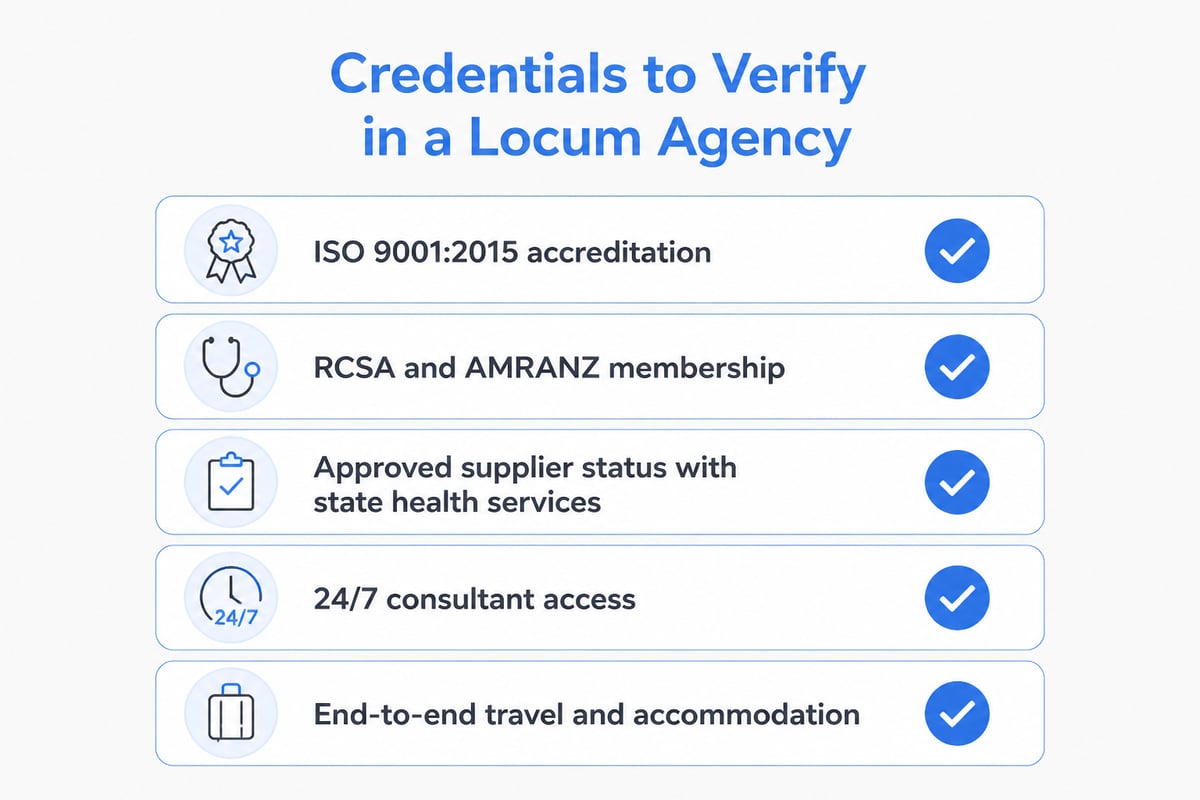
Membership of industry bodies is a weaker signal than supplier status, but it still tells you something. The Recruiting, Consulting and Staffing Association (RCSA) and the Association of Medical Recruiters Australia and New Zealand (AMRANZ) both set standards for member conduct. An ISO 9001:2015 accreditation shows an agency has a documented quality management system, and the length of time it has held it shows whether that system has survived repeated audits.
How Best Practice Medical approaches locum placement
Best Practice Medical is a doctor-owned and operated medical locum agency led by a practising doctor with over 30 years in medical recruitment.
On the credentialling and quality side, the facts are specific:
- Every locum is credentialled to the highest standards before placement.
- The agency has held ISO 9001:2015 Quality Management accreditation since 2009.
- It is a member of the RCSA and AMRANZ.
- It is an approved supplier for NSW Health, Tasmanian Health, WA Country Health Service, NT Health, Vic Health, QLD Health and ACT Health.
- It supplies major private providers including Ramsay Health Care, Healthscope and St Vincent's Health.
On the service side, doctors and facilities receive regular updates from a dedicated consultant, and consultants are available 24/7, 365 days a year for urgent shift needs. Placements are covered end to end, including shift confirmation, travel and accommodation. The agency has served one facility partner continuously for over 15 years, which is the kind of track record a manager can ask about directly.
For ad hoc and short-notice cover, Best Practice Medical runs Short-Term Medical Locum Placements across hospital specialties including Emergency Medicine, Anaesthetics, ICU, O&G, Paediatrics, Psychiatry and Surgical. Doctors are matched to facilities on specialty, credentialling status and availability, whether the need is a single shift or a block of weeks.
Matching specialties to the right setting in Sydney
Specialty drives almost everything about a locum placement, because it determines which facilities can use you and what credentialling they require. A medical recruitment agency in Sydney that places across several specialties should be able to tell you where demand sits.
Hospital emergency departments and anaesthetics lists tend to produce the most short-notice requests, because absences there cannot wait. ICU and obstetrics and gynaecology have similar pressure, with the added requirement that the doctor's scope of practice is confirmed in advance. Psychiatry and paediatrics cover often involves both metropolitan and regional sites, and surgical cover can be as narrow as a single operating list.
For a doctor, the practical step is to be clear about what you will and will not do. A precise statement of scope, such as which procedures you perform independently and which you do under supervision, lets the agency match you correctly the first time and saves the facility a credentialling query.
For a manager, the equivalent step is describing the gap accurately. State the specialty, the grade required, the dates, whether on-call is included and any facility-specific systems the doctor will need to use. Vague requests produce slow matches.

Practical considerations for doctors working across NSW
Sydney placements are only part of the picture, and many locum doctors combine metropolitan work with regional blocks. That raises travel, accommodation and continuity questions that are worth settling before you accept.
Agencies differ on how much of the logistics they carry. When travel and accommodation are arranged by the agency, you can compare offers on the work itself instead of working out what you will pay out of pocket. When they are not, add those costs to your calculation before comparing rates.
Check the following with any agency before you commit:
- Who confirms the shift in writing, and how far ahead.
- What the process is if a facility changes the roster after you have travelled.
- How timesheets and payment are handled, and the usual timing.
- Whether your credentialling carries across to other facilities in the same group.
The last point matters more than it seems. If one credentialling file can be reused across several sites in the same health service or private group, your second and third placements are faster than your first.
Red flags when comparing agencies
The warning signs are mostly about vagueness. If an agency cannot tell you how it checks credentials, who will answer the phone after hours, or which health services it supplies, treat that as information.
Be cautious if:
- The agency promises placements before it has seen your registration and documents.
- Fees, pay arrangements or cancellation terms are not put in writing.
- You are passed between several people with no single consultant who knows your file.
- Claims about accreditation or supplier status are not backed by something you can verify.
Verification is straightforward. Industry body membership can be checked with the body itself, and supplier status can be confirmed with the health service concerned. An agency confident in its record will not mind you asking.
Using the Sydney market to your advantage
Timing and preparation make more difference than rate negotiation for most locum doctors. Start registration conversations well before you need work, keep your documents current, and tell your consultant about your availability early so you are first in mind when a gap opens.
For managers, the equivalent is building the relationship before the emergency. Agree what credentialling information you need, nominate who can approve a placement out of hours, and share your recurring pressure points, such as school holidays or long weekends, so the agency can plan. A roster gap that is known two weeks ahead costs far less to fix than one discovered the evening before.
Both sides benefit from regular contact. A consultant who hears how a placement went can improve the next match, and that feedback loop is usually what separates a good agency from a database of names.
If you are a doctor ready to look at locum work, check your Ahpra renewal date and gather your identity, work history and credentialling documents this week so you can accept a shift quickly when one appears. If you manage a facility with a gap to fill, write down the specialty, grade, dates and on-call requirements before you call anyone. Either way, you can speak with a consultant at Best Practice Medical about your availability or your cover needs, and Contact Us to talk through what a placement would look like.