

If you are looking for medical doctors for locum work in Australia, the fastest route is a specialist locum agency that credentials candidates before placement and can confirm shifts at short notice. Doctors get access to flexible work across states and specialties, and facilities get cover without carrying the cost of a permanent vacancy. At Best Practice Medical, every locum we place is credentialled to the highest standards before they work a shift.
This article explains what locum work involves, what registration and paperwork sit behind a placement, and how to match the right doctor to the right shift, whether you are the doctor taking the work or the manager trying to fill a roster gap.
What locum work involves for doctors in Australia
Locum work means covering a vacant or short-staffed position for a defined period, from a single shift to several weeks, in a hospital or clinic that needs a qualified doctor immediately.
For doctors, the appeal is control. You choose when you work, which states and facilities you work in, and which blocks you leave free. Registrars, specialists and junior medical officers all take locum shifts for different reasons, from building experience across hospital systems to covering gaps between rotations or during leave.
For facilities, locum cover protects patient safety and protects the permanent staff who would otherwise absorb the gap. Overworked rosters are a known problem, and locum cover is one of the few levers a manager can pull quickly.
Locum work is not permanent employment. If you want a full-time substantive role, a locum agency is not the right channel, and this article will not suit you. If you want flexible, short-term work, read on through the sections below.
Registration and provider numbers: what you need before the first shift
A doctor needs current registration with the Medical Board of Australia before working anywhere, and the costs are worth knowing before you commit. For 2026/27, the Board's annual general registration fee is $1,102 nationally, or $925 for registrants whose principal place of practice is in NSW. Doctors applying for general registration for the first time also face an application fee, currently $1,661 for 2026/27, and must pay the applicable registration fee as well.
If you are still working through the application, Ahpra's registration application guidance sets out the process, including the point that applicants pay both an application fee and a registration fee. Sort this early. A pending registration is the most common reason a start date slips.
Provider numbers are the second piece. A provider number identifies a health professional and their practice location, and a medical practitioner generally needs one for each location where they practise. Locum work has a carve-out: Services Australia lists locum tenens provisions as an exception to that rule. The same page also makes clear that holding a provider number does not automatically make a practitioner eligible to claim Medicare benefits, so check your eligibility rather than assuming.
Most hospital-based locum shifts involve salaried or contracted arrangements where billing is handled by the facility. Still, confirm the arrangement for each placement before you accept it.
How our medical doctors are credentialled before placement
Credentialling matters because the credentialling file is what a hospital medical administration unit will ask for first, and a thin or out-of-date file is what stalls an urgent booking.
A credentialling file for a hospital locum typically covers identity checks, registration status, qualifications, specialty or training stage, employment history, referees, immunisation records and working-with-children or equivalent checks where the state requires them. The exact requirements differ between states and between public and private providers, which is why a doctor who has worked in one system still needs to be matched carefully to the next.
Our process keeps one dedicated consultant attached to each doctor and each facility, who provides regular updates so nobody is chasing a status report. We are accredited to ISO 9001:2015 Quality Management and are members of the Recruiting, Consulting and Staffing Association (RCSA) and the Association of Medical Recruiters Australia and New Zealand (AMRANZ).
For a facility manager, the practical benefit is simple. When a doctor arrives, the paperwork has already been done, so the first hour of the shift goes to patients and not to chasing documents.
Matching specialty, stage and shift type
A good match depends on three things: the doctor's specialty and training stage, the facility's actual needs on the day, and the doctor's availability and travel tolerance.
Locum demand is not evenly spread across specialties, and the areas that often need cover in hospitals include the following.
Emergency Medicine, where a single unfilled shift can change how a department runs overnight.
Anaesthetics and ICU, where credentialling and recent experience carry the most weight.
Obstetrics and gynaecology and paediatrics, which can be hard to cover in regional sites with small rosters.
Psychiatry and surgical specialties, where continuity across a block of weeks often matters more than single shifts.
Training stage matters as much as specialty. A registrar who is comfortable running a ward overnight is a different match from a JMO who needs defined supervision. Facility managers get better results when they state the level of supervision available, the expected case mix and whether there are procedural duties. Doctors get better results when they are honest about their recent experience.
For a closer look at how the specialist pathway works, Best Practice Medical has a plain guide on kinds of specialist doctors.
Short-notice shifts and urgent cover
Most facilities do not plan to need a locum at 6 am. They need one because a doctor is sick, a rotation has fallen through or a regional site has lost its only cover.
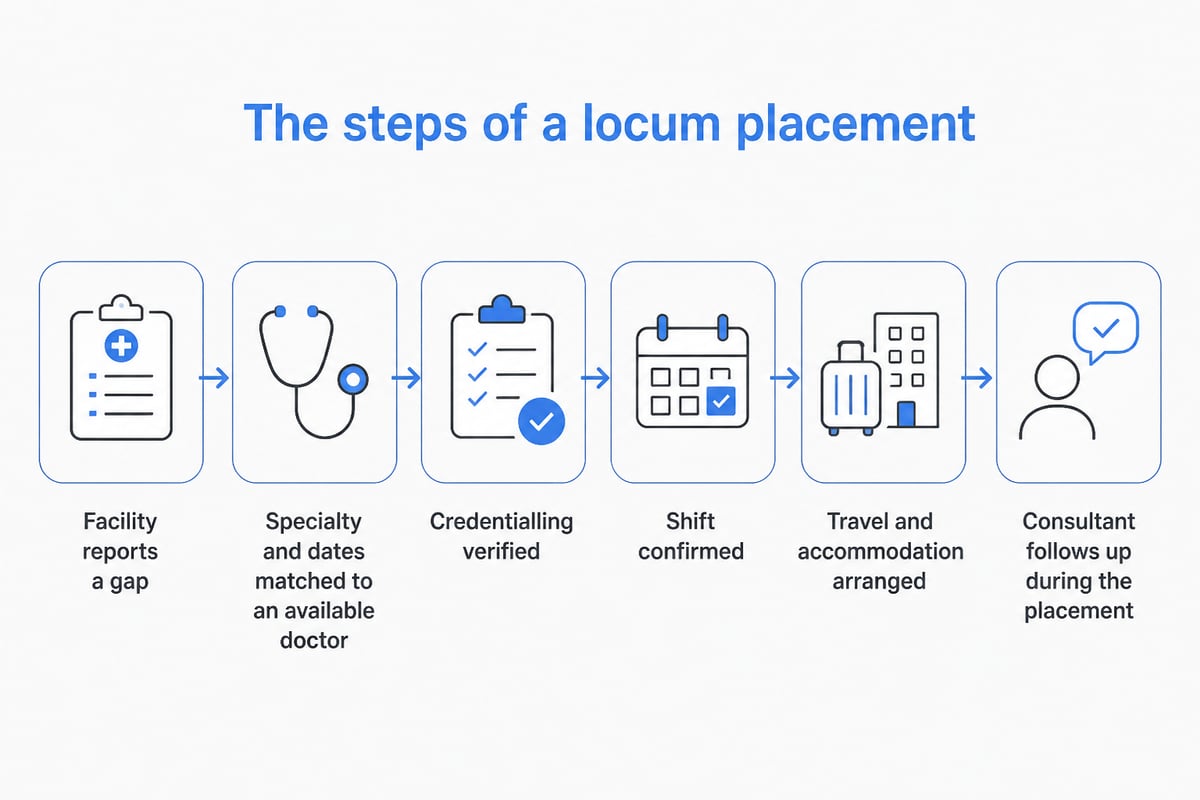
Our Short-Term Medical Locum Placements service is built for exactly that: ad hoc and short-notice shifts across Emergency Medicine, Anaesthetics, ICU, O&G, Paediatrics, Psychiatry and Surgical. We match the doctor to the facility by specialty, credentialling status and availability. A placement can be a single shift or a block of weeks, and it is backed by consultants who are available 24/7, 365 days a year for urgent shift needs.
Hypothetical example: a regional hospital learns that its anaesthetist will be unavailable the following week. The manager contacts a consultant with the dates and credentialling requirements, and the agency searches for credentialled anaesthetists who are available and willing to travel.
The speed in that scenario comes from preparation. A doctor whose file is already complete can be confirmed in hours. A doctor who still needs referee checks cannot.

What end-to-end support looks like for doctors
A locum placement fails more often on logistics than on clinical fit. A doctor who cannot get a flight, a bed near the hospital or a clear start time will not stay with a placement for long.
We cover placements end to end, including shift confirmation, travel and accommodation, which removes much of the admin that makes remote work unattractive.
Doctors weighing up the switch to locum work will find it useful to consider the practical trade-offs before committing.
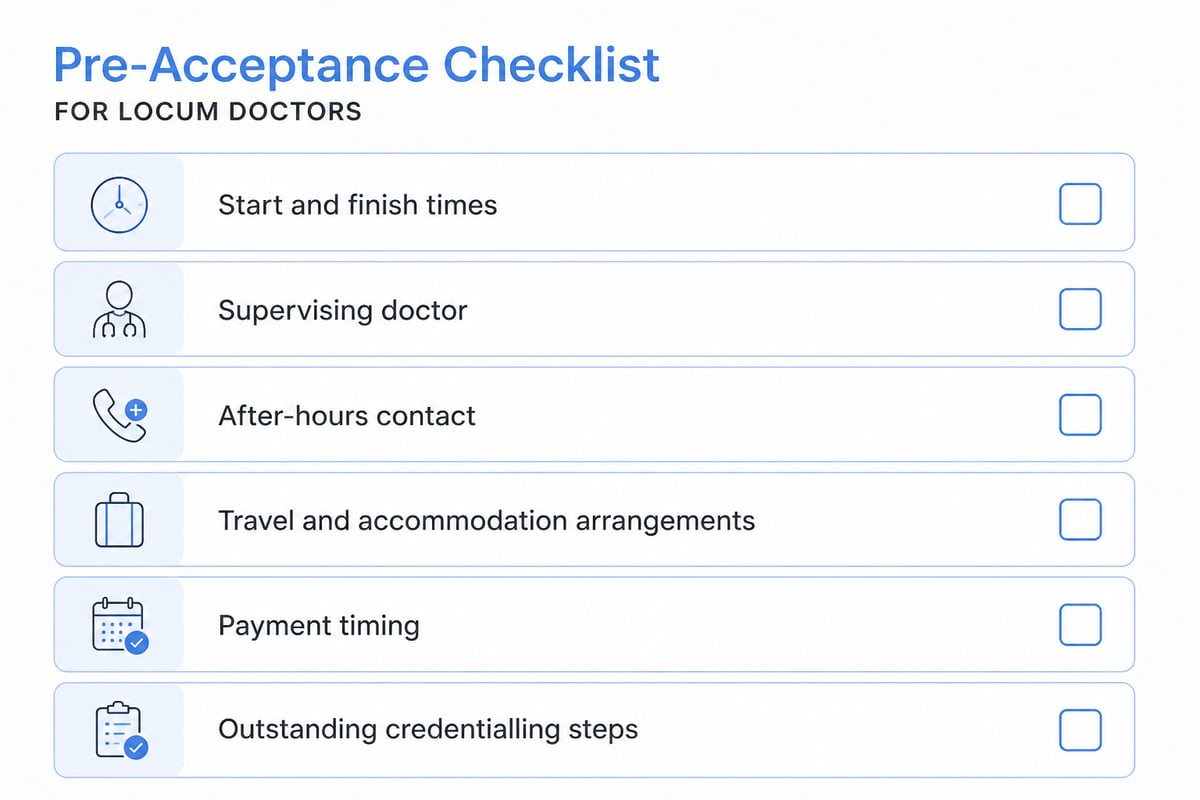
Before you accept any placement, confirm these points in writing:
- the exact start and finish times, including handover
- the supervising doctor and who to call after hours
- who arranges and pays for travel and accommodation
- how and when you will be paid
- the credentialling steps still outstanding
These are ordinary questions. A good consultant will have the answers ready.
Why regional and rural sites depend on locum doctors
Regional and rural hospitals often depend on locum doctors because recruiting permanent staff to small centres can be slow. A site with two or three doctors cannot absorb a single resignation or a period of leave without outside cover.
For doctors, regional placements offer broader scope, closer supervision relationships in some settings and a clear sense of the difference your shifts make. They also carry real trade-offs: distance from home, fewer colleagues on site and variable access to specialist backup. A fair assessment weighs both.
Regional sites that offer clear rosters, fair pay and good accommodation tend to fill their gaps faster than those that do not.
Choosing a locum agency: what to check
Choosing an agency comes down to whether it can show you verifiable standing, state-level access and consistent service. Ask any agency, including us, the following.
First, ask about accreditation and professional memberships, and ask to see them. Ours include ISO 9001:2015 Quality Management accreditation, plus RCSA and AMRANZ membership.
Second, ask which health services it is approved to supply. Best Practice Medical is an approved supplier for NSW Health, Tasmanian Health, WA Country Health Service, NT Health, Vic Health, QLD Health and ACT Health, and supplies major private providers including Ramsay Health Care, Healthscope and St Vincent's Health. Approved-supplier status matters because it determines which facilities you can actually work in.
Third, ask who leads the business. We are doctor-owned and operated, led by a practising doctor with decades of experience in medical recruitment. That means the person setting policy understands what a bad roster does to a department.
Fourth, ask about continuity. We have served one facility partner continuously for more than 15 years, which is a more useful indicator than a list of logos.
Finally, ask what happens at 2 am on a Sunday. If the answer is a voicemail, keep looking.
How facility managers can get better results from a locum agency
Facility managers get better results when they give the agency clear information early and treat the consultant as part of the planning cycle and not as a last resort.
A useful brief includes the specialty and level required, exact dates and hours, the supervision structure, the case mix, any procedural expectations, and the local credentialling requirements. Tell the consultant what a good outcome looks like, and what has gone wrong in past placements. Agencies cannot fix a problem they have not been told about.
Plan for the predictable gaps. Leave periods, conference seasons, rotation changeovers and school holidays are all foreseeable. Booking a block weeks ahead gives you a wider pool of doctors than calling the day before, and it costs less in stress.
Pressure on the workforce is a long-running concern, and managers who build locum cover into their standard planning are better placed than those who treat it as an emergency measure.
Keeping locum work sustainable
Locum work gives you flexibility, but flexibility can slide into overwork if you say yes to every shift. Doctors on the road still need sleep, time off and a sensible cap on consecutive night shifts.
Set your own rules before the first booking. Decide the maximum number of consecutive days you will work, how much travel you will accept in a week and how much leave you need between blocks. A good consultant will respect those limits and will not push you past them. If an agency does, that tells you something about the agency.
Best Practice Medical has a short read on healthy doctors for anyone who wants a practical starting point. Locums who last in this work tend to be the ones who treat their own schedule as seriously as the roster they are covering.
Your next step is to gather your registration details, CV and referees into one place so a consultant can start matching you or your facility to the right shifts. If you are a doctor looking for flexible work or a manager with a gap to fill, contact Best Practice Medical and one of our consultants will talk through the dates, specialties and credentialling you need.