

Searching for a "dr NSW" usually means one of two things: you need to find a doctor in New South Wales, or you need to understand how doctors are registered, employed and placed in the state. This guide is written for doctors who want flexible locum work in NSW, whether you are a JMO, registrar or specialist, and it covers how to verify a registration, how the state system is structured, and how to find shifts that suit your life.
If you are a clinician looking at the state from the outside or from another jurisdiction, the questions are practical ones. Who regulates you? Where do shifts come from? What does a locum placement involve once you say yes? The sections below answer those in order.
How do you find and verify a Dr in NSW?
You verify a doctor in NSW by searching the public register kept by the Australian Health Practitioner Regulation Agency (Ahpra), which lists every registered medical practitioner, their registration type, any conditions on their practice and any public notations. Every doctor working in NSW, permanent or locum, must appear on it.
For locums, this register matters in both directions. A facility will check yours before it books you, and you will often want to check colleagues, supervisors and the registrar or consultant you are covering for. A few things to look at on the register entry:
Registration type. General, specialist, provisional or limited registration each carry different scopes. A provisional registrant, for example, must work under supervision, which changes what a facility can ask of them.
Conditions and undertakings. These show up on the public entry and explain restrictions on scope, location or supervision arrangements.
Specialty and endorsement. Specialists should show their field. If you are placing yourself in a rural emergency department, the details of your registration should match the role.
The first thing anyone should check before accepting a shift is whether the registration, indemnity and scope all line up with the work offered. If one of them doesn't, resolve it before you travel.
What does the NSW health system look like for a locum doctor?
The NSW public system is run through Local Health Districts and specialty networks under NSW Health, and a locum doctor typically works inside one of those districts, in a private hospital group, or in a community or regional service.
That structure matters because each district sets its own rostering, credentialing and onboarding. A doctor who has worked at a large metropolitan hospital in Sydney will find a smaller rural facility runs very differently, with fewer colleagues on site, broader scope expected and often a longer drive to a referral centre.
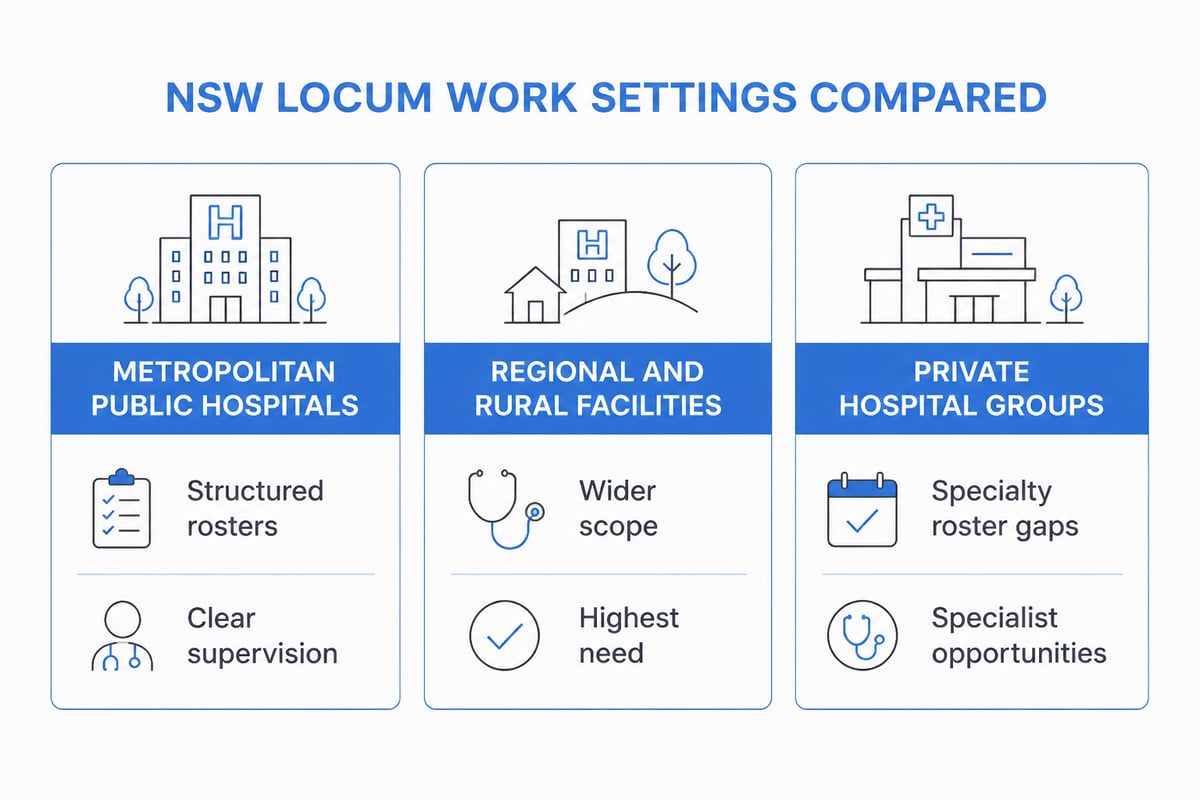
Roughly, work in the state falls into three settings:
- Metropolitan public hospitals, where rosters are structured, supervision is clear and shifts are often in emergency, anaesthetics, medicine or surgery.
- Regional and rural public facilities, where the need is highest and the scope is widest. See Best Practice Medical's piece on how to attract more doctors to regional Australia for the workforce picture.
- Private hospitals, where the large groups such as Ramsay Health Care, Healthscope and St Vincent's Health book locums for gaps in specialty rosters.
If you want a sense of how demand is spread across disciplines, the specialities page shows where shifts commonly arise.
Who is the NSW health minister, and why does it matter to locums?
The NSW Health Minister is the elected member responsible for the state's health portfolio, and the office changes with government and reshuffles, so the current holder is best confirmed on the NSW Government and NSW Health websites rather than from a guide that may age quickly.
It matters to locums for a practical reason. Workforce policy, award rates, rural incentives and the rules around agency use in public hospitals are set at state level. When a minister announces a change to how districts engage agency doctors, or to rural retention packages, it filters down to the shifts that get advertised and the rates attached to them.
Keep an eye on three things that move with state policy:
- Public hospital rates and overtime arrangements for visiting and locum medical officers.
- Rural and remote incentives that affect whether a regional shift is worth the travel.
- Supplier panel arrangements, which determine which agencies a district can use. Best Practice Medical is an approved supplier for NSW Health, along with Tasmanian Health, WA Country Health Service, NT Health, Vic Health, QLD Health and ACT Health.
You don't need to follow politics to work in the state. You do need to know that the commercial terms of your work are partly set by decisions made in Macquarie Street.
Can doctors trained overseas work in NSW?
Yes, doctors trained overseas can work in NSW, including those from India, provided they gain the appropriate registration through the Medical Board of Australia and Ahpra, and the pathway depends on their qualifications and specialty.
The routes differ by background:
- Specialist pathway. Overseas-trained specialists are assessed by the relevant Australian specialist college, which decides whether they are comparable, partially comparable or not comparable to an Australian-trained specialist. That outcome determines supervision requirements and timelines.
- Competent authority pathway. Graduates from certain recognised programs can apply for provisional registration and move to general registration after a period of supervised practice.
- Standard pathway. Others sit the Australian Medical Council exams before applying for provisional registration.
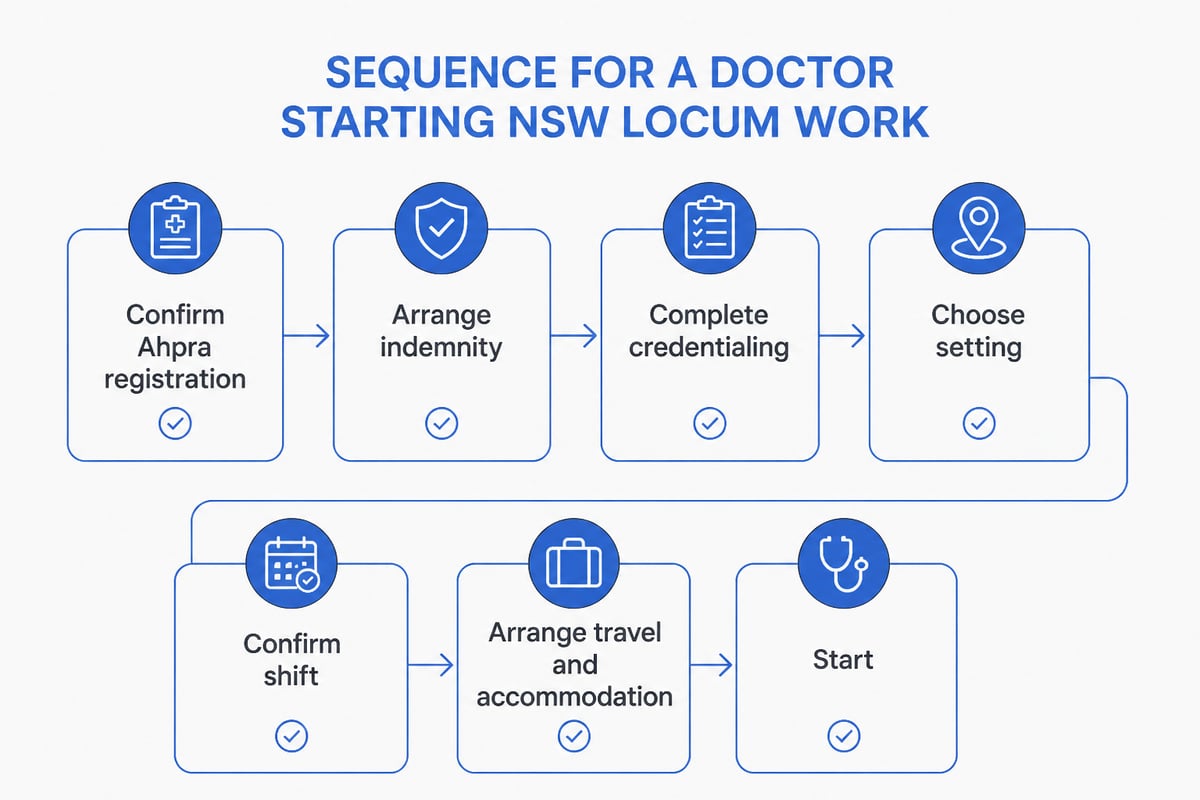
Visa and registration are separate processes, and both take time. Start the registration paperwork before you start looking for shifts, because a facility cannot roster you until your registration, indemnity and credentialing are in place.
For doctors weighing up whether locum work is available to them early on, Best Practice Medical has a plain guide on whether you are eligible to become a locum doctor.
How do you report a doctor in Australia?
You report a concern about a doctor to Ahpra or, in NSW, to the Health Care Complaints Commission, which handles complaints about health practitioners in the state and works alongside the Medical Council of NSW.
In practice, the route depends on the nature of the concern. Notifications about a doctor's health, performance or conduct go through the national regulator, while the state body assesses complaints and can refer matters onward. If you believe a patient is at immediate risk, tell the facility's clinical governance or medical administration team first, then follow with a formal notification.
As a locum, you may also be on the receiving end of a complaint. Keep contemporaneous notes, make sure your indemnity cover is current, and notify your insurer early. Working across several sites means more people may hold a view about your practice, and the paper trail is your protection.

How do you find locum shifts in NSW?
You find locum shifts in NSW by registering with a medical recruitment agency that supplies the districts and private groups you want to work for, by applying directly to facilities that advertise, or by doing both and comparing what is on offer.
Each route has trade-offs. Direct applications give you control but add administration, since each employer has its own credentialing forms. An agency holds your credentials once and presents you to several facilities, which saves time if you want regular variety.
What an agency should be able to show you:
- Credentialing to a high standard before any placement.
- A named consultant who sends regular updates rather than leaving you to chase.
- Out-of-hours availability for urgent shifts.
- Coverage of the practical parts, including shift confirmation, travel and accommodation.
Best Practice Medical is accredited to ISO 9001:2015 Quality Management, a standard it has held since 2009, and it has supplied one facility partner continuously for over 15 years. Its consultants can be reached around the clock for urgent shift needs. For current vacancies in the state capital, see the page on doctor jobs in Sydney, or browse medical locum jobs more broadly.
What should a JMO, registrar or specialist check before accepting a shift?
Before accepting a shift, confirm that the role matches your registration and training stage, that supervision is clearly defined, and that the practical details such as rate, travel and accommodation are in writing.
The checklist differs by career stage.
For JMOs
Check who your supervising registrar or consultant is and what escalation looks like after hours. Junior hours vary a lot between sites, and Best Practice Medical's piece on junior doctor working hours covers what to look out for.
For registrars
Confirm whether the shift counts toward your training or is purely service work, and ask your college if you are unsure. There is more on the registrar pathway on the page about the doctor registrar role.
For specialists
Ask about the on-call arrangement, the theatre or clinic list you are covering, and whether visiting rights or credentialing at the specific hospital are already in place. Private hospitals often need site-specific credentialing even if you hold public appointments elsewhere.
Whatever your stage, a good shift is one where the roster, the scope and the support behind you are all clear before you arrive.
Where do patients or colleagues go when they need a doctor out of hours?
When a patient or colleague needs advice on where to go outside normal hours, NSW Health points people who are not seriously ill to call healthdirect on 1800 022 222, which runs 24 hours a day, 7 days a week.
The line is free. According to NSW Health, a registered nurse can assess the caller, recommend an appropriate care option, help find a nearby doctor or pharmacist, or arrange a call or video call with a doctor. If someone is seriously ill or injured, the instruction remains to call Triple Zero (000).
Locum doctors get asked this more than you might expect, usually by friends and family who know you work in the state. It is worth knowing the pathway, and the healthdirect NSW Health page sets out when to use it. For finding services in a specific area, the national Service Finder lists health services across Australia.
What makes working as a locum in NSW worth the effort?
Locum work in NSW pays off when you value control over your calendar, exposure to different hospitals and a chance to test a region or specialty before committing to anything longer.
Many doctors use short placements to rebalance a rotation that has become relentless, to fund study or travel, or to see whether a rural community is somewhere they could live. The flexibility is real, though so is the admin: registration renewals, indemnity, tax and superannuation arrangements are yours to manage as a contractor, and it is worth getting accounting advice early.
If work-life balance is the main driver, the pieces on the benefits of a flexible working environment and work-life balance lay out how other doctors structure it. Searching for a dr NSW placement is the easy part. Knowing what you want from the work is the harder question, and it is worth answering before you sign for the first block.
FAQ
How much does a doctor locum shift pay in NSW?
Rates vary by specialty, seniority, location and whether the shift is in a public or private facility, so there is no single figure that holds across the state. Ask for the rate in writing before you accept, and confirm what it includes, such as travel, accommodation and on-call loading.
Do I need separate registration to work in NSW?
No. Ahpra registration is national, so a doctor registered anywhere in Australia can generally practise in NSW. You will still need facility-level credentialing for each hospital you work at, plus current indemnity cover.
How far ahead do locum shifts get booked?
It ranges from months ahead for planned roster gaps to a few hours for urgent cover. Doctors who want short-notice work should keep credentials current so they can be placed quickly when a gap appears.
The next step is to check that your Ahpra registration, indemnity and credentialing documents are current, because that is what decides how fast you can start in NSW. Once they are, Best Practice Medical can talk through the shifts available across the state, so contact us to discuss where your specialty and availability fit. As a doctor-owned agency approved to supply NSW Health and major private providers, it handles shift confirmation, travel and accommodation from start to finish, and it has a consultant available around the clock if something changes at short notice.