

Locum agencies in Australia match doctors who want short-term or flexible work with hospitals, health services and practices that need cover, and the facility pays the agency, not you. For a JMO, registrar or specialist, a good agency handles credentialling paperwork, finds shifts that fit your specialty and availability, and arranges the logistics so you can turn up and work. A poor one leaves you chasing payment and sorting out your own flights.
This guide covers how the model works, who pays whom, what you need in place before your first shift, and how to judge an agency without relying on a marketing page.
What locum agencies do for doctors
A locum agency acts as the go-between for doctors seeking temporary work and facilities that have a rostering gap, and the useful ones take on the administrative load on both sides.
In practice that means several jobs:
- Holding your documents on file so you are not resubmitting the same certificates for every placement
- Sending your details to facilities for credentialling and approval
- Offering shifts that match your specialty, seniority and dates
- Confirming the shift in writing, including hours, location and who to report to
- Arranging travel and accommodation for placements away from home
- Handling timesheets and invoicing so payment reaches you without you chasing a hospital accounts team
Best Practice Medical's specialities page lists the areas it recruits for, including emergency medicine, anaesthetics, ICU, obstetrics and gynaecology, paediatrics, psychiatry and surgery. Demand shifts by region and season, so many locums build their year around a mix of metropolitan and regional work. If you are looking for a medical recruitment agency in Sydney, our guide explains how placements, credentialling and contracts work.
How do locum agencies get paid?
Locum agencies get paid by the facility that books the doctor, not by the doctor, and the fee is built into the rate the facility pays for the shift.
The usual arrangement is that the hospital or health service agrees a rate with the agency, the agency pays you your portion, and the agency keeps the difference to cover its costs. You should not be asked to pay a registration fee or a placement fee to be put forward for work. If an agency asks you for money upfront, treat that as a red flag and ask for the terms in writing.
What you should ask about is how the arrangement affects you directly:
- The rate you will receive for the shift, stated before you accept it
- Whether you are engaged as a contractor or an employee for that placement, since this changes tax, super and insurance obligations
- The payment timeline, including how soon after a shift your timesheet is processed
- Who covers travel, accommodation and any cancellation of the shift
On the last point, the better agencies cover the placement end to end. Best Practice Medical, for example, handles shift confirmation, travel and accommodation as part of the placement. Whatever agency you use, get those details in writing before you commit to dates.
What you need in place before your first shift
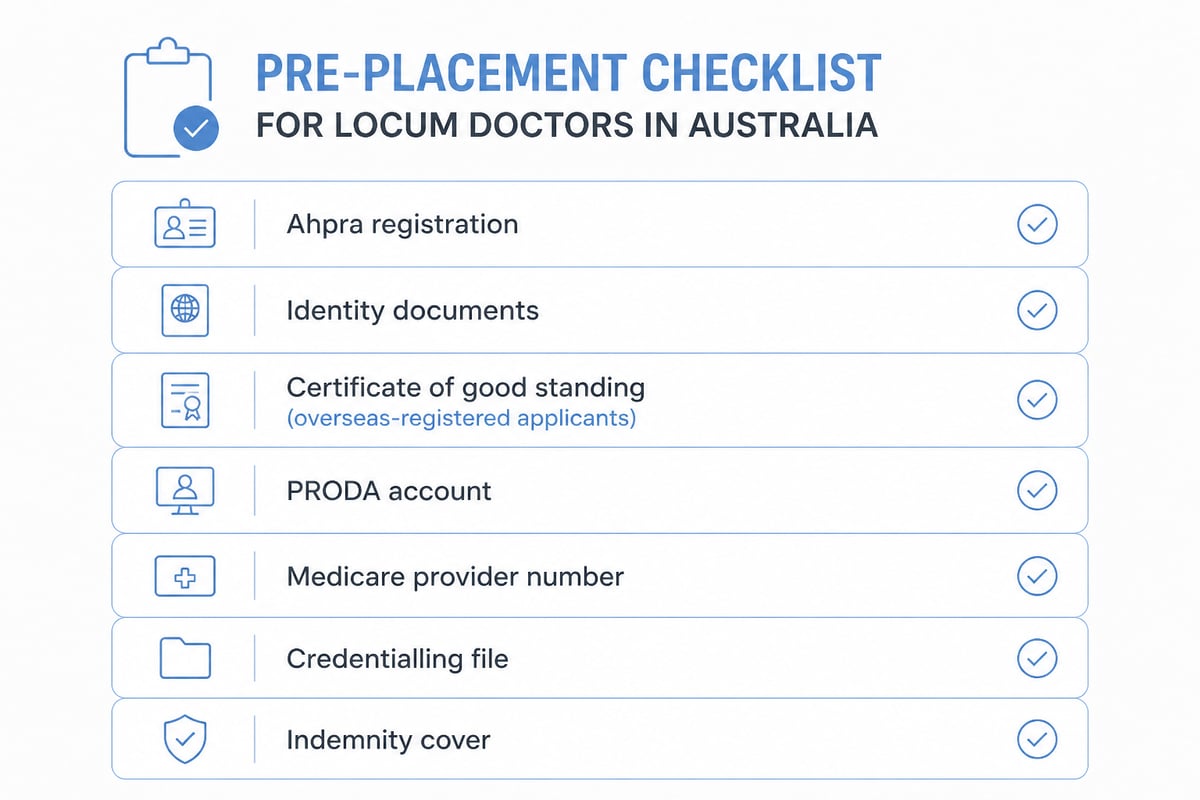
You need current Ahpra registration, the right Medicare provider number arrangements, and a credentialling file that a facility will accept, and sorting these early is what separates a quick placement from a delayed one.
Registration comes first. Ahpra states that applicants need to pay the relevant fee and provide identity documents, and overseas-registered applicants may also need a certificate of good standing and certified qualifications. If you trained overseas, start collecting those documents before you start looking for shifts, because they are the slowest part of the process.
Provider numbers are the next piece. According to Services Australia, a Medicare provider number identifies a health professional and the practice location, and a separate number is generally needed for each practice location, with exceptions including locum tenens provisions. Two further points from the same page matter for planning: a provider number does not automatically grant access to Medicare benefits, and eligible health professionals apply online through HPOS, which requires a PRODA account. Set up PRODA well ahead of your first booking.
Locum-specific rules also exist. A 2026 federal instrument, the Health Insurance (Provider Numbers) Instrument 2026, includes a locum-specific provider-number criterion for certain practitioners: locum work at a distribution-priority-area practice for no longer than six months, subject to the instrument's other conditions. If you are an overseas-trained doctor or otherwise subject to those conditions, read the instrument or ask the agency to confirm how it applies to you before you accept a block of work.
How credentialling works and why it affects your start date
Credentialling is the process where a facility confirms you are qualified and fit to work in its setting, and it is usually what decides how quickly you can start.
Each hospital or health service sets its own requirements, and state health departments often run approved-supplier arrangements that agencies have to meet before they can place doctors there. A credentialled file typically covers your registration, qualifications, work history, referees, immunisation status and identity checks. The agency collects and verifies these, then submits them to the facility.
Two practical points follow. First, an agency that has already credentialled you to a high standard can place you faster, because the facility can rely on a complete file rather than starting from scratch. Best Practice Medical credentials every locum to the highest standards before placement. Second, keep your own copy of everything and update it as things expire. A lapsed immunisation record or an out-of-date referee is a common reason a start date slips.
What is the best locum agency in Australia?
There is no single best locum agency in Australia, because the right one depends on your specialty, how much notice you want for shifts, where you want to work and how much support you expect.
A short list of questions will tell you more than any ranking:
Does the agency supply the facilities you want to work in? Check whether it supplies the public systems in the states you are targeting, and whether it supplies private providers. Best Practice Medical, for instance, supplies major private providers including Ramsay Health Care, Healthscope and St Vincent's Health.
Who runs it? Ownership and leadership shape how an agency treats doctors. Best Practice Medical is doctor-owned and operated, led by a practising doctor with over 30 years in medical recruitment, which tends to mean the person on the phone understands a roster and a handover.
What accreditation and memberships does it hold? Look for ISO 9001:2015 quality management accreditation and membership of industry bodies. Best Practice Medical is accredited to ISO 9001:2015 and is a member of the Recruiting, Consulting and Staffing Association (RCSA) and the Association of Medical Recruiters Australia and New Zealand (AMRANZ).
Can you reach someone out of hours? Urgent cover does not respect business hours. Consultants at Best Practice Medical are available 24/7, 365 days a year for urgent shift needs.
How long do its facility relationships last? Long-running relationships suggest reliable service on both sides. Best Practice Medical has supplied one facility partner for over 15 years.

Short-notice and ad hoc shifts
Short-notice work is where a good agency earns its fee, because a facility with an unfilled shift tomorrow needs a doctor who is already credentialled and available.
If you want to pick up single shifts or blocks of a few weeks around other commitments, look for an agency that runs a dedicated short-term service. Best Practice Medical's short-term medical locum placements cover ad hoc and short-notice shifts across hospital specialties including emergency medicine, anaesthetics, ICU, obstetrics and gynaecology, paediatrics, psychiatry and surgery. Consultants are available 24/7, 365 days a year for urgent shift needs.
The trade-off with short-notice work is predictability. You gain flexibility and often a higher hourly rate, but you give up the steady roster and leave entitlements of a permanent post. If you are weighing that choice, Best Practice Medical's piece on the benefits of a flexible working environment sets out the case for flexible work, and it helps to be honest with yourself about your tolerance for gaps between bookings.
Which agency should a JMO, registrar or specialist choose?
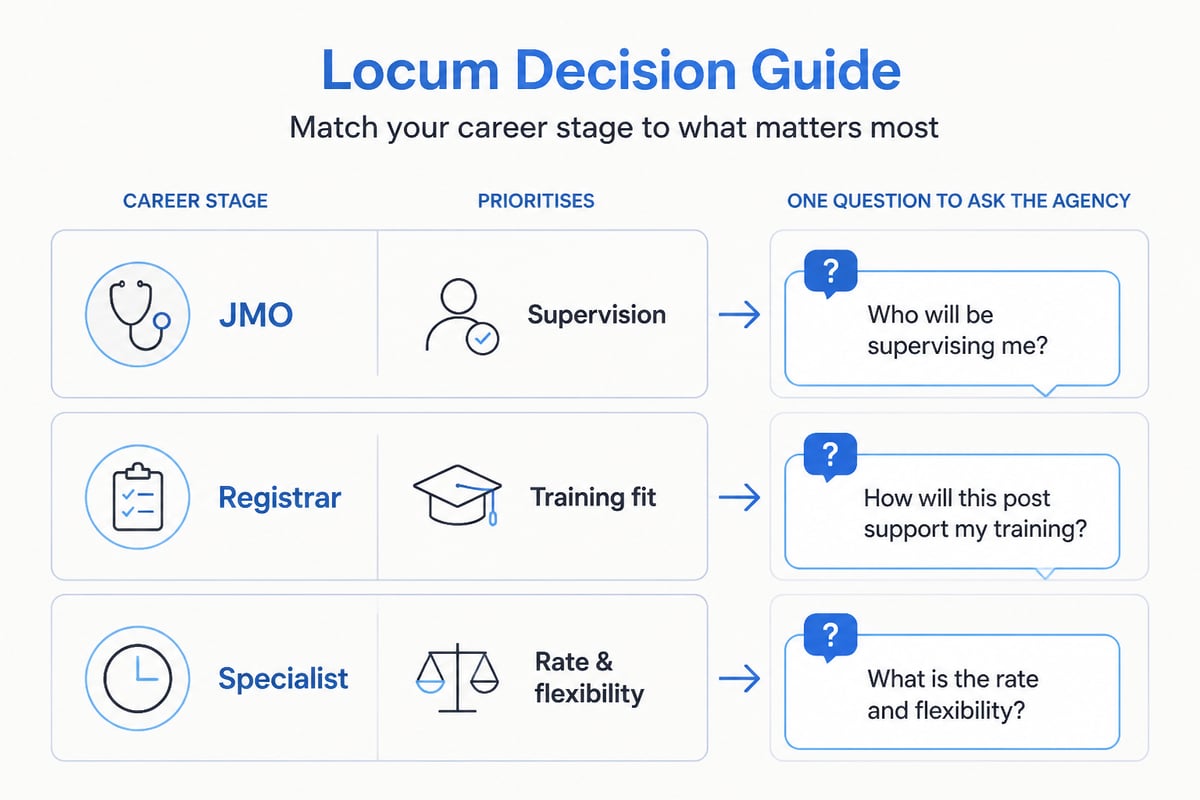
The right choice depends on your career stage, because the work on offer, the supervision you will have and the questions you should ask all change as you progress.
| Career stage | What to prioritise | Question to ask the agency |
|---|---|---|
| JMO | Placements with clear supervision and a defined scope | Who supervises me on shift, and what is the escalation path? |
| Registrar | Specialty-matched shifts that count toward your training goals | Do these shifts suit my training requirements and college rules? |
| Specialist | Rate, block length and flexibility around private practice | Can I set my availability and rate expectations upfront? |
JMOs should look hard at supervision. A locum shift as a junior doctor can put you in a ward with limited senior cover if the agency has not checked the setting properly. Best Practice Medical's guide to becoming a locum doctor covers who is eligible and what to have ready.
Registrars should check how locum work interacts with training requirements before taking time away from a rotation. Specialists usually have the most negotiating room, particularly in areas with persistent shortages, and can reasonably ask for the rate and the length of a block before agreeing to be put forward.
How to compare locum agencies in Australia before you sign up
Comparing locum agencies in Australia comes down to testing what each one promises against what it can show you, and you can do most of this in a couple of phone calls.
Work through these checks in order. Ask for the rate and terms in writing for a specific example shift. Ask how quickly the agency has confirmed shifts for doctors in your specialty. Ask what happens if a facility cancels at short notice. Ask who your point of contact will be and whether you will hear from a consultant regularly. Best Practice Medical gives doctors and facilities regular updates from a dedicated consultant, and that kind of named contact is worth looking for wherever you sign up.
It is also reasonable to register with more than one agency. Many locums do, since each supplies a different mix of facilities and no single agency will have every shift. Keep your credentialling file current and consistent across all of them so you can accept good work quickly. Some agencies run loyalty or reward programs; Best Practice Medical's rewards page explains its approach.
Finally, think about the whole picture of a placement, not only the hourly rate. A slightly lower rate with travel, accommodation and shift confirmation handled for you can leave you better off than a higher rate where you carry those costs and the admin yourself. Best Practice Medical covers placements end to end, including shift confirmation, travel and accommodation. Planning the practical side is easier with a few good tools, and Best Practice Medical has a short list of apps that make locum life easier.
FAQ
Who is the biggest recruitment agency in Australia?
There is no authoritative public ranking of medical recruitment agencies by size, and size is a poor guide for a locum doctor anyway. What matters is whether an agency supplies the facilities and specialties you want and handles credentialling and logistics well.
Do I have to pay a locum agency to register?
No. Agencies are paid by the facilities that book doctors, so you should not be charged to register or be put forward for work. If an agency asks for upfront payment, ask for the terms in writing before you agree to anything.
Can I work with more than one locum agency?
Yes, and many doctors do. Each agency supplies a different mix of facilities, so registering with two or three widens your options, as long as your credentialling file stays current and you avoid double-booking the same dates.
Start by checking that your Ahpra registration is current and your PRODA account is set up, since those two items hold up more placements than anything else. From there, a conversation with a consultant will tell you which specialties and states have shifts that suit you. If you want to talk through short-notice work, credentialling or travel for a specific block, get in touch with Best Practice Medical and a consultant can walk you through the next steps.