

Medical doctor jobs in Australia sit in three main places: public hospitals run by state and territory health services, private hospital groups, and community or rural services that rely heavily on locum cover. If you are a JMO, registrar or specialist, you can fill a roster in all three without a permanent contract. If you manage a facility with gaps, those same three settings are where you compete for staff.
The numbers explain why demand stays high. In 2025 Australia had 126,206 registered and employed medical clinicians, according to the Australian Government Department of Health and Aged Care. That workforce is spread across metropolitan, regional and remote areas very unevenly, and the gaps are where locum work comes from.
How many medical doctor jobs in Australia exist, and who fills them?
The 2025 workforce included 15,924 hospital non-specialists and 47,381 specialists, per the same Department of Health and Aged Care workforce data. Hospital non-specialists are your interns, residents, principal house officers and unaccredited registrars. Specialists include consultants and fellows across every college.
The age and hours figures tell you what each group's roster looks like. Hospital non-specialists averaged 32.8 years of age and 45.8 work hours a week in 2025. That is a long week, and it is one reason many junior and mid-level doctors move to locum arrangements once they have the experience to choose their own hours.
For facility managers, the practical reading is simple. Junior and registrar-level positions turn over fast, rosters are tight, and a single resignation or leave request can leave a ward or emergency department short within days.
Which settings offer the most work for JMOs, registrars and specialists?
The largest volume of hospital-based work is in public hospitals, followed by private hospital groups, then smaller regional and rural facilities. Each setting suits a different kind of doctor.
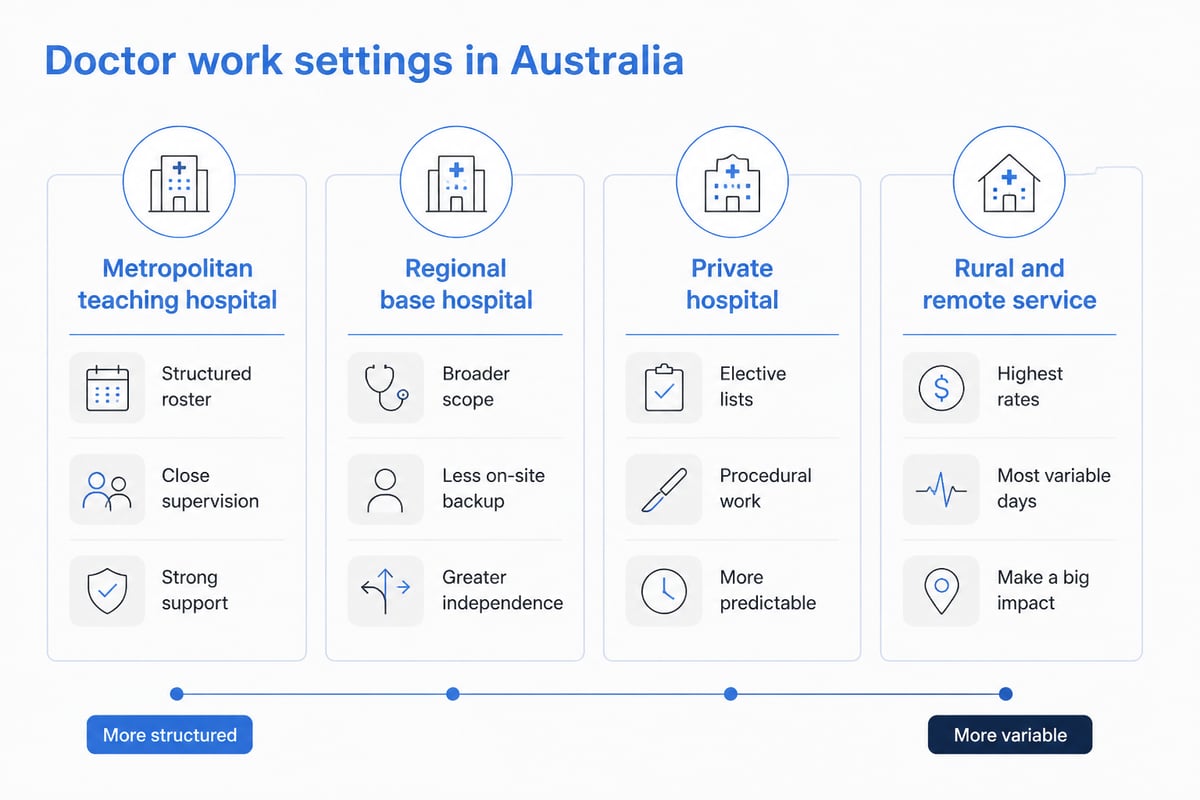
Metropolitan teaching hospitals hold the highest concentration of training positions. A JMO or registrar here usually works to a structured roster, with supervision close at hand and clear escalation paths. Competition for permanent training posts is stiff, so locum cover for leave and vacancies is a common route in.
Regional base hospitals often offer broader scope. A registrar in a regional emergency department or surgical unit may see cases that a metropolitan trainee would hand to a consultant. The trade-off is less on-site backup, so a proper briefing before the first shift matters. Best Practice Medical's Registrar and JMO Placement work follows that logic: consultants understand the difference between a metropolitan teaching hospital and a regional base hospital, and brief doctors on it before they start. Placements run mainly across NSW metropolitan public and private hospitals, with secondary coverage across regional and interstate facilities.
Private hospitals run on different rhythms. Elective lists, day surgery and private emergency services create steady demand for anaesthetists, surgical assistants and registrars with procedural experience. Major providers such as Ramsay Health Care, Healthscope and St Vincent's Health all use locum cover to keep lists running.
Rural and remote services offer the highest shift rates and the most flexibility, and also the most variation in what a day looks like. Our piece on medical staffing in regional areas covers how to prepare for that.
What does registration involve before you can work?
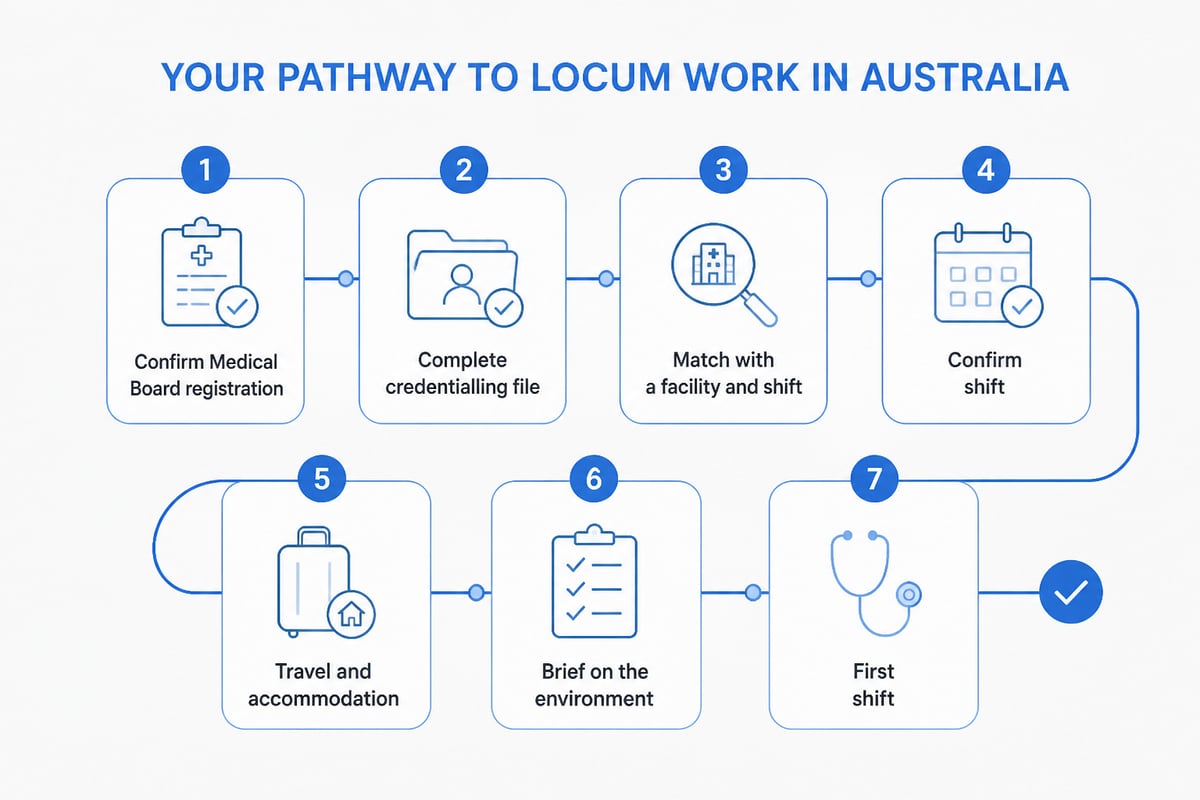
Every doctor practising medicine in Australia must be registered with the Medical Board of Australia, and applications and renewals can be made online through the Medical Board of Australia registration page. There is no way around this step, and it is the one that most often delays a start date.
Where you trained decides your pathway:
- Australian graduates register through provisional registration for the intern year, then general registration.
- Internationally qualified doctors follow one of several pathways depending on qualifications and specialty. The Board's overview of registration pathways for international medical graduates is the place to confirm which one applies to you.
- Specialists apply for specialist registration, which requires assessment by the relevant college.
Registration is only the first layer. Before a facility will roster you, it also wants current indemnity cover, immunisation records, police and working with children checks where relevant, and referee reports. For locums, this paperwork is repeated across every health service you work for, which is why credentialling support saves real time. Best Practice Medical handles credentialling before placement, so the file is ready before a facility sees your name.
Which states and territories hire the most doctors on locum arrangements?
Every state and territory uses locum doctors, but the pressure points differ. Larger hospital networks in states such as New South Wales, Victoria and Queensland carry much of the total demand, while more remote and smaller jurisdictions often depend more on short-term cover.
Best Practice Medical is an approved supplier for NSW Health, Tasmanian Health, WA Country Health Service, NT Health, Vic Health, QLD Health and ACT Health. For a doctor, that matters because approved-supplier status is what lets an agency place you into a public health service in the first place. For a manager, it means the paperwork and compliance sit with a recognised supplier rather than something you build from scratch each time.
If you are weighing a move, the Sydney doctor jobs breakdown shows how a single large city market works. Regional demand is covered in this piece on attracting more doctors to regional Australia.
What kinds of roles can a doctor take beyond a standard ward roster?
Hospital wards are only one option. Doctors on short-term arrangements also fill emergency department shifts, anaesthetics lists, psychiatry and mental health cover, obstetrics and gynaecology on-call, paediatric rosters, and procedural lists in private day surgery.
Some roles sit outside the hospital altogether. Medical officer positions in mining, defence, corrections and remote health services carry their own entry requirements and pay structures. The medical officer role is worth reading about if you are comparing those against a hospital registrar post.
Specialists have the widest choice. A consultant anaesthetist or psychiatrist can pick up a few days a month in a regional hospital while holding a metropolitan base, which is a common pattern.

How does locum work compare with a permanent medical doctor job?
Locum work trades security for control. You choose when and where you work, you usually earn a higher hourly or daily rate, and you carry your own leave, super and professional costs. A permanent post gives you a stable roster, paid leave and a defined training or career path.
| Factor | Locum work | Permanent post |
|---|---|---|
| Hours | You set availability | Set by roster |
| Pay | Higher hourly or daily rate | Salary with leave entitlements |
| Variety | Different facilities and teams | One team, deeper continuity |
| Admin | Credentialling per facility | Once at onboarding |
| Training progression | Depends on the placement | Structured, where accredited |
Registrars working towards a fellowship need to check that locum time counts toward college requirements before committing, as not all of it does.
What should facility managers look for when filling a medical gap?
Speed matters, but a quick fill that goes wrong costs more than a slow one. Managers covering a roster gap should check four things before accepting a doctor.
Credentialling status. Ask what has been verified and when. A complete file means you can approve the doctor without chasing documents.
Fit to the environment. A registrar who is excellent in a metropolitan teaching hospital may need a proper briefing before a regional base hospital shift with fewer senior staff on site.
Logistics. For regional and rural shifts, travel and accommodation decide whether a doctor accepts the booking. Best Practice Medical covers placements end to end, including shift confirmation, travel and accommodation, so those details are settled before the doctor arrives.
Out-of-hours contact. Rosters collapse at 2am on a Sunday, not at 10am on a Tuesday. Best Practice Medical consultants can be contacted for urgent shift needs, and facilities and doctors get regular updates from a dedicated consultant.
Pressure on supply is not easing. Our look at why Australia's medical workforce is under increasing pressure explains the drivers, and how healthcare providers are finding the right locum fit shows what works in practice.
How do you choose a recruitment partner for doctor work?
Start with accreditation and track record, because those can be verified. Check whether the agency holds quality management certification, belongs to industry bodies, and is an approved supplier for the health services you want to work with.
Best Practice Medical has held ISO 9001:2015 Quality Management accreditation since 2009 and is a member of the Recruiting, Consulting and Staffing Association (RCSA) and the Association of Medical Recruiters Australia and New Zealand (AMRANZ). It has supplied one facility partner continuously for over 15 years. For a doctor, that kind of long relationship suggests shifts get honoured. For a manager, it suggests the agency is still there when the next gap opens.
Then ask practical questions. Who will you speak to when something changes? How quickly can they confirm a shift? What happens if a booking falls through? An agency that answers these specifically is worth more than one with a long list of vacancies.
If you want a wider view before choosing, our guides on doctor recruitment in Australia and medical locum jobs lay out what the process involves from both sides.
What do hours and workload look like across medical doctor jobs in Australia?
Hours vary a great deal by career stage and setting. In 2025, hospital non-specialists averaged 45.8 hours a week against 35.9 for GPs, and the age gap between the groups, 32.8 years against 51.2, shows how much of the junior hospital workforce is early in training, according to the Department of Health and Aged Care.
Long hours are a known issue for junior doctors, and our piece on junior doctor working hours covers the realities in detail. Locum work lets some doctors cap their hours, though the reverse can also happen if you say yes to everything. Worth setting your own limits early.
Wellbeing deserves a plan, too. Moving between facilities means rebuilding rapport with new teams, and fatigue risk rises with travel. Doctors who pace themselves and build in rest days tend to last longer in locum work. The discussion of mental health in doctors is a useful read before you commit to a heavy run of shifts.
Where can doctors find support and a network outside hospital work?
A clinical career is easier with people around it. Primary care clinics such as Dominion health show how community-based services operate with in-house ancillary support, which is useful context if you are considering time outside a hospital setting.
Doctors who work remote or regional rotations often value a wider health network too. Allied services such as physiotherapy and counselling, like those offered at Velca in Auckland, are the kind of resource worth knowing about for your own recovery from physical strain, particularly if you move between sites often.
Practical decisions come first, though. Confirm your registration, assemble your credentialling file, decide the settings and states you want, and be honest about how many shifts you can sustain. Everything else follows from those four.
Check that your Medical Board registration, indemnity cover and immunisation records are current, then work out which state, setting and shift pattern suit you. When you are ready to turn that into booked shifts, or you need a gap on your roster filled quickly, Best Practice Medical is the place to get in touch: contact us and a consultant will talk through your availability or your facility's cover needs. Our doctor-owned team handles credentialling, shift confirmation, travel and accommodation, so you can focus on the clinical work.